Lottie Loves Nature: Bee-ware!

Lottie Loves Nature: Bee-ware!
Jane Clarke, illustrated by James Brown
Five Quills

In this second adventure young nature enthusiast and would-be wildlife presenter Lottie Boffin is engaged in a minibeast survey for her favourite TV show when she encounters Noah Parfitt who lives next door. Noah’s dad is anything but a lover of small wriggly, squishy creatures on account of the mini golf course he’s developed in his garden. So when Lottie and Noah burst in on his recreational activity in their search for minibeasts that might need rescuing, he’s far from pleased. Even less so when he’s flapped and buzzed by a bumblebee looking for a flower, of which there’s a distinct lack in the Parfitt garden.

Then to make matters much worse, Lottie’s insect attracting activities result in bees swarming in a tree in her garden that overhangs Mr Parfitt’s and he’s so furious he calls the pest exterminator.

Lottie’s mum calls a beekeeper who arrives almost simultaneously.

Now all Lottie has to do is to persuade Mr Parfitt to send the pest exterminator away and allow the bees to be collected and moved to a safe new hive.

Interspersed with Jane Clarke’s lively, humorous story are pages about insects, especially bees, from Lottie’s nature notebook

and some things readers can do (as well as notes of Noah’s whose interest lies elsewhere and who sees things through a different lens). In addition to the main narrative, this is a great way to get readers interested in the natural world and the delights it has to offer through first hand experiences.

With equally lively, humorous illustrations by James Brown this is a smashing book to foster curiosity about wildlife and the environment, either at home or school. Like their previous Lottie story, there’s plenty of parrot poop courtesy of macaw Nacho and Lottie’s energetic dog Einstein to add to the fun.

10 Reasons to Love a Lion / 10 Reasons to Love a Penguin

10 Reasons to Love a Lion
10 Reasons to Love a Penguin

Catherine Barr and Hanako Clulow
Lincoln Children’s Books

The latest additions to this environmentally concerned series that introduces children to, and encourages their positivity towards, animals in the wild, takes readers to some highly contrasting locations.
In 10 Reasons to Love a Lion we discover that sadly, there is only one species of lion remaining in the wild, living in central and southern Africa

and the Gir Forest National Park in Gujarat, India.
Unlike other big cats, lions are social animals, living in prides and in Africa, so we learn, huge territories of arid savannah are patrolled by each pride which might comprise as many as three magnificently-maned males, plus lionesses and their offspring.

I was unaware that despite their having quills that are potentially lethal to lions should their skin be pierced and become infected, the large cat predators – the females do the hunting – like eating these prickly creatures. Ouch!

In addition to this information we’re told about lions’ ability to see in poor light when hunting, thanks to their ‘glow-in-the-dark eyes; hear of the playfulness of cubs; their manner of greeting and becoming friendly towards, other lions using their individual oily scent; and their propensity to sleep, particularly after fully sating their appetites.

Other birds and animals are also featured in Hannah Clulow’s realistic-looking scenes; so for instance we can tell which location – African or Indian – it is by say, the presence of an Indian peacock, or ostriches.

Scattered throughout the book are 5 ways in which we all can show our appreciation towards lions and thus perhaps help in their preservation.
In contrast there are 18 penguin species, which, with the exception of the Galapagos penguin all live in or near Antarctica. Each one is pictured on the opening spread of 10 Reasons to Love a Penguin.

Ecologist and environmentalist, Catherine Barr adopts a similarly engaging style as she writes of these flightless birds as ‘super speedy swimmers’ using their ‘underwater wings’ to ‘twist and turn’ as they hunt for fish. She talks of their specially shaped eyes that help underwater vision while searching for ocean food, some of which unfortunately is being depleted by large floating nets that might also entangle the penguins.

We see and read of penguins tobogganing on their tummies,

sneezing salty water, some species huddling close together to fend off the chill – their feet still suffer though; discover the mating habits of adelies; the chick rearing of emperors penguins; the loss of waterproofing during their ‘catastrophic moult’ and more.

Again, interspersed throughout are 5 ways we humans can help the cause of penguin preservation.

Written in collaboration with the Natural History Museum, these are two to add to primary classroom collections, and for ecologically aware individual readers.

Secrets of the Mountain / Rock Explorer: Minerals & Rock Explorer: Fossils

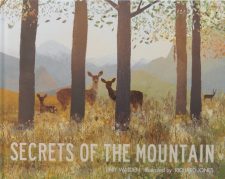
Secrets of the Mountain
Libby Walden and Richard Jones
Caterpillar Books

The mountain referred to in the title of this breathtakingly beautiful book is I think, part of the Rocky Mountain Range.

Libby Walden’s narrative takes readers to spend a day on the mountain observing the plethora of animals that make it their home be that on the plains, the slopes or the mountaintop.

It begins as the sun rises and starting at the summit, day dawns. A breeze moves down the mountainside waking the furry pikas to look for their morning food.

At midday, the forest erupts with birdsong and sunlight glows among the trees.

Animals large and small are on the move.
Then come sundown, the air is cool: night is drawing in and the bears can sense it …

Then is the time to seek a place to sleep and let the nocturnal hunters take over in the shadows of the night-time forest while, watched by the patrolling wolf, the moon illuminates the rolling plains and the mountain lion stands waiting for yet another dawn to awaken the chorus of birdsong.

Everything has changed, yet everything is the same: evolving and ever constant, both.

From gorgeous front endpaper to back endpaper (the final one comprises 48 small named pictures of the mountain fauna), every one of Richard Jones’ spreads is simply stunning in its beauty.

Rock Explorer: Minerals
Rock Explorer: Fossils

Claudia Martin
QED

These are two titles of the four in a series of very visual books that introduce aspects of geology to younger readers. This is an under represented topic and yet once children are introduced to it, they are often fascinated.
Minerals looks at their formation, location and use. Did you know for instance, that fluorite is used in toothpaste and feldspar is used in making glass and pottery?

Fossils explains what a fossil is, outlines how they form, where to hunt for fossils and what we can learn from them. I was intrigued to discover that the Victorians first discovered fossilised Dinosaur poo – hmm.
Clearly and invitingly presented with good quality photographs, both are worthwhile additions to a primary classroom or school library.

Little Adventurers: What Bear? Where? / Autumn

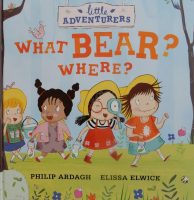
Little Adventurers: What Bear? Where?
Philip Ardagh and Elissa Elwick
Walker Books
Peanut, Floss, her little brother, Sprat and Finnegan, the four little adventurers who hold weekly club meetings in their very own shed HQ are back. Now they’re on the trail of animals in the garden where they head with collecting jars, magnifying glass and binoculars at the ready.
Inevitably, there are misidentifications: Peanut’s snake turns out to be a hosepipe …

and Peanut’s giant egg is in fact Sprat’s long-lost ball; and Peanut forgets that things look much bigger when viewed through a magnifying glass.
The creepy crawlies search however is more fruitful with several minibeasts being found;

but the most important find of all is that of a furry animal – a very special one indeed. In fact that’s the only one that doesn’t get released back into the wild at the end of the day.
As well as the entertaining story, there is a whole lot to see and enjoy by way of visual detail: posters, signs, speech bubbles and occasional font changes, all of which are embedded within Elissa Elwick’s zany illustrations.
Another Little Adventurers story that will, one hopes, spark the imaginations of curious adventurers around the ages of Peanut et al.
More of the natural world in:

Autumn
David A.Carter
Abrams Appleseed
This is the third of the author’s seasonal pop-up books and as always Carter’s paper-engineering is amazing.
We start at ground level with a variety of squashes bursting forth from the centre-fold surrounded by a scattering of other flora and fauna and there’s ‘a chill in the air’.
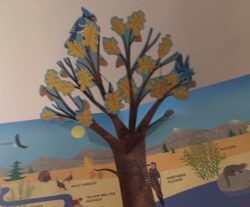
Turn over and clever cutting allows you to make some of the leaves appear to be falling from the oak tree …

behind which wild turkeys roam and a river winds, providing a home for some otters. On winds the river through fields, ‘full of life’ widening out to a place where beavers have built a dam and lodge.
Next stop is a wheat field, ripe and ready for cutting for, as the final spread informs, ‘Winter is coming: it’s time to harvest.’
Full of mellow fruitfulness this lovely book certainly is, albeit USA style, but that can be an interesting talking point as well as an opportunity for widening horizons.

The Wild Fluffalump

The Wild Fluffalump
Mwenye Hadithi and Adrienne Kennaway
Troika Books

Here’s a lovely rhyming story penned by Bruce Hobson, the well known author, who writes under the name Mwenye Hadithi;
Set on the African plains, it’s a fun read aloud but with a serious intent: Hudson commissioned the book in aid of TUSK (a charity dedicated to protecting wild animals in Africa) with the aim that young children ‘should learn to feel protective towards rhinos and elepahnts’ as well as the more cuddly kinds of wild animals.
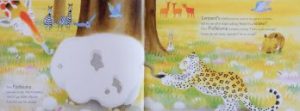
When a baby creature goes to sleep beneath a tall Cotton Wool tree, where Leopard’s child has been leaping and bouncing all night, little does it know it’s in for a big surprise the next morning.
When it wakes, it’s as a giant fluffy white ball and doesn’t recognise itself at all.
First on the scene are the Meerkats and they decide it’s a wild Fluffalump.
Other plains creatures come along one by one: Eagle, Buffalo, Lion, Hyena, Vulture, Bush Baby, Rhino, Giraffe and even Leopard’s child …

and with their poking, prodding, pushing and shaking, endeavour to identify the creature.
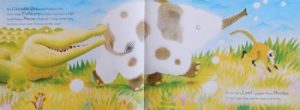
Down comes the rain, washing off some of its fluff as it heads to the waterhole for a drink. Crocodile cannot resist taking a bite of its bottom causing the thing to emit a loud trumpeting sound.

Recognising the cry, along comes mother Elephant.
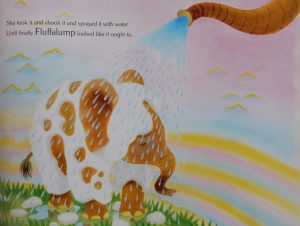
She picks up Fluffalump, takes him to the lake, washes off all the fluff and restores the creature to his former self.

He then realises that he is in fact ‘Elephant’s Child.’
Adrienne Kennaway’s paintings of the iconic animals of the savannah are full of humour and suffused with glowing African sunlight. The prodding and poking inflicted upon the Fluffalump gradually expose bits of his disguise so that observant readers may guess the identity of the mystery creature before his mother does.
Great fun and a cause well worth supporting.

Trees / We’re Going on a Bear Hunt My First Adventure Field Guide

Trees
Lemniscates
Walker Books
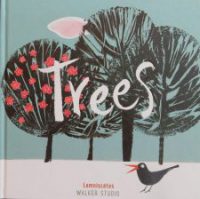
Published under the Walker Studio imprint, this is a gorgeously textured, digitally worked, tribute to trees. Through elegant illustrations and a succinctly worded text, homage is paid to trees. We see them in all their changing seasonal glory;

trees with ‘their heads in the clouds and their feet on the ground.

And we learn something of the functions of their roots; their various locations and something of the important environmental roles they play: homes for a plethora of birds and other creatures, providing shade for humans and other animals, cleansers of the air we breathe; and providers of a bounty of fruits. In the last few spreads we are in the company of a child in various tree interactions both rural and urban.

Share this lovely book with young children and then go outside and start to observe, enjoy and appreciate the wonderful trees around.

We’re Going on a Bear Hunt My Adventure Field Guide
text by Hannah Peng/Walker Books
Walker Entertainment
Somebody somewhere has had the clever idea of capitalising on the popularity of the original Rosen/Oxenbury We’re Going on a Bear Hunt picture book and the more recent success of the animation of the same and come up with this natural history adventure guide using some stills of scenes from the latter.
Like all good adventures, it takes a bit of planning and making sure one takes the appropriate things along in the way of clothing and protection, together with a handy notebook. Then it’s off into the big wide world of explorations, be they at home, school, countryside or seaside, by day or perhaps, night, always accompanied of course, by a responsible adult.
High in the Sky’, ‘Down in the Ground’ in that ‘thick oozy mud’; Further Afield to caves, through woodlands and forest (stumble trip) and onto the shore are other possible places for spotting a plethora of flora and fauna, large and small. Doing weather observations, making mud bricks, collecting fruits for scrumptious baked apples, creating a special plant habitat at home and measuring the heights of trees are just some of the numerous possibilities included; and I’m sure children will relish the idea of a poo hunt.
With its wipe-clean cover, this backpack-sized beauty concludes with some important words about the impact of certain kinds of human activity on the natural world, ways to help combat these and a final glossary.
For any child with a taste for adventure, either at home or in school.

I’ve signed the charter 

A Pandemonium of Parrots & An Acorn

%0A

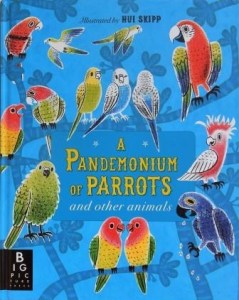
A Pandemonium of Parrots and other animals
illustrated by Hui Skipp
Big Picture Press
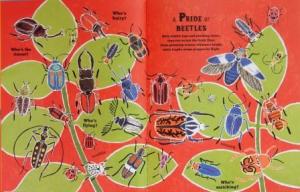
Essentially what we have here in this super book is a series of spreads featuring collective nouns for a dozen or so animals large and small, each one playfully and alluringly illustrated by a talent new to me, Hui Skipp; and embedded within each illustration is a descriptive quatrain (presumably written by Kate Baker), such as this:
With nimble legs and pinching claws,
     they run across the forest floor.
Their gleaming armour shimmers bright,
    while fragile wings prepare for flight.
… as well as questions to answer by exploring what’s depicted on the spread.

DSCN8099

Representing the feathered ones are the parrots of the title, flamingos (a flamboyance), penguins in a huddle and these Hummingbird dazzlers …

%0A

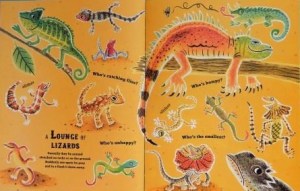
There are tigers – an ambush, a Lounge of Lizards basking in the sunshine …

%0A

       Casually they lie around
slouched on rocks or on the ground.
       Suddenly one spots its prey
       and in a flash it darts away.

and on the river banks ‘An Army’ of frogs – croaking, singing wonders every one. The mammals are represented by a Sloth of Bears, An Ambush of Tigers, A Troop of Monkeys, A Conspiracy of Lemurs …

DSCN8102

and A Caravan of Camels – beauties all.
The final two spreads are a “Did You See?’ array of all the animals with questions, followed by a concluding Who’s Who that gives snippets of information about each animal included.
Altogether this book is a treat for the eyes, an opportunity to learn some collective nouns and a chance to discover a few facts about thirteen fascinating groups of creatures. One for the primary classroom or family bookshelf.

%0A

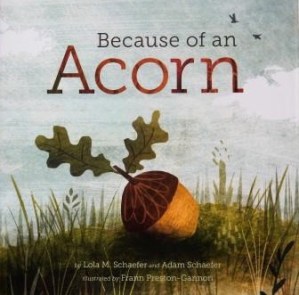
Because of an Acorn
Lola M.Schaefer, Adam Schaefer and Frann Preston-Gannon
Chronicle Books
This is a simple, but wonderfully effective look at a forest habitat and the interconnectedness of the flora and fauna that are a part of the ecosystem.
Because of an acorn, a tree grows; this in turn provides a nesting place for a bird, an insect-eating one that happens to aid seed dispersal.

%0A

The seed in turn grows, producing a flower that fruits, providing a chipmunk food. A snake with its beady eye upon the chipmunk …

%0A

is in turn seized in a hawk’s talons and when the hawk lands on the branch of, yes, an oak, down comes an ripe acorn and more until ultimately, there’s …

DSCN8126

a forest

Circles and cycles of life are evident in this cleverly conceived, unassuming little book that packs a powerful punch.
In addition to being a super little book to share with a class or group of young children, the fact that the text is simple, patterned, and perfectly matched to the pictures on each page, beginning readers can try reading it for themselves and feel empowered having done so.
There’s so much to see and to discuss in Frann Preston-Gannon’s lush foresty illustrations. UK readers will find some of the animals less familiar and the oak species is different from the British ones but this could be a good talking point.

WNDB_Button localbookshops_NameImage-2

Adventures at Bedtime

DSCN7154 (800x600)

Mr Moon Wakes Up
Jemima Sharpe
Child’s Play
I’m not sure what kind of creature Mr Moon is but that’s part of the beauty of this magical book – it leaves spaces for children to step into. What is certain though is that he has a tendency to nap at all the wrong times – for the child narrator at any rate …

DSCN7155 (800x600)

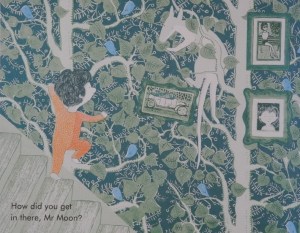
One night however, summoned seemingly by birdsong, he springs from the bed and climbs into the wallpaper on the stairs …

DSCN7156 (800x600)

Intrigued, the child follows and together they enter an altogether different, mysterious place. Here Mr Moon is wide-awake and the two play games …

DSCN7159 (800x600)

frolic in the maze, go adventuring, and boating …

DSCN7160 (800x600)

Then there’s a wonderful picnic tea party with Mr Moon’s friends …

DSCN7161 (800x600)

On this occasion though, it’s not Mr Moon that starts to feel sleepy and think about bed …
The gorgeous dreamlike quality of Jemima Sharpe’s illustrations draws children into a parallel reality that reminds me at once of Sendak (The Moon Jumpers) and Alice’s wonderland. The voice of the brief telling is unobtrusive allowing the reflective, almost meditative scenes to be pondered over at leisure.

DSCN7244 (800x600)

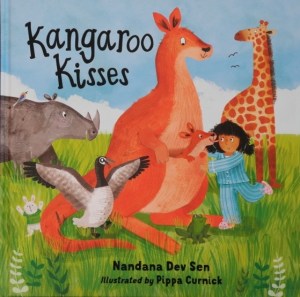
Kangaroo Kisses
Nandana Dev Sen and Pippa Curnick
Otter-Barry Books
Headstanding (not a good idea for one so young thinks the yoga teacher in me), flying, hippo cuddling …

DSCN7245 (800x600)

whale’s tail nuzzling, alligator racing, giraffe tickling and dancing with rhinos are all proffered as bedtime delaying tactics by the little girl to her patient mum in this gently rhyming picture book, the text being presented as exchanges between mother and daughter.
And even when she’s eventually got her pyjamas on, the very mention of a toothbrush sets her off again. There’s elephant’s tooth flossing and bear’s fur brushing to attend to, and more. Then the clock chimes and despite her yawns, the young miss must still give her pup a hug – oh and that kangaroo needs kissing …  Will she ever snuggle down for the night? … Yes, finally …

DSCN7247 (800x600)

Sweet dreams.
The blend of fantasy and reality works well here. It’s as well that this little girl didn’t have any more animal theme toys or other paraphernalia in her home …

DSCN7246 (800x600)

or she might be letting her imagination run wild even now …
Pippa Curnick beautifully captures that childhood joie de vivre spirit and the mother’s determination to remain calm and in control in her bold, bright scenes.

Use your local bookshop     localbookshops_NameImage-2

WNDB_Button