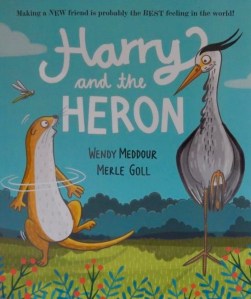
Harry and the Heron

Elsie, Clive and Harry are otters and we first meet the playmates as they practise keeping still by pretending to be logs. This is easy for Elsie and Clive but Harry, no matter how hard he tries, just can’t. Just as he’s about to have one more try he spies something in the reeds and asks the others what it is. ‘Just a heron,” Elsie replies urging Harry to lie down again. As you probably anticipate, Harry keeps fidgeting and staring at the static heron.
The heron, Ray, meanwhile stares at the water wondering why he never gets to play with the otters. Feeling left out, he hunches over and lifts one leg out of the water deciding that ‘Feeling a bit left out is probably the worst feeling in the world!”

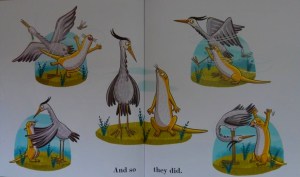
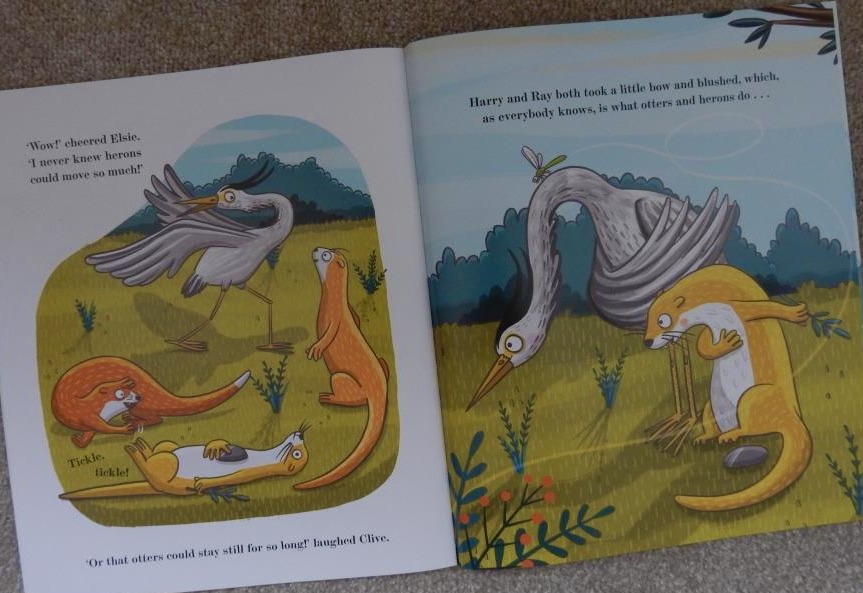
Along comes Harry waving and calling hello to Ray. He tells the heron his name and how he loves the way he stays so still. Ray in return says he loves how Harry moves so much. They decide to teach one another their respective skills.

Meanwhile Harry’s otter pals rouse themselves and notice Harry with the heron. The tell the bird to leave Harry and drag their friend away, unaware of the effects it will have on Ray. A dejected Ray goes into miserable mode and Harry begs the other otters let Ray play with them. As Clive gives what he thinks is a good reason for refusing, Harry points out something about Ray, something that the other otters can’t argue with and it changes the way all four creatures feel.

A fun story about including everyone in a group activity. I love the wry humour of Wendy Meddour’s telling and Merle Goll superbly expressive illustrations of characters with their similarities and differences. Definitely a book to share and discuss with younger primary readers and in families.

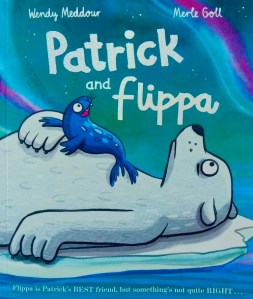
Patrick and Flippa

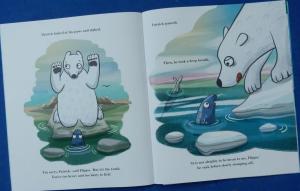
Best friends Patrick, a polar bear, and Flippa, a seal, love to watch the clouds together. Each day Flippa dives into the ice cold sea to catch juicy fish for Patrick to fill his tummy. However, despite having a full tummy, Patrick is suffering from an empty-bear feeling, so he tells Flippa. The trouble is that he thinks Flippa is overly dominating: why should she always be the one in charge never allowing Patrick to make his own decisions?

Following some disagreeable words between the two, Patrick stomps off, but to his surprise he feels no better. A snow fox comes along, stops and offers some wise words to the polar bear. Patrick decides to follow the fox’s advice; he plunges into the sea and for the very first time, catches his own fishy meal.

Unbeknown to the polar bear, Flippa has been watching and admits that she was already aware that Patrick could fish, going on to explain her reason for being so over-bearing. Of course being besties, the two talk things over, make up and all ends happily.

With themes of friendship and boundary setting, Wendy Meddour’s gently humorous story in combination with Merle Goll’s equally humorous scenes that convey the changing feelings of the two characters, make a read aloud tale that offers a good starting point for discussion with young children.

Sunny and the Birds

This image has an empty alt attribute; its file name is dscn9572-2.jpg


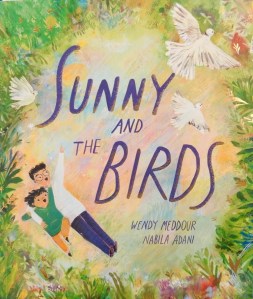
Sunny and his family have only recently moved to a new country. Almost inevitably there are things his dad misses. Every evening when they watch the birds through the window and Danny’s father asks him if he can name them, Dad’s response refers to similar ones “back home”. His son’s reply is “But this is our home!”

This image has an empty alt attribute; its file name is dscn9573-2.jpg

It’s evident that Dad doesn’t yet feel at home where he now is. In the middle of the night both Sunny and his Dad are wide awake and the boy acknowledges his father’s sad feelings.


This image has an empty alt attribute; its file name is dscn9574-2.jpg

After school the following day, Sunny’s Nanna meets him and the boy asks if they can go and buy Dad a present – a surprise. Can his bird-related plan help his father begin to feel at home in this new country?


As always Wendy Meddour’s story is written with great sensitivity. Presenting what for many immigrant families is a challenging time, she shows how with love, support, kindness and nature’s healing power, the process of adjustment to a different life can begin.


The richness and beauty of the natural world – real and remembered – is elegantly captured in Nabila Adani’s misty illustrations and you can read the changing emotions in her portrayal of the two main characters.


With more and more schools having immigrants as part of their community, this book would help children understand how newcomers might be feeling. Share at home, share in the classroom and invite listeners to participate in discussion, whatever the setting.

Cleo the Completely Fine Camel

Cleo the Completely Fine Camel
Wendy Meddour and Carmen Saldaña
Oxford Children’s Books

Nothing can stop Cleo the camel feeling on top of the world and absolutely fine or can it? She’s such a ‘glass half full’ kind of creature that even when the sand under her feet is burning hot, the sweat is pouring off her face and she’s so thirsty that she licks the surface of a rock, she insists to fellow desert dwellers Lizard, Jerboa, and the circling vultures, that she feels happy.

Suddenly a fearsome sandstorm blows up, almost completely burying Cleo. Her friends dig her out and still she maintains that she is fine, despite her hump having shrunk significantly. Along comes Ostrich who has just emerged from the sand. “I’m fed up. Fed up of sandstorms, Fed up of the heat. And fed up of getting sand in my eyes.” Cleo still tries the ‘we’re desert animals’ line but Ostrich continues with “Yes, I feel rubbish. Totally awful. Absolute pants. How about you?” Will Cleo finally take that leap of confidence and admit how she really feels?

Thankfully for all, yes she can and having faced up to reality, she follows Ostrich’s lead in search of an oasis where welcome refreshment awaits.

Wendy Meddour’s story gently and humorously imparts an important life lesson to young children: it’s all very well putting on a brave face but not to the detriment of your own well-being. Carmen Saldaña makes the searing desert heat radiate from the pages in her illustrations, which show the impact on the animals – humped or not – as they struggle to cope with the harsh reality of desert life.

Peggy the Always Sorry Pigeon

Peggy the Always Sorry Pigeon
Wendy Meddour and Carmen Saldaña
Oxford Children’s Books

Try as she might Peggy Pigeon manages to please nobody; all she succeeds in doing is getting in the way and apologising for so doing. The scruffy pigeons, the road sweeper, and a yappy dog all shoo her out of their way, watched unbeknown to Peggy, by a seagull that introduces herself as Joan.

Joan too receives an immediate apology from Peggy but she in response tells the pigeon to stop saying sorry when she’s done nothing to apologise for. She also calls Peggy’s explanations ‘Nonsense’ and goes on to explain why. She insists Peggy must stand up for herself and goes on to support the pigeon in her efforts so to do. Little by little Peggy’s confidence grows as she gives as good as she gets to the very same characters that treated her unkindly.

I love her ‘SOGGY HAT SANDWICH’ and other retorts that definitely give her bossy persecutors a big surprise.

By the end of the day when Peggy and Joan relax together on the water as the sun sets, Peggy thanks her new friend and also gives her supportive seagull pal something of a surprise; seemingly Joan has done her job even better than she thought.

With its lovely, somewhat unexpected finale, Wendy Meddour’s tale of learning to stand up for yourself, supportiveness and friendship is an empowering story to share with young listeners who will love the opportunity to emulate Peggy’s retorts as she stands up for herself and enjoy Carmen Saldaña’s splendidly expressive illustrations of the action: the looks on the faces of the various characters – avian and otherwise – are wonderful.

The Friendship Bench

The Friendship Bench
Wendy Meddour and Daniel Egnéus
Oxford Children’s Books

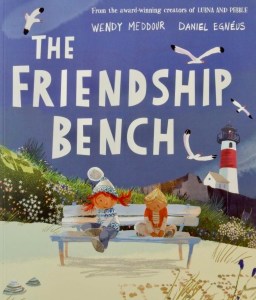
New beginnings is the theme of this beautiful story that celebrates young children’s creative play.

Tilly has just moved to a new home beside the sea: the setting looks gorgeous but she’s very disappointed when her mum tells her that her beloved dog Shadow can’t go into her new school on her first day. Nothing is the same without her canine friend.
At playtime, Tilly is alone and when her teacher notices this he suggests she try the Friendship Bench. However when she gets there, the bench is already occupied. Back to the teacher goes Tilly who tells her to have another try.

The little boy hasn’t vacated it however, so she joins him and after a bit they both decide the bench needs fixing to make it work. They set to work improving it until …

On the way back from school that afternoon Tilly tells her Mummy about how she and Flint transformed the Friendship Bench and about their future plans.

As always, there’s power in both Wendy’s straightforward, finely honed telling and Daniel Egnéus’ dreamlike illustrations. I love his warmth, the occasional gentle humour in the details and the way he puts readers right close to the action.

One to add to foundations stage/KS1 collections and family bookshelves.

Tisha and the Blossom

Tisha and the Blossom
Wendy Meddour and Daniel Egnéus
Oxford Children’s Books

What is this life if, full of care,
We have no time to stand and stare.

To me, these opening lines of the WH Davies poem I learned in primary school lie at the heart of this latest collaboration between Wendy Meddour and Daniel Egnéus.

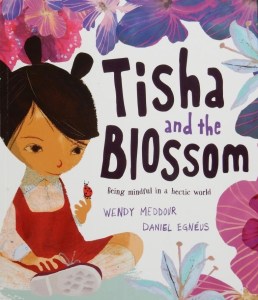
Like most of us, young Tisha and her family lead busy lives and wherever she goes, whatever she does, the little girl is constantly being told by adults to “Hurry up”. It happens in the morning as she enjoys watching the blossom fall, as she leaves for school and all the way through the school day.

So when her mum arrives to pick her up and urges her to hurry for the bus, it’s the last straw.

Fortunately Tisha’s request that they slow down results in mother and daughter walking home and enjoying a special game to help them do just that.

Then when they reach home Dad is there to join in with the welcome change of pace.

We all need to make time to be still and mindful in our hectic world; if nothing else the last twelve months has made us realise the importance of paying attention to the pleasure offered by small things. Wendy’s engaging story with Daniel Egnéus’ scenes – especially the blossom-filled ones, are a truly gorgeous affirmation of this.

Howard the Average Gecko

Howard the Average Gecko
Wendy Meddour and Carmen Saldaña
Oxford Children’s Books

Howard apparently has a very high opinion of himself and a seeming disregard for his fellow rainforest dwellers. So intent on bragging about his camouflage skills is he,

that he fails to notice that same ability in a number of the other creatures, that is until he encounters a stick insect. Stick insect’s “The rainforest is full of camouflaged creatures”

is let’s say, an ego deflater, even more so is its “You’re average”. and Howard has a crisis of confidence about his lovableness.

Suddenly out of the foliage comes a stunning creature

and despite what the stick insect thinks of her, Howard declares the wobbly-eyed reptile “magnificent”. This other gecko introduces herself as Dolores. The instantly smitten Howard invites her to watch the sunset with him and together these two ‘average geckos’ climb up a tree onto …

With its surprise finale, this is a fun story that introduces animal camouflage (look out for the creatures Carmen Saldaña has hidden away in her leafy scenes) while being a smashing book to show all young children that they’re just right as they are. Endless comparisons with others do nothing to foster self-esteem: it’s having people who love you that counts – to them you are in your own unique way, very special.

Not In That Dress, Princess!

Not In That Dress, Princess!
Wendy Meddour and Cindy Wume
Otter-Barry Books

Full of spirit and exuding energy from cover to cover, this is the story of how a strong-minded young Princess Bess tosses aside gender stereotyping norms – “There are things we DON’T DO in a dress!” …

“a princess must always impress” and does exactly what she wants to do, proving that dress notwithstanding, there is absolutely nothing, this determined female can’t do.

Her brothers, the princes More and Less, along with a host of animals large and small, watch in awe as she scales tall buildings, hikes, skis through a storm, goes on safari,

cavorts with a wizard and much more.

Eventually the queen, her highness Gloriana Stephaness, realises that it’s a case of no holds barred: her daughter’s behaviour IS truly impressive. She even decides to make a public announcement concerning dress code; moreover it’s not long before other, unlikely royals, are also sporting dresses.

Wendy Weddour’s jaunty rhyming narrative will have young listeners joining in with the oft repeated “in my dress” as they relish the sight of Bess (Cindy Wume shows her in a different dress for every activity) having the most incredibly exciting time beyond the confines of the palace.

I’ve always had a soft spot for children – real or in stories – who push the boundaries, challenge and subvert pointless rules and are ready to break out of their narrow confines: Bess joins their number

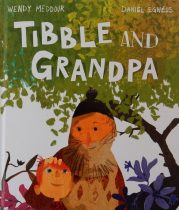
Tibble and Grandpa

Tibble and Grandpa
Wendy Meddour and Daniel Egnéus
Oxford Children’s Book

The relationship between a child and a grandparent is often very special and uncomplicated, and so it is here.

Tibble’s Grandpa is grieving. He seems to be always in the garden: Mum explains that what he needs is time.

Full of loving concern, Tibble wants the old Grandpa back: he barely recognises this silent, withdrawn person. Little by little he gets Grandpa to open up as they spend time together talking of favourite things.

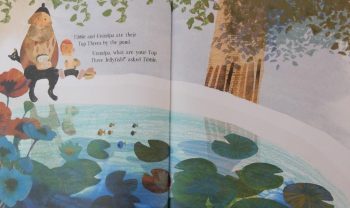
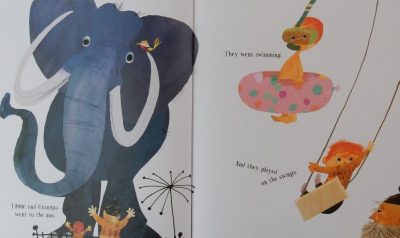
Next morning Grandpa actually seeks out Tibble’s company and they spend the day doing the boy’s favourite things – his ‘Top Three Days Out’ all in one.

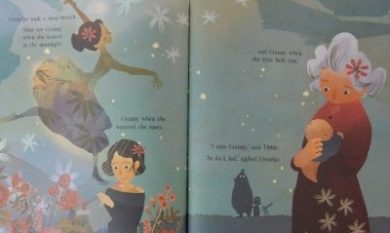
That evening they get out the telescope Granny had given to Tibble and they watch the stars together. Tibble opens up a discussion about favourite (Top Three) Grannies, ‘Mine are granny who is dead. Granny Agnes who lives on top of the shoe shop. And the Granny in Little Red Riding Hood,’ he says and this acts as a release for Grandpa.

Wendy Meddour has created an enormously affecting tale of loss, grief and love. Her repeated use of ‘Top Threes’ throughout the narrative is genius, injecting just the right degree of gentle humour into her telling.

Daniel Egnéus reflects so well both the humour and poignancy of the story in his outstanding mixed media illustrations making you feel as though you want to hug both Tibble and Grandpa.

Yes it’s a book about coping with the death of a loved one but it’s also an outstandingly beautiful story about intergenerational love and its power to heal.

Stephano the Squid: Hero of the Deep

Stephano the Squid: Hero of the Deep
Wendy Meddour and Duncan Beedie
Little Tiger

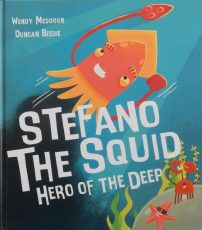
Life for Stefano squid is far from easy. Why is it that the unique characteristics of a squid go unappreciated? That is what Stefano ponders upon.

His fellow deep sea creatures offer reasons relating to his lack of colours, being unbat-like and not being shaped like a hammer …

while the dolphins suggest he should endeavour to look more intelligent; the sea dragon favours looking more leafy and the sea cucumber’s suggestion is to look more vegetable-like.

All the while Stefano is at pains to point out that being a squid makes their suggestions impossible, and when the anglerfish  asks about his weaponry, all the squid can do is to go and hide himself away in a cave.

There he receives some words of comfort from the Sea Cucumber but they are immediately negated by the comments of the limpets.

However, when Sea Cucumber points out one of the diving crew is in trouble, it’s down to Stefano to come to his aid; small and insignificant as he considers himself to be, he just can’t swim away and do nothing.

Rescue mission achieved, or rather,  the little cephalopod and his pal get the surprise of their lives – make that two surprises -when the identity of the rescued diver is revealed; but the second one comes the following day and to discover what that is, you’ll need to get your fins on a copy of this thoroughly immersive book.

Wendy’s telling is great fun but at the same time reminds us of the importance of self-worth and self-belief. Duncan’s terrific undersea scenes are splendidly expressive and comical, and I love his marine colour palette.

There are talking points aplenty once you’ve shared this super splashy story.

Lubna and Pebble

Lubna and Pebble
Wendy Meddour and Daniel Egnéus
Oxford University Press

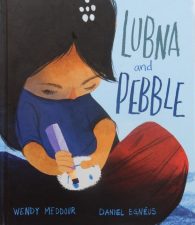
Every pebble is different, some are special, others not: the pebble in this beautifully moving story is of the former kind. It’s smooth, shiny, grey and it’s Lubna’s best friend. She discovered it when she and her father arrived one night on the beach before falling fast asleep in her Daddy’s embrace.

These two people have landed in a tented world and with her pebble clutched in one hand and her Daddy’s hand in the other, the little girl feels protected.

In one of the tents she finds a felt-tip pen, which she uses to draw a smiling face on her pebble.

Lubna opens up to Pebble telling her now much loved new pal of the war, her home and her brothers.

Winter comes and with it chill winds that flap the tents. Daddy keeps his daughter warm and together they make a warm bed for Pebble.

Into this chilly camp comes a little boy, silent and afraid. Lubna introduces him to Pebble and the boy introduces himself to Pebble: Amir is his name.

A new friendship develops between Lubna and the newcomer although Pebble remains her best friend.

One day Daddy receives some wonderful news: he and Lubna are leaving for a new home.

Amir’s reaction means that Lubna now has mixed feelings and that night in bed she lies awake pondering. She consults Pebble but no answer is forthcoming.

By morning though, Lubna knows what she must do when she leaves …

This is a book that really tugs at your heartstrings. Wendy’s tale of love, hope, friendship, sacrifice and transcendence perfectly complemented by Daniel Egnéus’ powerful, sometimes sombre, scenes of the refugee camp dwellers left me with tears in my eyes and a lump in my throat.

Definitely one to add to the growing number of beautiful picture books featuring people displaced from their own home country seeking safe refuge elsewhere.

The Glump and the Peeble

DSCN7739 (1)

The Glump and the Peeble
Wendy Meddour and Rebecca Ashdown
Frances Lincoln Children’s Books
What an intriguing title: what on earth is a Glump and what’s a Peeble? Sounds almost like something from Lewis Carroll I thought. I pondered these questions before even opening this deliciously fanciful book. Let me enlighten you now: the Glump in question is a troglodyte loner. He’s not a loner by choice however; he desperately longs to break out of the glump do-nothing mould and join in the moonlit fun and dancing with the peebles; but he just can’t bring himself to do it …

%0A

Then, what should skip into the wood, ‘singing and dancing just like peebles should.’ (Yes this story’s told in Wendy Meddour’s mellifluous rhyming text.) but a veritable peeble. What she does next though is decidedly un-peeble-like: she sighs, frowns, pauses and sits down on the ground. Moreover, she starts to sing and this is her song:
I know that a peeble should dance every night./ I know I should twirl in the glow of moonlight./ But it makes me feel dizzy, I get hot and pink. / Why can’t I sit still like a glump and just think?
The Glump, from his cave, tries ignoring these words, and the peeble, but somehow he cannot. Instead he coughs and invites her in – in for a sit still. The surprised Peeble accepts and eventually follows the Glump into his cave; where she sits meditatively, breathing in the still and quiet of the night…

%0A

Thereafter, a discussion ensues and the Glump tells his visitor of his yearning to dance, pointing out the troubles his toes would be likely to cause were he to do so; and the Peeble in turn persuades him to have a go – good on you Peeble. And off the two go to give it a spin …

%0A

Guess who, with fear overcome, is soon wowing all the other peebles with his dance moves and equally important, a new friendship has been forged, well and truly. Two firsts in one night: a sitting still, thinking Peeble and a dancing Glump: that’s some going Glump and Peeble.

%0A

All this is visually realised in Rebecca Ashdown’s wondrously quirky scenes wherein we are shown how this enchanting pair of characters manage, with each other’s help, to take a risk, step out of their respective comfort zones and dare to be different.localbookshops_NameImage-2

WNDB_Button

Starting with a Fairy Tale …

rapunzal 007 (800x600)

Cinderella’s Big Day
Katie Cotton and Sheena Dempsey
Templar Publishing
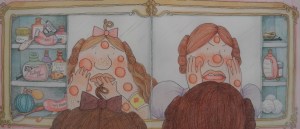
It’s just one week before the wedding of Prince Charlie and Cinderella when a letter arrives on the royal breakfast table addressed to the King and Queen: a letter from Charlie, informing Their Most Marvellous Majesties that the ring he’s due to place on Cinderella’s finger has gone missing. Immediately the King’s suspicion falls on the ugly sisters. But is he right? There follow five further letters through which much of the narrative detail unfolds. The wedding does take place though with some notable absentees and all is made clear why through the final communication fired off by Cinders herself as she relaxes happily on her honeymoon – that and …
rapunzal 010 (800x600)

Billed as ‘After Happily Ever After” I suspect this amusing novelty book is the first of a new series. Sheena Dempsey has used a palette of soft colours to create her scenes. Scenes that contain a mixture of contemporary items such as Cinderella’s heart shaped sunglasses, wry details like the mouse’s tail extending round the skin lotion bottle,

rapunzal 008 (800x600)

as well as the more traditional fairytale paraphernalia. Children will particularly love the wedding fold-out scene that is crammed with characters from traditional tales and nursery rhymes.

rapunzal 004 (800x600)

How the Library (Not the Prince) Saved Rapunzel
Wendy Meddour and Rebecca Ashdown
Frances Lincoln Children’s Books
On the top floor of an inner city tower block Rapunzel languishes, ignoring callers: the milkman, the postman bearing a letter, the baker woman, Rapunzel’s aunt with dinner, even a prince bearing chocs and red roses.

rapunzal 005 (800x600)

All exhort, “Rapunzel, Rapunzel, please let down your hair.” But, receiving no response, and with the lift out of order, one by one they continue on their way. Later though, concerned on account of her lack of food, they have a change of heart and after a discussion, all (except the prince who is never seen again) decide to return to make amends. Back they go and up, up to the sixteenth floor where a hearty meal is cooked for Rapunzel and the letter duly delivered. The food restores colour to her cheeks but it’s the contents of the letter that really puts a smile on her face.
Rapunzel leapt up and she shouted with glee:
“I’ve got a new job at the library!”

From then on our heroine is transformed: no longer does she sit idly waiting to be wooed; she spends her time enthusing about books at work and educating herself when she gets home – courtesy of LIBRARY BOOKS – what else?
Told through a longish, zingy, rhyming text and bold illustrations that are full of funny details and mischievous touches such as the crow tugging at a tress of Rapunzel’s wayward auburn hair, not to mention cats, dogs and birds galore.
A great plug for libraries and the delights of books and a great picture book debut for illustrator, Rebecca Ashdown.

Also told in jaunty rhyme is:

rapunzal 011 (800x600)

Princess Sleepyhead and the Night-Night Bear
Peter Bently and Laura Ellen Anderson
Orchard Books
Night has fallen over the kingdom; in the castle all are slumbering, all that is except one: Princess Sleephead is wide awake. But kindly Owl at her window is determined to help so off he flies, returning soon with Fox and Mouse. Their sleep-inducing ideas are great fun but very energetic and only serve to wake her further. Owl however has promised three friends so who is missing? Ah! It’s Bartholomew Brownfur-Brown – a large friendly creature – aka the Sleepytime Ted clutching a collection of bedtime fairy tales:

rapunzal 012 (800x600)

just the thing to cure the princess’s insomnia.
Exuberant illustrations littered with the princess’s ephemera, endearing animal characters and some enchanting sleepy-time scenes and a text that is a pleasure to read aloud, are the main ingredients of this fairy tale romp.

shhhh 001 (600x800)

SHHH!
Sally Grindley and Peter Utton
Hodder Children’s Books pbk
It’s great to see this book reissued; my original hardback copy was read to destruction. Loosely based on Jack and the Beanstalk, the manner in which this book draws readers in is just superb. With the entreaty to “Come inside” we enter the giant’s castle wherein we view and creep past, a huge-bellied sleeping mouse, a slumbering cat – enormous, a broody hen, the giant’s wife busy cooking dinner and then, the snoring giant.
Distorted perspectives, grisly domestic details such as an axe to slice the bread and eyeballs in the stew pot, retrospective flaps so readers can check whether those they crept past have been disturbed – reassuring until the final one, after which it’s a case of doing what we are told …

shhhh 003 (800x600)

Not for long though, I can guarantee there will be cries of “read it again” straightaway.

Find and buy from your local bookshop:

http://www.booksellers.org.uk/bookshopsearch