
Cloth Lullaby
Amy Novesky and Isabelle Arsenault
Abrams Books for Young Readers
Subtitled ‘The Woven Life of Louise Bourgeois’, this poetic book give details of the life of the world famous artist, best known for her sculptures. Louise spent the early part of her life living beside a river in a big family house. Her family were tapestry restorers and when she was just twelve, Louise began to learn the trade.

Her mother taught her about form, colour and the various styles of textiles. As she learned about the warp and the weft, about the tools of the trade and how to dye, the relationship between mother and daughter became increasingly intense, ‘ … patient, soothing … subtle, indispensible … and as useful as an araignée (spider) while that with her father (not a weaver but a buyer of cloth) was more dramatic. She once threw herself into a river, so angry was she at her father’s frequent departures on buying trips.
When Louise’s mother died, deeply affected she abandoned her mathematical studies at university and turned to art. ‘She drew, she painted, she wove, She missed her mother so much, she sculpted giant spiders made of bronze, steel and marble she named maman.’
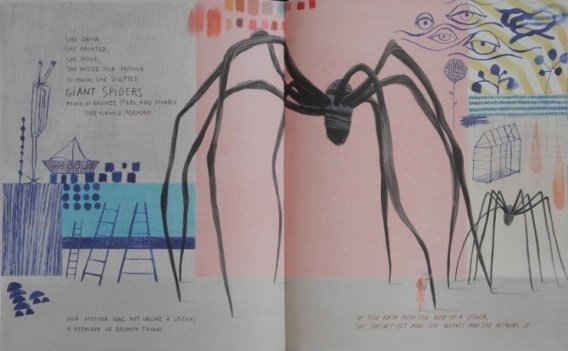
Then later she began focusing on fabrics – the fabric of her life -, sewing, stitching, weaving and sculpting smaller, more delicate spiders …

and other objects in particular cloth books and a cloth lullaby.
Louise Bourgeois worked in bronze, steel, wood, stone and cast rubber and in textiles. Her life story here is rendered in ink, pastel, pencil, watercolour and photoshop by Isabelle Arsenhault whose wonderful mixed media collages, predominantly in shades of red and blue, feature spiders, web designs, water and textiles, music even. These powerfully evoke the rivers and threads that were a constant running through her life, and are a superb demonstration of how we all weave memories into our own lives in one way or another.
It’s difficult to know who would most enjoy this book, adults interested in the artist and her work, those generally interested in shape and form and creativity, or younger readers coming upon this poetic homage to Louise Bourgeois either as part of a topic or simply being attracted to it by the wonderful cover.
Use your local bookshop 

 Red Reading Hub - Jillrbennett's Reviews of Children's Books