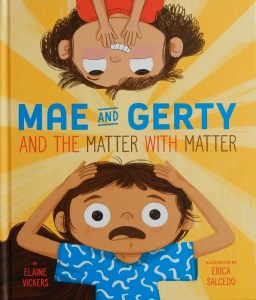
Mae and Gerty and the Matter With Matter
Elaine Vickers and Erica Salcedo
Beaming Books
Science and story come together in this picture book.
Mae and Gerty are sisters but they are very different. Mae, the elder of the two becomes increasingly annoyed when her parents constantly talk about their notions that Gerty is showing a scientific bent at so young an age; indeed the very first word she said was ‘madda’. Dad is forever drawing attention to her actions: “Look at all the ways she can manipulate matter: pushing, pulling and colliding!” he comments one bath time.
Gerty certainly does love mess making,

trying things out, constantly asks questions. These are exactly the things scientists do and during the story, both siblings discover that this is so, for Mae decides to show her mum and dad that she too can do all that Gerty does. They start exploring together and soon they become a true science team taking every opportunity to experiment, asking Why? Why? Why?

Some of their experiments in the kitchen produce matter of a very tasty kind but most important of all is that with their parents’ encouragement the siblings’ eyes and minds are always open to the scientific possibilities the world offers.
After the narrative, the author provides some questions adults might discuss with young listeners and there’s also a bubble recipe. Erica Salcedo’s wonderfully expressive scenes of the girls’ interactions with matter really brings out the importance of letting children explore the world with all their senses.
There’s more science in

Let’s Build
Weather
Helen Mortimer & Cristina Trapanese
Oxford Children’s Books
These are both additions to the Science Words for Little People series.
In Let’s Build, the children are going to make a car wash and the book takes us through the stages involved in its construction from drawing up a plan to the finished building. The simple text is split between a straightforward narrative and speech bubbles containing the child constructors’ comments. Key words – materials, invent, tinker, forces, magnets, strong foundations, machines, movement solving problems, energy are used as headings for each of the twelve spreads, the twelfth being ‘all about building’ whereon readers are asked leading questions to get them thinking about their own projects.
The final spread gives ideas to adults to help them get the most from this book and Weather.
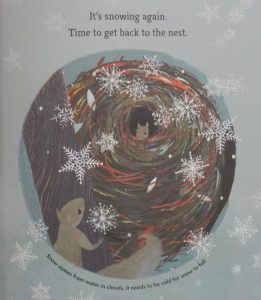
Similarly organised, the latter uses key terms including meteorology, atmosphere, various cloud names, cyclones, hurricanes, tornadoes and hurricanes in the brief narrative that has spreads on sun, clouds, rain, a rainbow, wind, storm, snow, seasons, weather watching and climate.
Visually and verbally engaging with a diverse group of child characters, both titles are worth adding to early years collections.



 Red Reading Hub - Jillrbennett's Reviews of Children's Books