Brick Building 101

Brick Building 101
Courtney Sanchez
Walter Foster Jr.

I’ve yet to come across a child who doesn’t enjoy using LEGO bricks or similar. This book capitalises on this enthusiasm presenting, as the cover says 20 activities to teach about STEAM.
What is STEAM you might be asking? In the UK teachers are familiar with STEM; STEAM adds arts and so comprises science, technology, engineering, arts and maths.
According to the introduction ‘STEAM learning is about giving children real-life problem-solving skills through exploration, play, and exciting learning experiences. STEAM engages kids to find their own solutions. … Kids learn by doing, failing, and trying again.’
Each activity has sections: ‘Parent Prep’ offers tips on things adults can do to help make the activity engaging and fun; STEAM Stats says which of the STEAM categories are incorporated in a project; STEAM Sparks offers further ideas and ways to extend a project.
Activities focus on using bricks (big and small), baseplates, and small figures, along with other materials you can easily find around the home or in a nursery setting or early years classroom, and are offered at different levels – easy, moderate or challenging.
Here’s one of the examples at the first level:

 ‘Super Symmetry’ is in the moderate category and could equally be done by pairs of children rather than adult and child – I’ve tried it and it works well with 4/5/6 year olds working together.

At the challenging level ‘Build a Bridge’ is great fun with a reception class working in pairs. And who can resist trying their hand at ‘Balloon Racer’.

This would fit in well under a movement, transport or any number of other topic headings.
Enjoyable and educative at the same time, and equally worthwhile to have and dip into at home or school.

Maths, Manipulations and Mindfulness

5 Wild Numbers
Bella Gomez
Words & Pictures

Vibrant scenes of jungle animals introduce counting and the numerals 1 to 5 in this chunky book.
The thick sturdy pages accommodate a die-cut numeral on each spread with a sliding disc so that small fingers can follow the arrows, move the disc and trace the numeral for ‘One fierce tiger’, ‘Two stripy zebras’, ‘Three parrots’, ‘Four long-tailed monkeys’ and ‘Five pink flamingos’.

The rhyming text introduces exciting words such as ‘paces and snarls’ for the tiger; ‘laze’ and ‘scorching days ‘ for the zebras and even metaphorical language – ‘ their feathers shining bright as jewels’

A fair bit of pressure is needed to move the discs so in my view the value of this activity lies in helping develop fine motor skills but is of limited help in learning to form the numerals.

Shapes Colours Numbers
Dario Zeruto
Words & Pictures

This is a wordless, (apart from the initial ‘How many shapes and colours can you find?) simple, yet ingenious, chunky book that as it unfolds, encourages youngsters to find out about 2D shapes and colours, and do some counting along the way as they explore a series of gatefold flaps.

Playful, engrossing and educational, and all based on five colours, squares, triangles, rectangles, circles and diamonds.

Touch Think Learn Wiggles
Claire Zucchelli-Romer
Chronicle Books

An engaging rhythmic text, inspired perhaps by Hervé Tullet, urges young children to use their wiggly fingers to dance on each spread as they trace shapes, tap and hop, slide up and down, follow circle outlines, zigzags, and spirals as the text is read aloud.

The text is upbeat and playful, the shapes cut out in fluorescent green, pink, or yellow are attractive and inviting but the white type against pale blue pages less satisfying that the brighter shade of blue used for the cover.

ABC Mindful Me
Christiane Engel
Walter Foster Jr.

Mindfulness – paying attention to the present moment, or being in the here and now – is very much in vogue at the moment, with schools adding it to their daily programme, often sadly, tacked on as an optional after school extra rather than it being part and parcel of the curriculum.

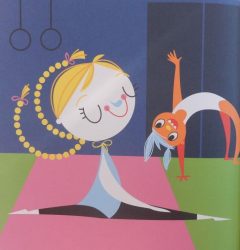
Christiane Engel’s sturdy large format board book could help integrate it into the foundation stage curriculum at least. She takes us on a journey through the alphabet linking each letter to an activity – walk, yoga, breathe for example, or a state of mind or concept –awareness, giving, joy or thankfulness.
The rhyming text talks directly to the child and the illustrations are attractive and inclusive.

The book concludes with some creative ideas related to the book’s overall theme.

If you think young children need help to be mindful then this will be useful: I know from experience that if left to their own devices, preschool children naturally reach a state of mindfulness; adults just need to step back – it’s they, rather than children who need a book such as this.

Come into the Garden – A Big Garden / The Magic Garden

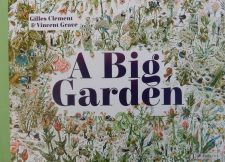
A Big Garden
Gillles Clément and Vincent Gravé
Prestel Publishing

As I write, our garden is really starting to burst forth: leaves are unfurling, flower buds are opening everywhere, birds are beginning to nest – spring has finally arrived.

Now is the time to celebrate and how better than with this unusual edition that originated in France. It’s a truly mind-blowing book with a wide age range appeal, and BIG it surely is to encompass that titular big garden.

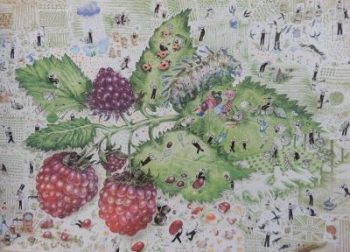
Prepare yourself to get totally lost within each and every awesomely beautiful illustration as, starting with May, we are treated to a month by month close up look at the seasons alongside the gardener who tends it.

The text is a straightforward miscellany of horticultural musings with the occasional flight of fancy: September being given over to the gardener himself.

However, it’s those intricately detailed illustrations that will entrap you as you explore the intricately detailed pictorial pages,

June Fruit

each one comprising a plethora of fanciful mini-scenes, and search for the hidden objects mentioned on the prose pages.

And be sure to peruse the title pages and endpapers; they too are superb.

For younger readers is

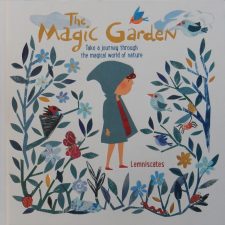
The Magic Garden
Lemniscates
Walter Foster Jr.

Do you think of your garden as magic? Probably not, although you perhaps do notice and enjoy the seasonal changes, and the abundant wildlife that inhabits it.

Not so, young Chloe the protagonist of this book which begins one autumn afternoon with her walking without awareness until suddenly a sound causes her to pause beside the tree and take notice of its colourful leaves; it’s as if the wind is whispering to her.

Thereafter we’re taken on a journey of her garden where we can observe some of the wonderful creatures that live there – among the branches,

behind stones, in the pond – taking note of seasonal activity and change.

We see the garden by day but also by night when other insects make their presence known.

Some animals prefer to keep themselves hidden and readers are encouraged to look more closely for those as well as noticing the brightly coloured ones.

The seasons pass, the tree too changes: it’s bedecked with blossom, laden with fruits.

All this and more is part and parcel of this seemingly ordinary, yet ‘magical’ place. I prefer the use of magical rather than magic; for me nature is awesome and magical but not magic – a potential talking point when you share the book with children.

It’s beautifully designed and illustrated with much of the text taking the form of the wind’s words to the child.

Hidden World: Ocean / 50 Wacky Things Humans Do

Hidden World: Ocean
Libby Walden and Stephanie Fizer Coleman
360 degrees

Essentially this is a visual exploration of living things that live beneath the ocean waves.
Six spreads present in turn Giants – some of the world’s largest creatures; Colourful Creatures; Hide and Seek – animals that camouflage themselves;

creatures that dwell on The Ocean Floor; Deep Sea creatures – those that live in the chilly, dark ocean depths and finally, The Coral Reef where sponges, corals, puffer fish, butterfly fish, clown fish and crabs can be found.
Each spread has six labelled flaps that open to reveal the creatures in their natural surroundings, and some brief factual information. I was amazed to discover that there are over 3000 different species of sea slug, for example.
With ecosystems such as coral reefs under threat from global warming, as well as being a fascinating book for young children, it’s also one that when shared with an adult, can open up discussions about the importance of protecting the crucial marine environments.
The book’s sturdy pages should help ensure that this resource can withstand fairly heavy handling from interested and enthusiastic youngsters.

50 Wacky Things Humans Do
Joe Rhatigan and Lisa Perrett
Walter Foster Jr.

Here we have a book that is full of fascinating facts relating to the weird and wonderful things our bodies do.
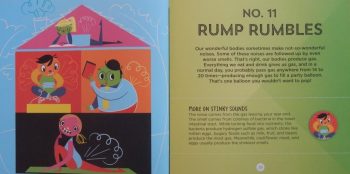
Each topic is introduced with an alluring title such as ‘Raisin Fingers’ (why our digits go wrinkly after a long time in the bath); ‘Rump Rumbles’ (there’s a lot of alliteration and wordplay in the headings);

Snot’s Amazing’ ;‘Black-and-Blue’ about bruising;

and ‘Be Flexible’. (It’s good to see yoga getting a mention here.)

Joe Rhatigan’s narrative style is chatty and designed to draw readers in, which it certainly does; and Lisa Perrett’s zany and colourful cartoons  add to the allure.
Most children are fascinated by their own bodies and what happens in and around them; and this unusually presented and arranged book on that topic will certainly both entertain and inform. It should also encourage young readers to value and respect their bodies, keeping them as healthy as possible.