Hot Food: Nice!

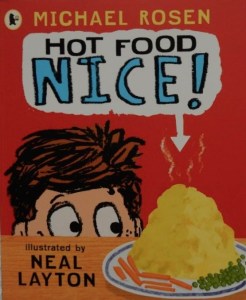
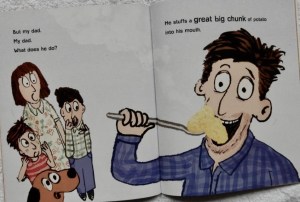
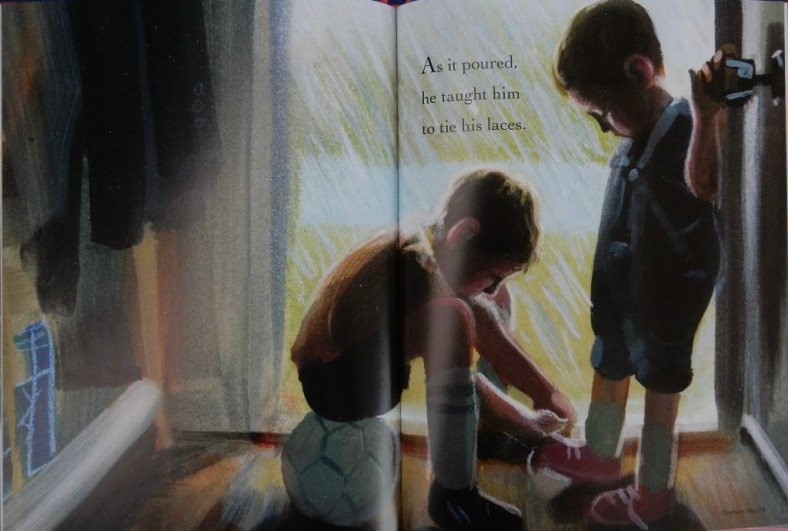
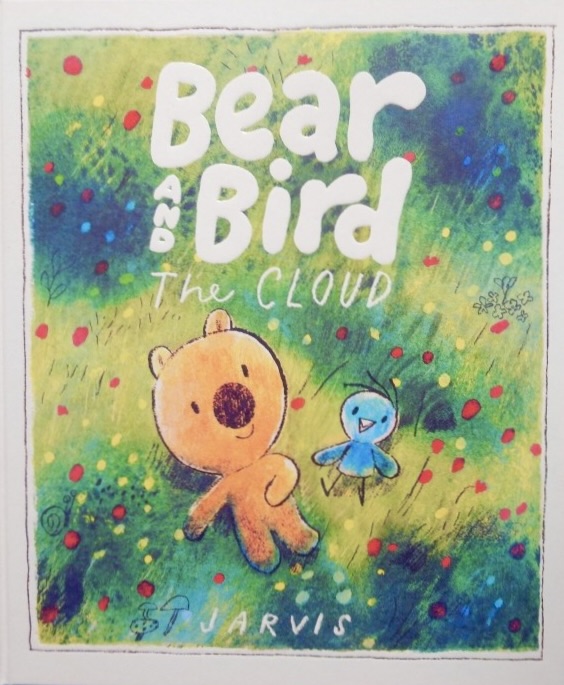
This is Michael Rosen’s hugely popular poem ‘Hot Food’ to which a prelude has been added wherein the narrator tells readers, “When I was a boy I thought my dad knew everything.’ However the day dawns when a discovery destroys that belief. This is what happens: It’s dinner time and the family – mum, dad, the narrator and his brother are sitting around the kitchen table, plates piled high with dinner. It’s evident to the narrator that the potato’s a tad on the hot side and so with just a small amount on his fork, he blows on it – whooph whooph – ‘until it’s cool, / just cool, / then into the mouth: nice!’ His brother and mum do a similar thing. Dad however acts, let’s say, rather rashly. Into his mouth goes a large amount of potato:

YIKES! You can almost feel the skin inside his mouth blistering in Neal Layton’s scene of Dad as he flaps his hands, blows and puffs and a whole lot more until he ejects the potato in small pieces back onto his plate. His family are obviously dumbfounded, perhaps even more so when he states, “Watch out everybody – the potato’s very hot.”

A paragraph from the publisher at the back of the book includes a couple of amusing facts concerning ‘nice’ the meme in both China and the USA.

Neal Layton’s illustrations capture the potato incident splendidly so it becomes a scrumptious slapstick visual story too, full of fantastic facial expressions. A unmissable read aloud for class and family sharing.
Snow

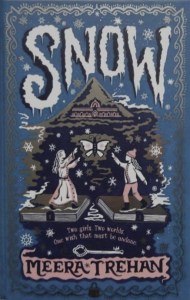
This story is set in Mistmir, a kingdom which is empty save for the Princess Karina who spends all her time digging Snow. This snow is not the ordinary precipitation, rather it has been scientifically modified to be self-replenishing in response to her wish for ‘perfect’ snow on her thirteenth birthday. As a consequence the Princess has been continually labouring and now she and her father, the King, are the only ones who haven’t fled.

One day as she shovels, the Princess discovers her precious fluttery toy, made by the strangers who created the Snow. A sign of hope surely, but before she’s been able to show her father, she encounters a girl, Ela, who has accidentally entered Mistmir from our world. Ela can hardly believe that this is the Princess from the Snow Princess book that her mother used to read to her every night.

Princess Karina realises that the unexpected visitor is key to saving Mistmir and invites Ela to her castle. Ela travels with Karina, hoping that she will discover the truth that lies behind the Book and the strange mental memory-like images it conjured. As they travel on the look out for menacing hounds on the prowl, the girls form a bond of friendship and work together to find answers and save the snow-immersed kingdom.

Combining magic and science, Meera Trehan has crafted a story with themes of loneliness, belonging and forgiveness that is perfect for the chilly winter months. The world building is throughly convincing and the climax of the tale satisfying. Altogether a thoroughly enjoyable, haunting read.

Molly, Olive and Dexter: Who’s Afraid of the Dark?

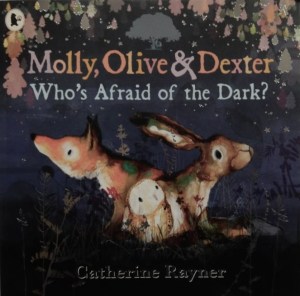
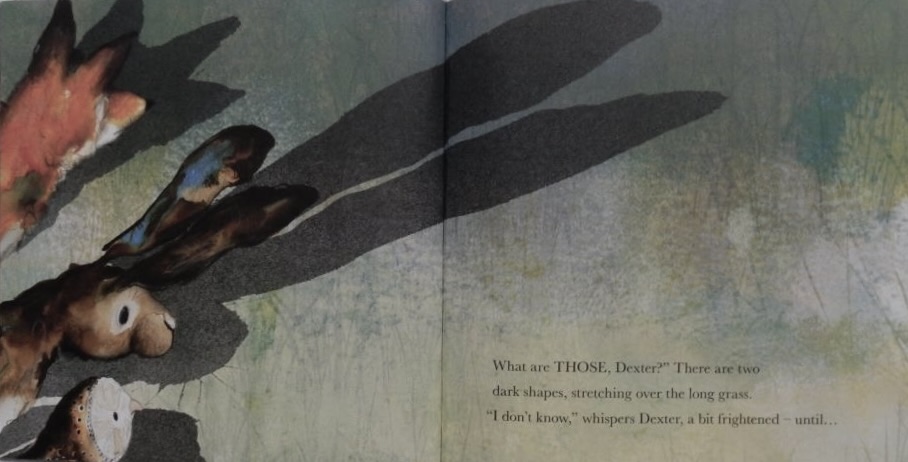
Friends Molly the hare, Dexter the fox and Olive the owl return in a tale of nighttime nerves. It begins with the three enjoying watching the sun setting, but as darkness descends, Molly hears a rustling sound that troubles her. It’s only Dexter cleaning his whiskers. Next Dexter feels something brushing against him and before long, Olive too is spooked though it’s merely shadow shapes. (They are made by Molly’s long leporine ears.)

Then comes rain whooshing down accompanied by thunder – another alarming experience – but eventually the friends realise that their sensory experiences are created by harmless things. The story ends with the three woodland pals enjoying something together before resting beneath their massive oak tree at the forest edge.

Young children too have night-time fears and this fun picture book, with Catherine Rayner’s watercolour scenes where the friends’ expressions – Molly’s in particular – show superbly their growing panic as the tale progresses, is perfect for sharing as a pre bedtime tale.

Molly, Dexter and Olive are endearing characters and their evening episode is ultimately reassuring. Add this book to early years collections and family bookshelves where there are young children.

Small Wonder

Tick, who is ten and his younger brother Leaf, (fivish) were cared for by their grandfather in a cottage on the farthest edge of the forest until he died. Thus far their life had been peaceful but then a fleet of black-sailed ships appeared on the horizon – the Drene warships – and what Tick calls a Hunter is on the prowl: it’s time to leave, destination the King’s Keep.Grandfather had warned that this day might come and now they have just six moons to reach the mighty fortress built by the previous ruler, Good King Avery, before the drawbridge is pulled up.

Readers follow the boys’ journey on their trusty steed, a dapple grey mare, Pebble, as they flee from all they’ve known. A terrifying and testing journey it truly is, full of adventure and with only a rough idea of how to reach King’s Keep, they travel through forest, grassland and around mountains. There’s snow to contend with, bandits, strangers who may not be what they seem, and more; but all the while Tick has in mind that he must honour his Grandfather’s last words,”If you have one chance, then you have to make it count.”

Can they both reach their destination in time or will the Hunter or the snow get them first? Assuredly it will take all Tick’s determination and courage, but eventually arrive, they do, in no small measure thanks to Pebble. By the time they get to the Keep, Tick has learned more than he ever imagined possible and is ready to face whatever comes next.

With the twist at the end, this is a truly brilliant adventure story, Ross’s best yet in my book. Thoroughly recommended for older readers and it would make a terrific read aloud to share with an upper KS2 class.

Beastopia

Digby Griffin is devoted to his pet mouse, Cheddar, and has been ever since he discovered her making a nest in his sock drawer. However as Digby’s tenth birthday is fast approaching he is troubled by the thought of The Curse of the Tenth Birthday -that’s the day on which Cheddar will be struck and disappear just like Digby’s elder brother’s budgie and his older sister Mog’s snake. Determined to keep Cheddar safe, Digby decides to stay up all night on his tenth birthday eve and also invites his best friend Tai for a ‘sleepover’ or rather a ‘watchover’.

Suddenly Grandad calls from downstairs asking for assistance. Digby is surprised to see him standing in a smoke filled kitchen clutching what appears to be a duck-billed platypus. This, Grandad thrusts into Digby’s hands as he attempts to deal with the cake mess in the oven. However the creature wriggles free and disappears into the basement. Aware it’s not the first animal to have done so, Digby is puzzled about what happens to them and decides to investigate sometime later.

That happens during the sleepover when a small present and a note are left in his bedroom. The present is a simple phone on which are two messages. As he reads them, Cheddar starts wriggling, then disappears downstairs and seemingly into the washing machine wherein Digby is sure he sees a tunnel – a portal, he suggests. Grandad appears on the scene and thus begins for Digby, Mog and Tai an entry test to become apprentice guardians of Beastopia. Beastopia, Grandad tells them is a sanctuary for magical creatures who can no longer hide in the human world, and he is the guardian.

After a strange journey, Grandad finds Mani, (a kind of walking book) that’s to watch over them, then leaves the recruits and heads off on a mission concerning the Loch Ness Monster.
The trio must then face three challenges as part of their assessment. the first being to collect dragon smoke. The second is to harness a basilisk, the third is to feed the fairies and keep them contained; but these fairies are of the troublesome kind and have an unusual diet …

Can Digby, Mog and Tai possibly succeed in all three challenges and thus become apprentices; several times the odds are stacked against them and nothing is as it seems … They’ll certainly learn more about themselves.

The book ends on a lead in to the next adventure for Digby et al, Beastopia The Ice Phoenix.
Exciting reading for young readers who love adventures involving animals and magic, with humorous illustrations by Jenny Taylor adding to the fun.

Tomorrow’s Ghost

It’s the summer of 1976 and twelve year old Anna who is living with her Aunt Maggie, is to go and stay with Auntie Em, recently retired and moved into an isolated cottage in the countryside. Aunt Em tripped and fell over her new dog while the two were out walking, has badly sprained her ankle, is hardly able to walk and needs help. As a consequence, Anna packs a bag and sets off to somewhere she’s never been to stay with someone she barely knows: not a happy prospect, spending the summer far from her friends. However Peartree Cottage is a welcoming place and Anna likes her room.

Soon she starts having vivid dreams about a girl from 1919. The girl, Etty, lives with her harsh, unloving grandfather in a mansion surrounded by statues. This house, steeped in sadness, seemed to be calling to Anna. After five dreams, each more vivid, she is determined to find out what happened to Etty, even if it means telling lies about where she’s been to Aunt Em. Later on Colin from the village shop offers to take Anna swimming and strangely she finds herself being irritated by this.

Then at the library she learns from the librarian, of a terrible fire that destroyed much of Featherstone Manor with almost everyone getting out safely. But what of Lady Henrietta, who was twelve at the time? The only way Anna has a chance of saving her from a terrible and untimely demise is to find a way to communicate with her. A mirror she’d seen in Etty’s bedroom, perhaps …

Gripping, haunting and powerfully atmospheric, this story will have readers on edge until the final chapter reveal. I read it in a day, so bound up in the fate of both Etty and Anna had I become.

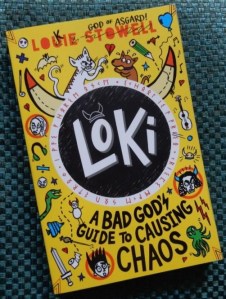
Loki: A Bad God’s Guide to Causing Chaos

In Loki’s latest month of diary entries, each one begins with a Loki Virtue Score card (virtue points are awarded for good deeds and taken away when as Loki says, ‘I do anything fun’.) This month we find Loki behaving in a very strange way and unusually it’s not for the most part of his own volition.

When newly appointed guardian, Freya, turns up, she’s wearing a necklace, one with magical powers and pretty soon things start turning chaotic. Friends Valerie and Georgina suddenly become enemies, Heimdall intends declaring his love for one of the teachers, Mrs Wiliams, The Giants suddenly love Thor and vice-versa, and Loki’s sworn enemy, Vinir, follows him everywhere offering him gifts and an invitation. Then Loki wonders if perhaps he does now like his new admirer after all. All the while Loki is endeavouring to break whatever spell is causing the chaos.

My head was spinning by the time I got to the end of this only to find the words, ‘TO BE CONTINUED … ’
Hilarity rules in this fifth story and it’s made even funnier by the liberal sprinkling of Louie Stowell’s drawings. Older primary readers will, like this reviewer, giggle their way from Day One where we see a drippy nosed Loki saying, ‘I card breade!’

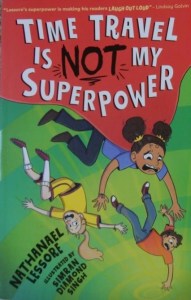
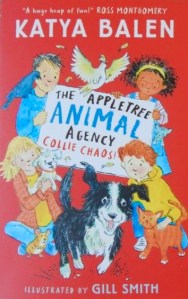
Time Travel is NOT My Superpower / The Appletree Animal Agency Collie Chaos

Sara, the young narrator of the second story set in the town of Walsham where special powers are part of everyday life, is working on improving her recently discovered superpower – teleporting. Thus far she is able to teleport herself but is unable to take any objects with her. However trouble starts when she accidentally teleports not only herself but her best friends, Georgie and Javier, as well as Jock her arch enemy, back in time to 2002. It’s crucial that they don’t interact with anybody, so nothing in the future is changed. However how is that possible when you find you’re at someone’s birthday party, a boy called Herman, someone that you don’t know. They eventually get away though, back to the present day, or is it? If it is, then why is Sara’s Mum wearing flip-flops and her Dad dressed in a parking warden’s uniform? They’re supposed to be superheroes. And as for being fed Brussels sprouts – don’t even mention the F__T word.

Something definitely is wrong, so how will Sara get herself and her companions in this muddle back into their proper universe.

With giggles aplenty both verbal and visual, this will go down well with KS2 readers who enjoy crazy adventures.

It’s winter and we’re back in the village of Mossdale where Appletree Agency have three new clients on their list – Algernon, a ten year old terrapin, Crumpet, a cat that’s something of a diva, and Domino, a dog with three legs. Domino is allocated to Mrs MacDonald but it’s not long before he escapes. The team load up with pet supplies, a compass, snacks and other useful equipment and off they set into the snow: Appletree Agency on the case.

They decide to follow a trail of threepaw prints and thanks to Luca, eventually track Domino down in a field belonging to the curmudgeonly farmer they’d already had a run it with. The dog makes it clear that the children should follow him and he leads them to discover a boy they’d seen earlier but now he’s injured.

Eventually having taken him to safety, the Appletree team learn that the boy, Finn, is staying with his grandpa, the very farmer they’d upset. Moreover he’s an animal lover. Finn was eager for a pet of his own and with Domino forming a bond with him it felt almost like he had one. Then the Appletree Agency members have an idea, an idea that will make everybody happy. But that’s not quite the end of this story …

A wonderfully heart-warming adventure that is perfect for pet lovers who like a touch of humour as well as passion in their stories.

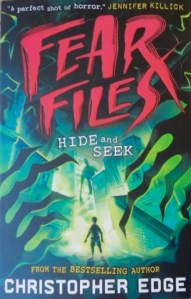
Fear Files: Hide and Seek

Based on the Darkive (a secret database filled with testimony recovered from survivors of inexplicable phenomena), this story is really going to get your adrenalin pumping. From the outset readers discover that this is to be a Level 4 Rated File ie it’s in the ‘Beyond Fear’ category.

Sol and Adam (from whose viewpoint the story is told) are spending the weekend on a camping trip. Adam is not at all happy with things having expected some degree of luxury and has ended up in a muddy field.

After a restless night, they go exploring and come upon an abandoned ghost town where, against Sol’s wishes, they find themselves involved in a really scary game of hide and seek with rules they don’t know. Soon Adam is desperately searching for his friend among weird statues, uniform clad children and the eerie voice of the “Itter” filling his consciousness. Even so, he must find Sol and get out before the Itter finds him. Seemingly though there’s no end to this game but is it a dream, some sort of trick, Adam’s imagination or a horrific reality?

Full of suspense, this is truly gripping reading with a mix of witness accounts, interviewer notes and black and white illustrations, though I definitely wouldn’t recommend this to the faint-hearted or as a pre bedtime read.

The Bestest Big Brother, Ever

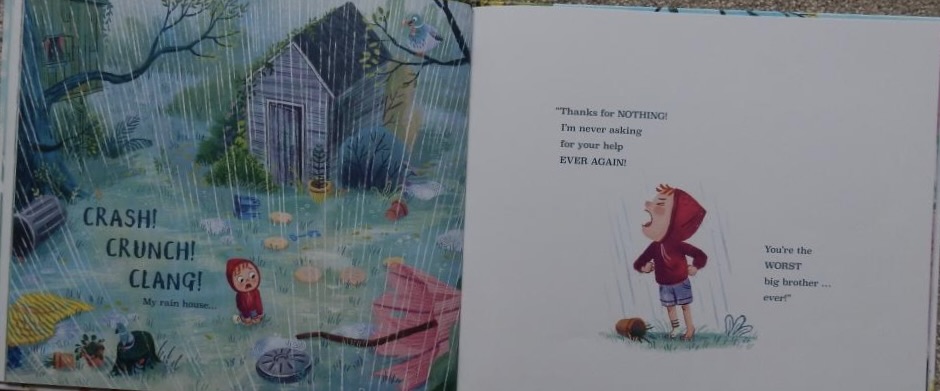
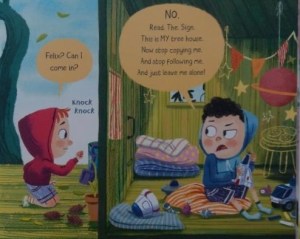
This is told from the viewpoint of Nano, the younger of two brothers. He and Felix are, so he tells readers, best friends who can read one another’s minds and have some ‘super secret code words’. Sometimes though Felix wants some space of his own, something their Mum agrees with after Nano is so upset at finding himself shut out of the treehouse having spoiled the picture Felix has drawn. However the message he gets when trying again to gain entry to the treehouse, ‘ … Now stop copying me. And stop following me. And just leave me alone!’ could’t be clearer.

Off sets Nano to build his own tree house but the one he makes is far from weatherproof. Nano’s shouts for help go unheeded and as a result, Felix has gone from being the bestest big brother to ‘the WORST big brother.’

Off goes Nano to sulk in his bedroom. Then after a while up comes Felix and what he shows Nano is something TOTALLY GRAPE! – convincing him that after all, he is the bestest brother and his best friend – most of the time.

Ben Mantle’s capturing of a common family situation is pitch perfect; told with gentle humour and some wonderfully whimsical wording such as ‘totally grape’ (really great) and ‘fancy-pants umbrella house!’ His scenes of the ups and downs of the relationship are full of fun details including Nano wearing one sock most of the time, two pigeons having a tug of war over a worm and the child-made boils hanging from a tree branch in the garden. Assuredly a story that will resonate with countless families.

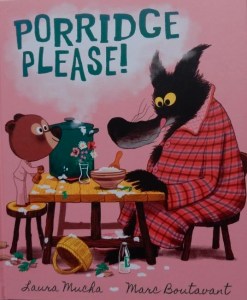
Porridge Please!

This is a terrific fairy tale spin off featuring a host of favourite characters that visit a little bear who is trying his very best to read the last page of his new book. The poor bear has had a continuous stream of visitors each wanting some of his ‘sumptuous scrumptious porridge’

as the Little Pig calls it when he comes a KNOCK KNOCK KNOCK knocking.

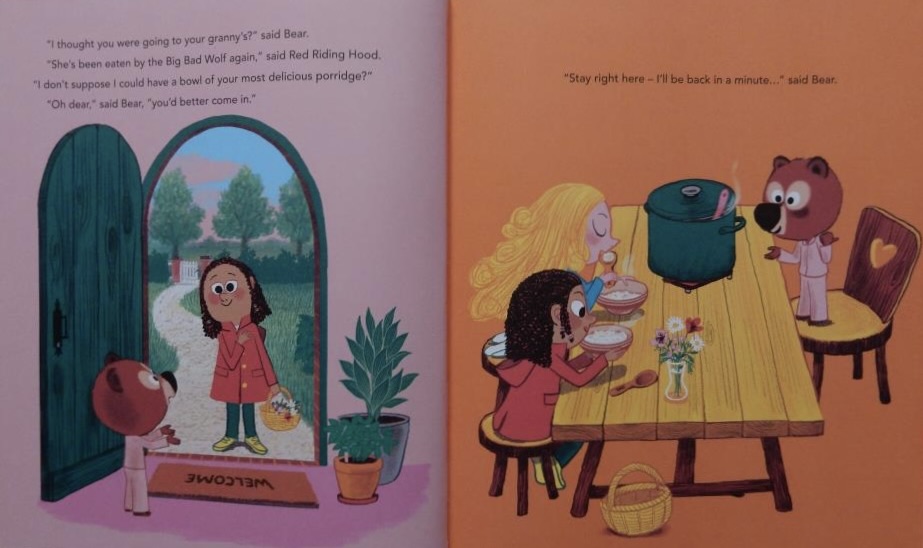
Having kindly fed Goldilocks, Red Riding Hood and three pigs,

Bear’s feeling frazzled when there comes yet another visitor – Granny supposedly – telling a tale of woe. But suddenly a realisation dawns: ‘THAT WASN’T GRANNY. Red Riding Hood said she was eaten by the Big Bad Wolf’. Time for some quick thinking and a clever ploy from Bear.

There’s so much to love about this book: Bear’s problem solving, his love of story books, and the tastiness of porridge: three vital ingredients in Laura Mucha’s telling and Marc Boutavant’s hilarious scenes of of the dramatic events.

In case you’re wondering whether Bear ever did get to read that last page, you’ll have to get your own copy of their book to find out. One thing that is certain though is that young listeners will endorse the READ IT AGAIN! plea on the final endpapers.


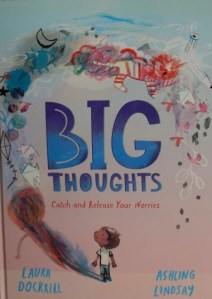
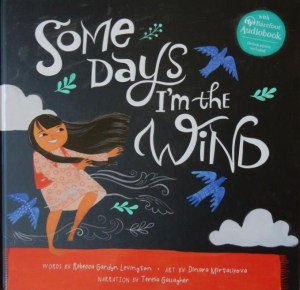
Big Thoughts / Some Days I’m the Wind

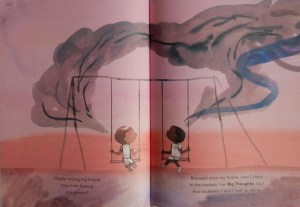
We’re all beset with worries from time to time – ‘Big Thoughts’ as the child narrator of this books calls them. Such thoughts can’t be seen by others despite them being loud inside your head. They might be Big Thoughts about the future, the past or perhaps even make-believe (not telling the truth). Moreover the more one tries to ignore such thoughts, the louder and more all embracing they become.

So what can be done to alleviate a very worried mind? One way is to share them with a an older person who has learned some coping strategies. Strategies that can be passed on and will then stay with the sufferer henceforward. Another way is to talk with a friend who has suffered similarly, so neither person feels alone.

Laura Dockrill’s text is such that readers/listeners are made to feel the centre of attention – seen and heard – and together with Ashling Lindsay’s sensitive illustrations and the final spread entitled Tips and Techniques’ make this a very reassuring and helpful book.

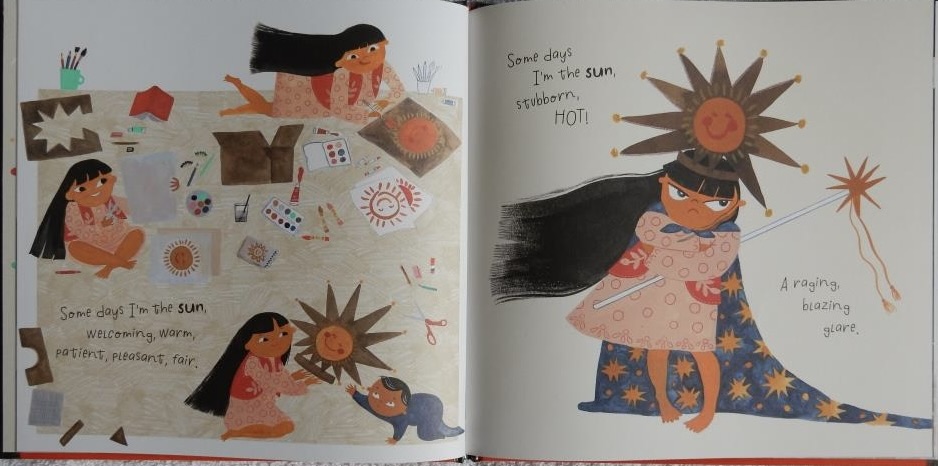
Using metaphors relating to the weather and the natural world, the young narrator of this book tells us how her feelings and emotions can change from day to day or perhaps several times in a single day. “Some days I’m the sun, welcoming, warm /patient, pleasant, fair. // Some days I’m the sun, / stubborn, HOT! / A raging, blazing glare.’

Or, ‘Some days I’m a tree, / flourishing, strong, reaching for the sky/ // Some days I’m a tree / trembling, bare, / bidding leaves goodbye.’

The well chosen, child friendly metaphors combined with the repeat ‘Some days’ of the gently rhythmic text and the vibrant, boldly coloured illustrations, keep readers turning the pages as they, like the narrator come to understand that there are a whole multitude of ways to feel, to act and to be. This is reaffirmed in the final proclamation, “And just like the wind, / or the sun, / or the sea / on some days / I’m some ways, / but all days // I’m me.”

After the child’s narration is a spread entitled “Exploring Our Emotions’ written by a child development specialist. A book to share and talk about at home, or with an EYFS or KS1 class.

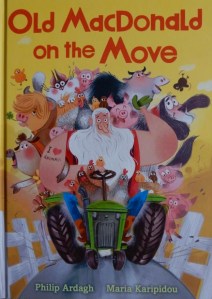
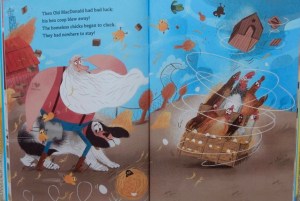
Old MacDonald on the Move

Philip Ardagh has taken the popular nursery rhyme and twisted it hither and thither to create a zany new version.

Nothing, it seems, is going right for Old MacDonald, (now an aging fellow) when his beloved farm starts crumbling before his eyes. First it’s the leaking barn roof. So to save his cows from the continual drip, dripping, he takes them off to a grand hotel for a couple of weeks while he attends to the leak. Next, the pigsty begins to sink, so the pigs are taken to join the cows, followed not long after by the loss of the hen coop.

Then the creek runs dry so, on account of no water and thus no grass, the sheep too are taken to become hotel guests.

Back at the farm Old MacDonald looks around. Enough! he decides. He puts the farm up for sale and moves out forthwith. Now, where will they all live … It’s in their happy ever after home. E-I-E-I-O!

Young children will delight in joining in with the animal sounds and repeat refrains, as well as watching the drama unfold in Maria Karipidou’s hilarious, contrasting scenes of the farm and the hotel. Look out for the mice and their diverting antics.

A Totally Big Umbrella

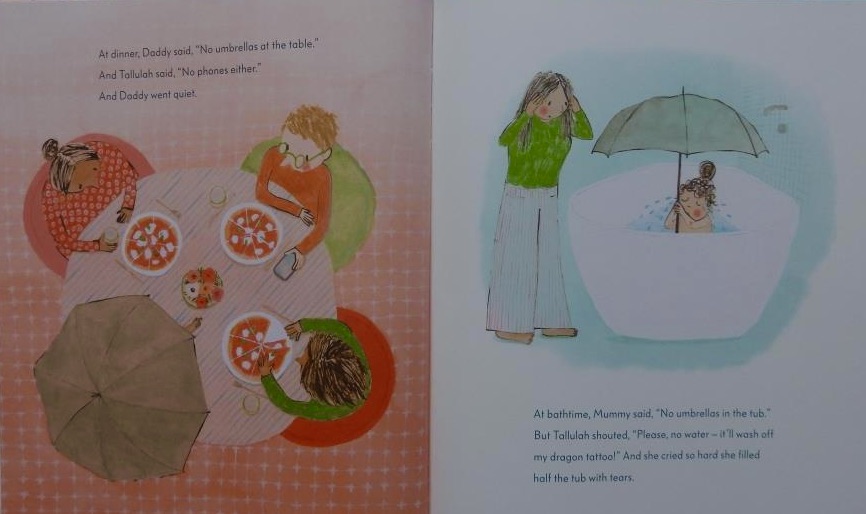
Tallulah hates the rain; it spoils things for her and after a downpour she dashes inside to her Grandma and asks to borrow her umbrella. Grandma says that the rain has stopped, but Tallulah explains that if it starts again, ‘her life will be ruined’. The girl insists on carrying around the brolly no matter what. However, walking about clutching an umbrella presents Talulah with challenges aplenty, outside, in the classroom and at home.

Nevertheless, back she goes to Grandma, still very concerned and her Gran finds her a larger umbrella and a teapot. Talullah’s worrying continues and so does her brolly carrying.

Then comes the day of Grandma’s party and guess what; down comes heavy rain. Up goes Talulah’s umbrella and she takes cover. However, nobody else seems to be particularly bothered by the downpour.

A realisation dawns: maybe squelchy rain-soaked parties can be fun after all and her constant worrying about the rain means that she’ s missing out on so much.

A sensitively written story infused with gentle humour that is ideal for sharing with young children who will see how it can take some time to overcome anxiety, be it about rain or something else. Sharing ones feelings with a trusted adult or friend is the best way to help manage them. Rebecca Cobb’s portrayal of the endearing Tallulah and her emotional learning journey are truly captivating: I love the range of view-points she has used.

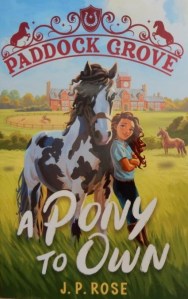
Paddock Grove: A Pony To Own

Georgia Harris (George) is thrilled she’s been awarded a scholarship to Paddock Grove, an elite equine boarding school. She’s far less thrilled though when instead of her beloved Timmy, the horse she’s already bonded with, her parents, (unable to afford Timmy) have bought her Bear, a mischievous horse also from the local riding school. Bear loves to get muddy all over and even does so on the day George is to start at her new school but that’s just the start of her troubles. When she arrives at the school parking area, Mrs Hawksworth, the headteacher of Paddock Grove greets her with the words “Miss Harris. You and your pony have made quite the entrance.” Fortunately though, soon after, Katie arrives on the scene and her kind manner as she shows George around, makes the newcomer feel a lot better.

She discovers that she’ll be sharing a room with three other girls one of whom is Katie. The others are Tabitha (who seems a tad cautious but has a big heart) and Lili whose home is on a small island near Fiji.She appears to be keeping things about her family life to herself but has a playful nature and is very enthusiastic about riding. The four roommates make a great team. But can George and the mischievous Bear become a team too? That is a vital if George is to keep her place at the school and there’s definitely one girl who does not want that to happen.

This first of an equestrian series is really well crafted and the storylines cleverly interwoven. I’d not read any other books by J.P. Rose; now I’m eagerly awaiting Riding For Gold, the next in this series.

Five Little Friends

What a treat for anybody who wants to get young children moving their hands, arms and sometimes their whole bodies, and using their imaginations too. This collection of thirty five short rhymes that cover all manner of topics both of the everyday and those full of drama, from tree climbing to teeth brushing, a bubble to a bike and a snake to snow.

There’s a wealth of lovely, playful language such as this from The Waterslide – ‘I’m sliding, sliding, sliding, / in a slipping, speeding flash. // Then I’m out the end / and ready for the … SPLASH!’

I had to laugh to myself as I read On My Phone that encourages young children (for the duration of the rhyme I hasten to add) to imitate the adults around them: it includes the lines ‘On my phone I listen music / and hear messages from my boss’ and concludes ‘I am on my phone so much / I think it’s stuck to my hand …’

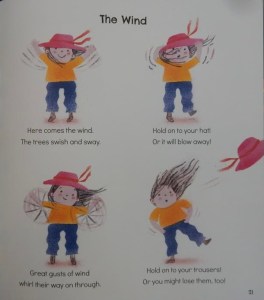
The way Fiona Woodcock has incorporated visual cues to suggest actions for the rhymes into her mixed media illustrations is nothing short of genius. See how she presents The Wind –


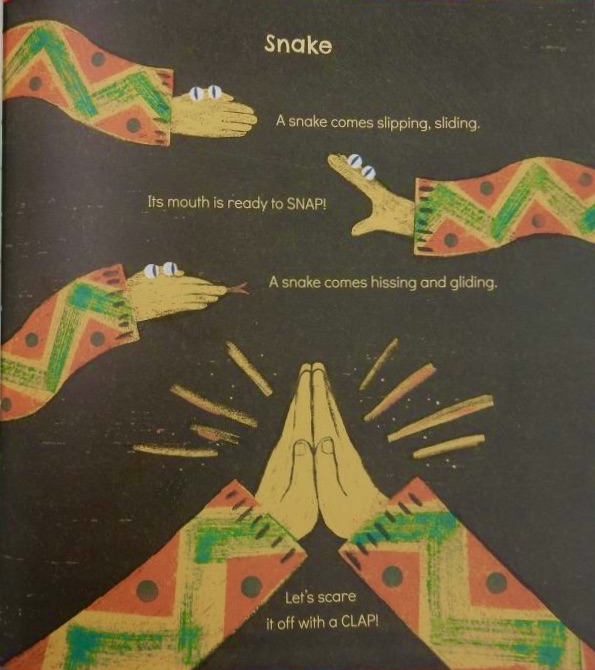
Totally different but equally clever and highly effective is the Snake portrayal –

Teachers, librarians and carers have long used finger plays and action rhymes with young children; this new collaboration from Sean and Fiona offering hours and hours of enriching fun is a must have.

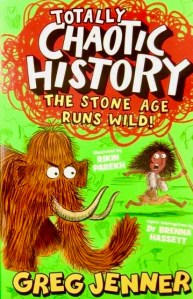
Totally Chaotic History: The Stone Age Runs Wild!

In this third book of the series, author Greg Jenner is aided and abetted by Dr Brenna Hassett, archaeologist and biological anthropologist whose voice is a great complement for Jenner’s chatty style.

Almost immediately many readers will find that what they thought they knew about the Stone Age is actually wrong. For starters scientists don’t use the term ‘Stone Age’, rather they divide it into eras and so we read, ‘there were loads of different species of hominids appearing, dying out, exploring new lands, inventing new technologies and experimenting with new ways to live.’

You’ll discover amazing buildings such as Gôbekli Tepe – the world’s first stone temple, and visit the Catalhôyûk,

neither of which I’d heard of before.

My head was spinning long before I finished this, which is no surprise because as the author tells us near the end, things were constantly changing during the time they were writing the book and they had to rewrite things on five occasions as new discoveries were made.

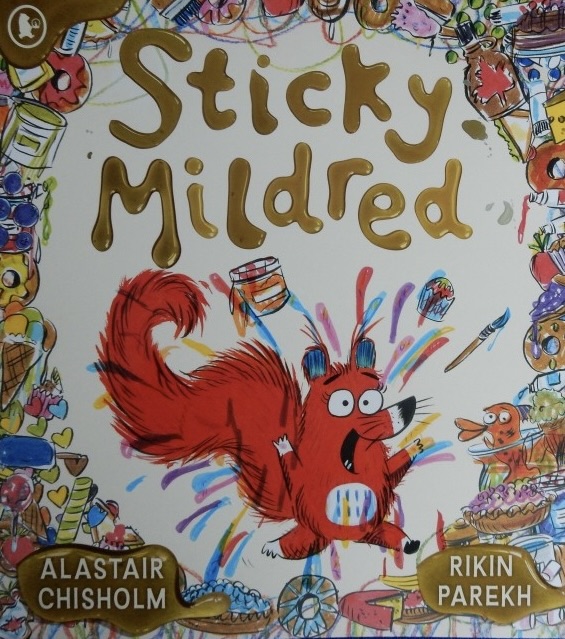
Bursting with facts, the whole thing is hugely amusing from cover to cover, made all the more so by Rikin Parekh whose illustrations are splendid. If this fails to engage children, then I’ll spend a night on that luxurious-looking stone bed. Ouch!

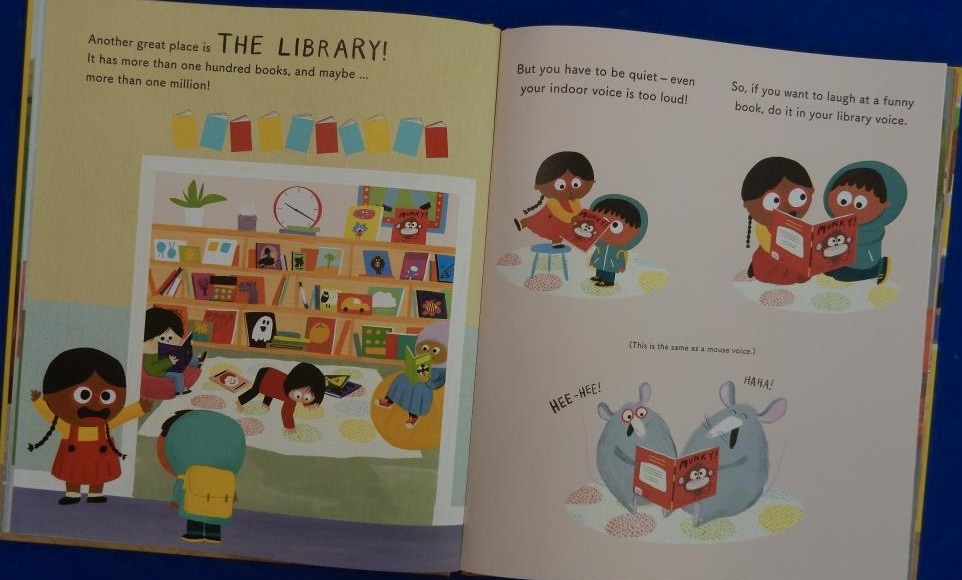
The Tour at School (Because You’re the New Kid!)

As the young narrator/guide informs us, ‘When you show a New Person around, it’s called giving them The Tour.’ The aim of this really important job is to make the new arrival feel welcome. As you might expect the tour begins with the toilets – a vital place of course but our guide feels things need to be made more fun with some additional facts such as, “The soap smells like strawberries” and there’s an ‘amazing-zing-zing’ echo when you sing (lots of people love to sing in the toilets after all).

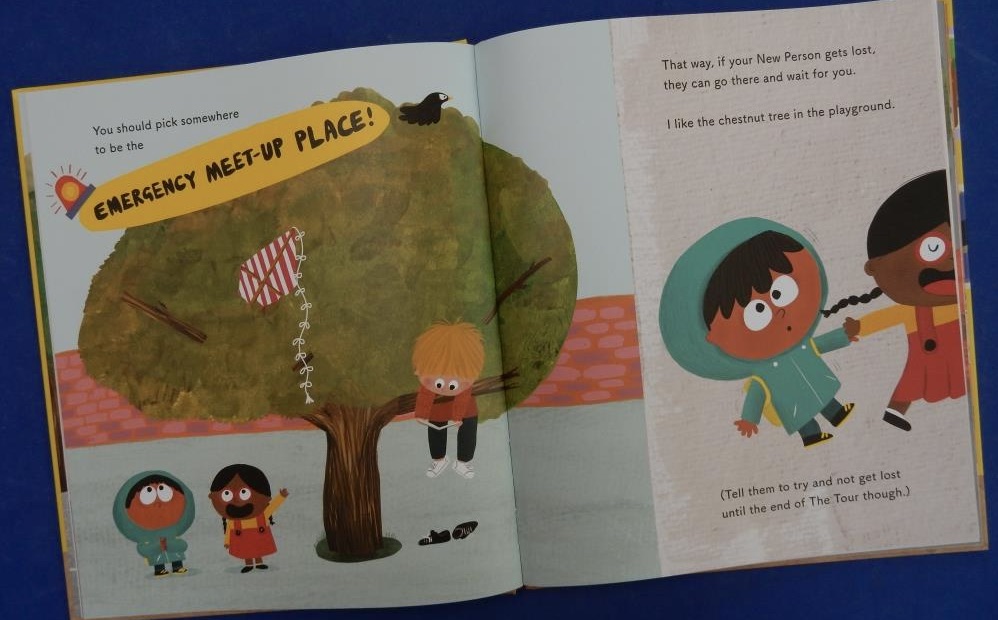
The next most important task is to decide on an ‘Emergency Meet-Up Place’

but it’s hugely important too to show off the best places – the playground and the library and to tell inviting stories about them but not to take too long.

Sensitivity is key so our guide considers introducing the newcomer to someone she knows, however this sensitive guide doesn’t notice everything especially that the new person is looking increasingly alarmed, overwhelmed even and may just have gone missing. (of course readers/listeners will have noticed).

Fortunately our guide tries putting herself in the new person’s shoes and also recalls ‘how it feels not to know anyone.’ This experience she shares with the new person whom she finds in the Emergency Meet-Up Place before proceeding to answer the all important question, “What happens when the Tour is over?” For any newcomer, the response cannot be better.

A smashing story that captures so well those collywobbles that many children feel when starting a new school. Equally it’s reassuring to know that an empathetic someone will be there to help. Both author, Katie Clapham and illustrator Nadia Shireen clearly understand how it feels to be starting something new. Nadia’s choice of colour palette is great and her illustrations are hugely expressive and in tune with the words. The use of capitalisation and font size make the book a terrific read aloud to share with a class or group.

The Last Pebble

This story is set in the seaside town of Bognor on the south coast and we follow a boy named Trader who struggles to make real friends at school but is fascinated by rocks and loves spending time beachcombing with his Grandfather.

One day Trader finds a very special pebble associated with which there seems to be a mystery. Grandfather helps him clean it up but it appears that the old man knows more about the pebble than he’s letting on. “This stone will change everything,” he tells Trader as the two part company for the day. There are only a few days before Trader leaves his primary school but he manages to get through it and starts to forge a friendship with Charlotte, a relative newcomer to his school. Hopefully she will be interested in his find, Trader says to Grandpa who seems far, far away.

The next day Trader shows the pebble to Charlotte but there’s no time to tell her all about it, something he wants to do. Meanwhile Grandpa disappears returning a few days later with a piece needed to fix the stone tumbler.

Then when Charlotte and Trader are on the beach together, Charlotte shows Trader a bottle that she’s found containing a message. Who could have left such a strange message and the subsequent ones? The Mystery deepens. Can the two friends get to the bottom of it?

A compelling story, gentle and thought-provoking, a story of family, friendship and loyalty that is beautifully crafted and ideal for summer reading.

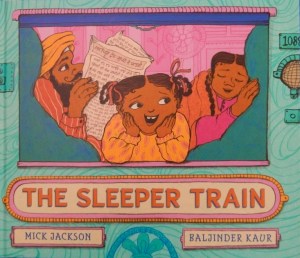
The Sleeper Train

A little Sikh girl relates what happens when she and her family take an overnight trip on a sleeper train.
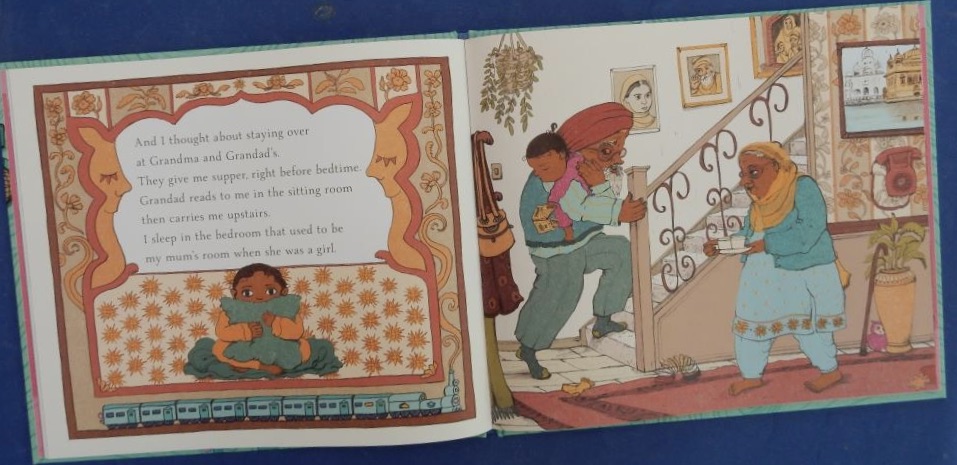
Having settled into their carriage and briefly look through the window. it’s time to open their bunks and get ready for bed. Mum and Dad are soon fast asleep but not so the little girl; she’s way too excited. She decides to bring on a sleepy feeling by remembering all the places she has slept starting with her parents’ room. She also recalls sleeping in a seaside hotel bedroom, a sleeping bag in a tent in a field, staying overnight in hospital for an operation and sleeping over at her grandparents home.

Seemingly by this time only the narrator and the train driver are still awake but eventually, lulled by the rocking of the train, the little girl goes off to slumberland. Come morning, the family dress, have breakfast and look out through he window until the train reaches its city destination.

There the family spend an enjoyable time with friends. Now the little girl has another memory to recall should she be unable to sleep on future occasions.

A warm-hearted tale of family love and togetherness. Baljinder Kaur’s vibrant scenes have lots of images that anybody who has visited India will recognise and the motifs in framed borders on many of the pages are reminiscent of block-printed designs.

Try sending your little one(s) off to sleep with this soothing bedtime story.

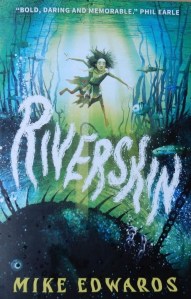
Riverskin

Green-yeller skinned Tess lives in the turns, beneath the River Tees with her guardian, darker green-skinned, spine-finned Aunt Peg and her Unkle Darkwater. So dangerous is he that he’s chained up in a pit and her aunt gives him slumber mix to keep him under control, but he’s an-ever present threat. Tess feeds on raw fish in a home furnished with ‘dry-folk stuff’ such as a ketul and other bits and pieces salvaged from the water. However Aunt Peg is getting older, becoming mind-slippy and mood-swirly so Tess can’t any longer rely on her for protection. Moreover, she starts having doubts about her true origin.

When Unkle Darkwater breaks free Tess is helped by Chris, a dry-folk boy she saved from drowning as well as extricating his bike from the nook. Now at last she begins to learn more about both herself and her true origins. When she finds out the truth though, what will she do?

I took a few pages to get used to Tess’s unique lyrical manner of telling her story but once I’d done so the drama and the world of the turns sucked me in and swept me along as I became more and more fascinated by her character and her fate.

With its roots in Teeside folklore, Mike Edwards’ debut book is exceptional and I eagerly await what comes next.

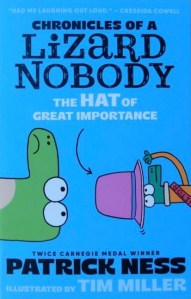
Chronicles of a Lizard Nobody: The Hat of Great Importance

At the start of this second in Ness’s wry series, when Zeke the monitor lizard’s best friend Daniel turns up at the school bus stop wearing a large pink hat, Zeke is deeply disturbed. Surely it’s only birds – the top of the pecking order – that wear hats.

However, things get stranger still with the very tall tower – the Death Ray of Death – so Daniel surmises, is being built exactly where Pelicarnassus and his mum live. Does she intend to melt the school or focus it on Zeke exclusively? Plus Zeke learns that his buddies, Alicia and Daniel are visiting the Guidance Counsellor and have been told to spend their time exclusively with one another. Poor Zeke feels alienated and persuades himself that someone is out to get him.

Then the bus doesn’t turn up the following morning, melted by the Death Ray of Death and replaced by a van driven by a shrew. When the same shrew arrives on a bike after school, saying that the van was melted in his driveway, Zeke is certain it’s not the shrew that’s the real target of the Ray of Death, (rather it’s himself).
With the focus on the dynamics of friendships and themes of mental health and the willingness to share emotions, the author also further explores social inequality especially that between the lizards that live in the poorest part of town and other creatures in the school.

Once again Tim Miller’s illustrations are as droll as the words and are sure to bring plenty of smiles to readers’ faces.


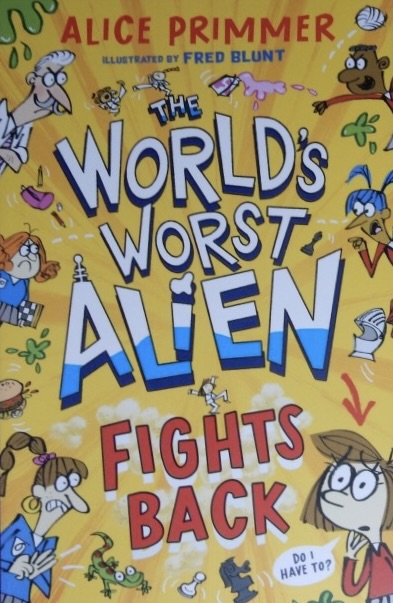
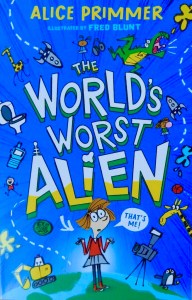
The World’s Worst Alien

This is a slice of life as lived and narrated by Sky, an alien student who has somehow created planet Earth for her school project. However, rather than the dinosaurs she hoped to find living thereon, it’s the age of humans and they appear to be doing a very good job of ruining the entire planet. Bang goes the good grades she’s desperately wanting. Sky decides to change her form and spend time on Earth, in in order to sort things out, without she hopes, having to do too much work before returning from whence she came.

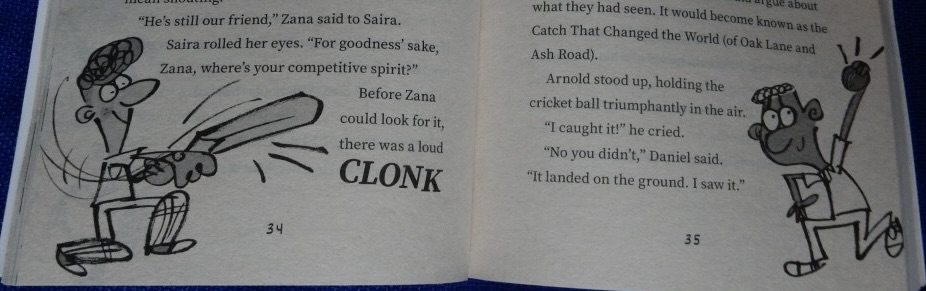
On arriving in London, she experiences cold for the first time and the attire she’s wearing is modelled on the gear worn by YouTube influencers and so totally inappropriate for the climate. But as well as having no name and no place to live, she has no clothes to change in to and off she goes to school straight to a year six classroom where the other pupils are led to believe she’s from Antarctica There she makes friends (kind of) with a girl named Zana to whom she confides that she wants to be an influencer on You Tube without having the first clue about the topic of her videos. Zana invites her new friend to stay the night with her, telling her mother that she’s an exchange student but the school forgot to book her accommodation.

From then on things get progressively more crazy and chaotic: there are unfair doings going on around her (giraffes to release from the zoo) as well as local environmental causes to become involved with.

A funny story that looks at humans from the perspective of an outsider: what though will Sky’s impressions of we Earthlings be by the time she’s completed her project? Alice Primmer’s debut children’s novel gives readers plenty to ponder on, laugh at and talk about, and there’s a plethora of Fred Blunt’s zany illustrations to accompany the silly situations Sky et al find themselves in.

Feel Your Happy

Emily Coxhead has created another uplifting book overflowing with positivity. Its narrator is a small, very endearing sloth that offers lots of practical strategies to use when things get too much. ‘When I hear a noise that hurts my ears, I find somewhere quiet to be still and calm’, is one. ‘When the world seems too bright, ‘I ask someone to read me a story’ is another

and ‘when somewhere new smells different or strange, I take my softest teddy to snuggle so it smells of home.’ – all of these will appeal to young children and help them to ‘feel their happy’. I love the reassurance given at the end of the book: ‘Your feelings are part of what makes you, YOU! Just remember to be proud, be yourself …”

Using the five senses to manage feelings really helps to make things accessible to very young children, especially when the text is accompanied by warm bright, joyful illustrations with humorous details that are as positive as the words and enable little ones to feel involved.

All children find it difficult to manage their emotions at times, so this is a book to have in home and early years/foundation stage collections.

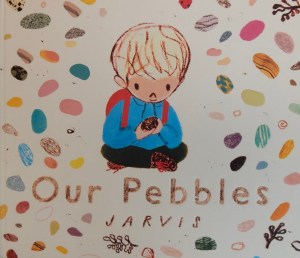
Our Pebbles

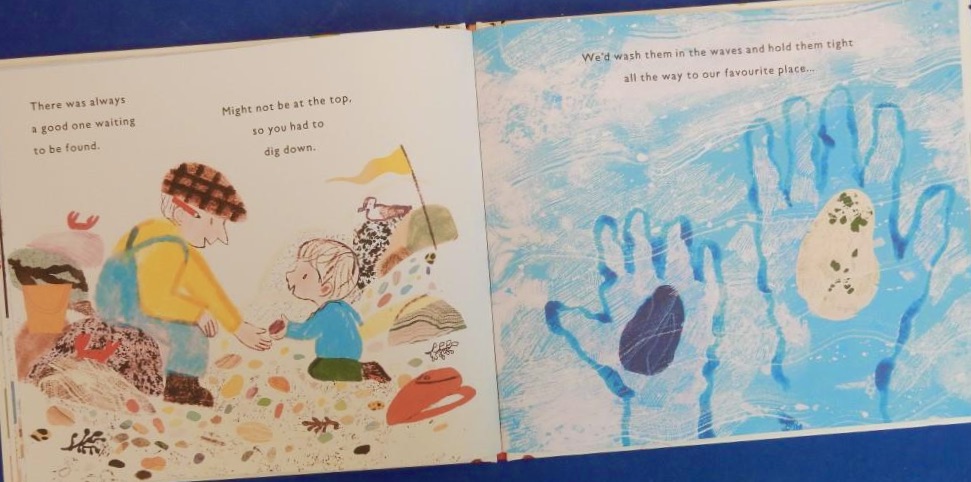
The young narrator and his Grandad loved going to their favourite place. They’d make their way through Wonky Woods, , stop briefly to wave to people on passing trains and to chat with spotty dogs, then climb over the stile when ‘Silly old Grandad’ would always say, “Careful you don’t hit your head on the sky.” Eventually they would arrive at the a place called Pebble Beach and here they’d spend the best of times together. The narrator recalls seeing a seal, playing pirates, eating ice cream while fending off marauding gulls and on every visit before leaving they’d each pick a pebble,

sit themselves in an abandoned boat – The Jolly Dancer – take out their paintbox and decorate their pebbles. These they’d add to those they’d already amassed (we see the collection depicted from above).

One day though Grandad moves away and inevitably the narrator misses his ritual, which becomes evident to his mother. She suggests the narrator takes her to see Pebble Beach and once at the favourite spot, the child selects two pebbles to take to Grandad when they visit him in his new home. There Mum gets out the paints and next time the narrator visits The Jolly Dancer there are two new pebbles to add to those displayed therein.

A beautiful, poignant demonstration of how joyful experiences can eventually become abiding, treasured memories. Jarvis’s illustrations are the perfect complement to his wonderfully warm words.

Kata & Tor

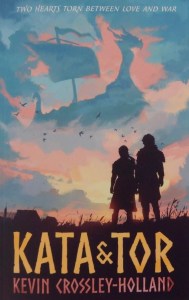
Set in 1066, the focus of this story is a failed invasion of York by the Vikings led by King Harald Hardrada of Norway and leader of the Viking fleet.. The king has sent his youngest son Tor and companion Eirik ahead as information-gathering scouts but an accident wrecks their boat and Eirik ends up dead. Unsure where he’s landed up and without a partner, Tor is at a loss to know what to do. He realises he must bury his friend but before so doing he goes wandering along the beach, discovers a hut and spends a couple of nights there before proceeding with his mission, telling those who ask that he’s come from Orkney in order to avoid suspicion.

Meanwhile Kata who knows very little about her parents, is hard at work in her village supporting herself and neighbours, yearning for something other than marriage at a young age within her Anglo-Saxon village and environs.

It’s fate that brings the two young people together and they’re immediately attracted to one another. However in such troubled times being in love with someone from so different a background and with rumours spreading about the imminent coming of Hardrada, Kata is constantly asking herself if she’s fallen for a Viking and if so, then what? Tor too has a difficult dilemma: he insists to Kata that he’s not a Viking – he certainly doesn’t want to fight – and is at odds with himself – but he has to decide where he really belongs. Can they find a way to be together?

History lovers in particular will enjoy this tale much of which, though not the titular characters, is historically accurate.

Finders of Silverthorn Forest: The Lost Treasures

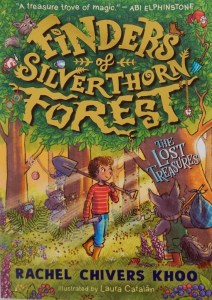
As the story opens we meet almost simultaneously the two protagonists: a small boy, Max, and the more diminutive Tuft, who wears odd shoes. It’s partly on account of this footwear that the two meet. Tuft (a Finder) is looking for treasure and Max is a passenger in his mum’s car that almost crashes into what Max mistakes for a tea towel.

Back at Grandma’s, Max continues his mission- to help her find the time capsule she buried almost seventy years ago, before she has to move out of her home. The problem is Grandma can’t remember where she buried it; maybe it was in her garden, or perhaps in the surrounding woods, or even in a treehouse in an ancient oak tree. Off goes Max in an old faux-fur coat of Grandma’s to search the treehouse but is surprised to discover it’s occupied.

Occupied by Finder, Tuftorius Snook, the very creature that Max mistook for a tea towel. Finders are woodland creatures that ‘scavenge lost objects’ that their whiskers help them find and treat them as treasure, even keeping an inventory. “Finders keepers’ is their rule. The two start chatting over tea and a friendship begins. Suddenly a lot more Finders turn up including Tuft’s grandfather, Old Grey.

Tuft persuades his grandfather that Max means no harm and on the way back through the woods, he tells Max that the next day is Domesday. When they arrive at Grandmas’s cottage Max asks Tuft for his help and a plan is formed.

The following morning Mr Pellington, the new owner of Grandma’s cottage arrives telling her that diggers are a coming and she must be out by noon. When they discover his real reason for buying the cottage, Max becomes desperate to see Tuft despite their having said their goodbyes to each other. Can they still do something to stop the entire wood being demolished and most importantly save the oak tree with that treehouse?

Another entrancing story from Rachel (I’ve loved both her previous books) with detailed illustrations by Laura Catalán adding to the pleasure at almost every turn of the page. Woven into the tale is a vital theme about tree preservation.

Alex Rider Stormbreaker

This is a silver edition celebrating the very first of the Alex Rider novels. The story begins with an ordinary fourteen year old boy being woken from his slumbers by the doorbell ringing. It’s the police with the news that his only known relation, Uncle Ian has been killed in a traffic accident. However, suspicious of the explanation he’s given, Alex starts his own investigation and discovers his uncle’s car full of bullet holes. Why kill a banker, he wonders, having just missed being crushed to death himself when his uncle’s BMW is tossed into the crusher.

When Alex climbs through a window to gain access to his uncle’s office it transpires that Uncle Ian was not a banker at all but a field agent for MI6 – a spy in other words. Before long Alex finds he’s been dragged into the world of cloak and dagger intrigue and espionage Then, having undergone an intensive programme of training, he reluctantly becomes MI6 youngest ever spy. His mission revolves around one Mr Herod Sayle and Alex sets about infiltrating Sayle’s operation and the revolutionary Stormbreaker computers set to be given to schools.

To call the assignment action-packed is a complete understatement: it’s totally gripping and has spawned a series that has become something of a rite of passage for pre-teen readers.
This 25th anniversary edition includes a brand new Alex Rider short story but you’ll have to get your own copy to discover what happens therein.

Your Forest / Your Farm / Your Island

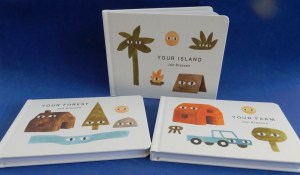
Eyes, eyes and more eyes. Every element in each of the three books has an eye, most have two and they all begin the same way. ‘This is your sun. It is coming up for you.’ Thus it positions the child reader as central to the whole.

Your Forest then gives that child suggestions to allow them to assemble a woodland scene comprising trees, a cabin, rocks, a friendly forest ghost (that only appears at night), a stream and a bridge. As the sun sets, the eyes close and the forest sleeps, all but one thing …
Sleepy time pleasure of the inimitable Klassen kind.

Like the previous book, as well as starting at sunrise, Your Farm, ends at night with the young reader receiving permission to sleep and think about the following day. Little ones then meet in turn a tree, a barn, a horse (to go in the barn) ditto some hay, a truck – in the barn too, a stool upon which to sit beneath the tree and a fence to surround everything. The sun then starts to sink, the eyes become sleepy and eventually close altogether. On the final page, it’s the moon that is wide-eyed and wide awake.

In common with the other books, little readers are given the power of creation of Your Island and it’s evident from the outset that the objects belong to the child. Item by item a palm tree, plants, a tent (to go beside the plants beneath the tree, a fire of the magic kind for it never goes out, a boat, a bird that takes to the wing from time to time comprise the island which is fully assembled come sundown. Then eyes close, the island sleeps , the reader contemplates tomorrow on the island under the watchful eyes of the moon.Another whimsical wonder to fuel the imagination and provide pre bedtime pleasure of the empowering, world-creating kind. If you have a toddler, I urge you to try all three and see … see… see.

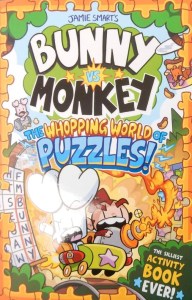
Loki: A Bad God’s Guide to Unruly Activities / Bunny vs Monkey The Whopping World of Puzzles

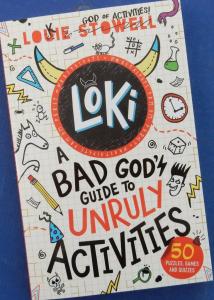
Loki’s fifth diary is rather different from his previous ones. and that’s on account of his having played too many pranks of the poo-related kind around the house. As a consequence Hemdall has challenged Loki to find ways to keep himself entertained and sent him off to his room so to do. These ways must definitely not be of the messy ie poo variety. Tedious or what? It shouldn’t be very hard though as Loki is a clever god and aided and abetted by his pals, he amasses a fun assortment of puzzles, quizzes, games and drawing activities.
There is for instance an Insult Generator with which to enjoy insulting your nearest and dearest, and Thor’s non-violent means of winning a fight to contemplate and possibly test at a later date- it’s a bum thundertron.

It’s true to say that there are activities for anyone and everyone and you don’t even need to have read the other Loki diaries to enjoy this one.

More fun and games of the interactive puzzling kind in

Herein Bunny, Monkey et al visit a secret theme park deep in their woods and human puzzlers join them as they discover this lost location. Once there they will enjoy all sorts of tricky mazes, word searches, crosswords of the cross words kind, or even try their hand or paw at creating squared paper on which to ‘embiggen’ a character like Pig.

Just the thing for a rainy day or with holidays approaching, a book to take on a long car journey to stimulate your little grey cells instead of constantly fiddling with your phone.

Ant Party

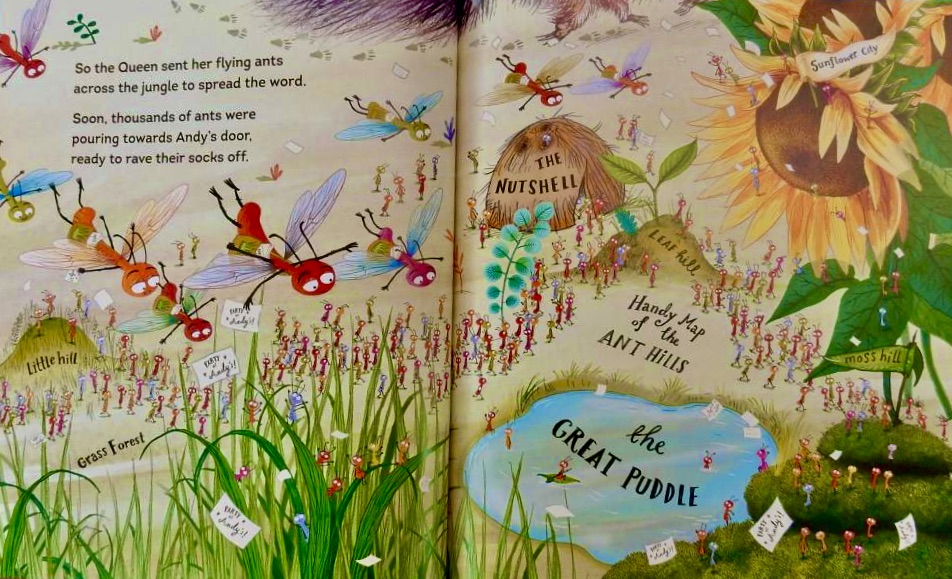
It’s Andy the ant’s birthday so he decides to throw a party – just a small affair to which only his neighbours are invited. But the neighbours haven’t any food to contribute so they invite the farmer ants. News of the party quickly spreads throughout the ant community to the worker ants, the soldier ants and the Queen. She takes it upon herself to invite residents of other ant hills nearby

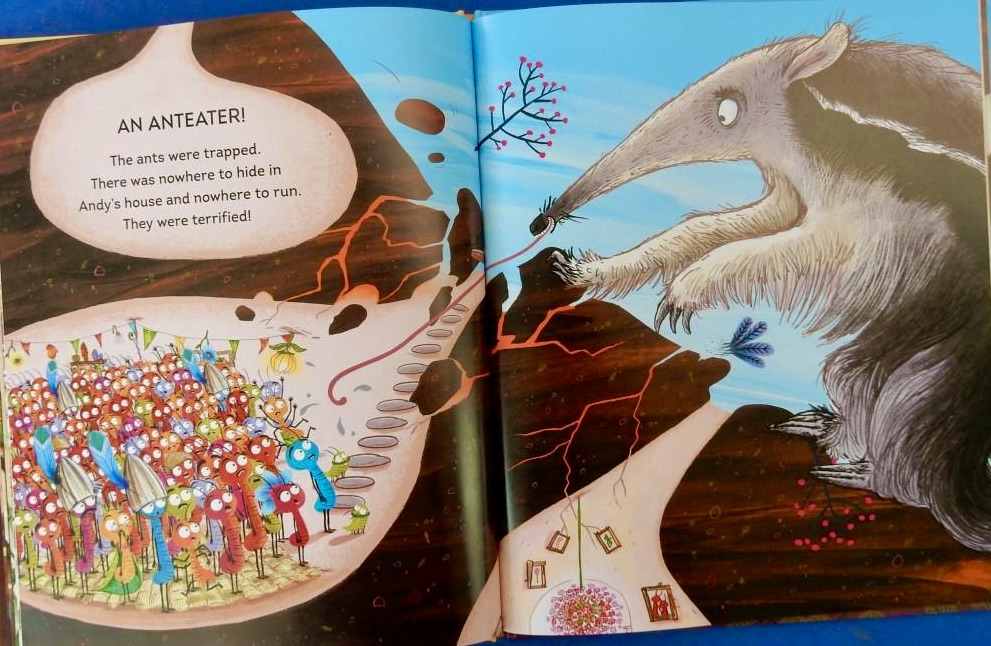
and before long there are thousands of excited ants ready for a rave. Andy finishes his preparations just as there comes a knock on his door. He can’t believe what his sees right before his eyes. In they come and immediately begin partying madly but suddenly there’s a horrifying sound that makes Andy’s house shake. It’s a gatecrasher in the form of an anteater and the ants are trapped, and terrified.

All that is except Andy who is absolutely furious. At his behest, the other ants rally round, form a conga line and the anteater gets his cum uppance. This will surely get child audiences cheering.
Having bested the intruder the ants celebrate long into the night giving Andy a terrific party, the greatest ever, despite not being exactly what the birthday ant had imagined.

Ross’s telling is thoroughly engaging and young children will adore Andy (I love his leafy apron) and the other ants, each of which Sarah Warburton manages to make different with spectacles, eyebrows, moustaches etc. Every turn of the page invites readers to linger long and enjoy all that’s going on. I’m sure this is a party children will want to go to many times over.

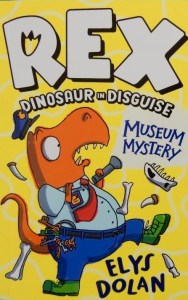
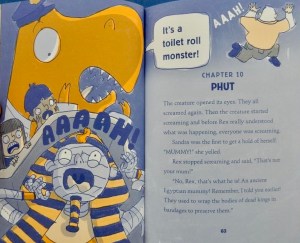
Rex Dinosaur in Disguise: Museum Mystery

This is the third tale of dinosaur hero Rex (now a PE teacher/netball coach) and his nine year old human friend Sandra, her investigations partner Anish, et al.

Rex can hardly wait for his first trip to the city museum but he and his friends learn from a security guard that strange things have been happening with exhibits moved around. The guard quits his job, Rex is interviewed and goes undercover as his replacement. This enables him to be there overnight to investigate and try to find the cause of the havoc before the museum’s biggest event of the year, The Big MuZZZeum Sleepover, the following evening. Of course he’s going to need the help of Sandra, Anish and Bigfoot.

Unexpectedly Rex makes a new friend; it’s an ancient Egyptian mummy named Amenphut 11 or Phut for short.

This mummy absolutely loves pizza but he really needs help to return to his own land; however he has an awful lot of stuff including a stuffed ferret, Imhotep. Can Rex help him catch his plane and crucially, can he make the museum sleepover the greatest ever?

With a plethora of laugh out loud moments, many of which are illustrated, this is a great book for KS2 readers. Hot chocolate anyone?

After

“Tell me agin how the world ended.” So says Jen as the story begins; this is something her father has talked of with her many times already. Now the two are walking towards the old city hoping to find food and other useful supplies. Once again Father explains how humans destroyed the world little by little, first its habitats, followed by The Flood that wiped out many of their own kind.

In the city their search of the supermarket shelves yields nothing, but the library has lots of books and Jen is fascinated by an old tablet bearing the label Seacroft Technologies. Then following an encounter with a family to whom they give all they have in the way of food and medicines, Father declares that they should find somewhere to spend the night; this they do in a deserted hotel. Come sunrise they leave, find something for Jen to eat in another supermarket and then proceed to walk, passing a number of wrecked robots including one resembling a massive scorpion. By evening they reach the edge of a forest.

As they sit together Jen notices a flickering in the darkness and urges Father to investigate. The following morning they take a detour despite Father’s concerns that they might encounter people, perhaps not friendly ones. His prediction is correct and they come upon a small community, which to Jen’s delight, seem welcoming. Among them is a boy around her age, so Jen is even more eager to join them. Father though must keep his true existence – an autonomous robot, with the appearance of a human – secret from these clearly technophobic Flood survivors. If not, what will happen?

Jen and Father are not related but have formed a very close bond even though the latter is programmed to be devoid of emotions and relies on a childcare book for his parenting. So when Father’s secrets start to unravel, Jen faces an impossible decision: Father or community? And what of that holiday camp place she’d read about in a brochure a while back?

With occasional illustrations by Steve McCarthy, this is another brilliant, entirely credible story set in a Dystopian future by the author of Stitch that is an exploration of what it means to be human; in addition however, Pádraig Kenny explores the role of AI and a possible horrendous outcome of human’s ever increasing reliance on technology.

I wonder just how far child readers think we humans should go in our never-ceasing endeavours to have a better life.

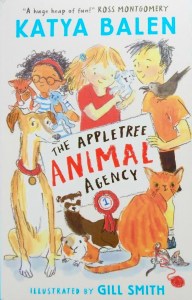
The AppleTree Animal Agency

Mattie loves animals and watches those that come to her garden in the evenings, pretending that Quilla the hedgehog, Bertie the bat and Marmalade the fox are her pets. Seemingly everybody in her class at Mossdale Primary School owns a pet and Mattie desperately wants a puppy but despite frequently asking her dad, he insists they don’t have time to look after one.

One night as Mattie stands watching her animal friends she sees a shooting star and makes a wish on it. Almost immediately through her binoculars, she glimpses a scruffy pup moving unsteadily as though hurt, but when she ventures outside to look, there’s no sign of it.

Next day when Mattie’s walking with her best friend, Zoe, and talking about the puppy, Zoe’s own puppy runs off only to lead them to the injured pup from the previous night. Off they head to the vets but find the place in a chaotic state.

A boy introducing himself as Caspar tells the girls his vet mum and he are staying for the summer while the regular vet goes to visit his poorly mum. The three children sort out the chaos while the vet tends to the injured paw. A couple of hours later everything is back as it should be to Dr Polly’s delight and she calls the three her apprentice vets.

So begins Mattie’s volunteering stint at the vet’s surgery – seemingly her dream is beginning to come true, but Luna as she’s now called, still isn’t hers. Then comes the incident of the runaway ferret: it ends happily and sparks Mattie’s brainwave – a pet-matching service at the village fete.. Zoe and Caspar love the idea and the three start working on it the following morning. Come fete day the service is a great success: is it just possible that all the animals will find suitable homes with responsible owners? Even Mattie’s beloved Luna? …

And so Appletree Animal Agency is formed.

Katya Balen’s feeling-centred story is thoroughly enjoyable and will captivate younger readers especially animal lovers. The friendship, determination and teamwork of the child characters is terrific and a great example to her audience.

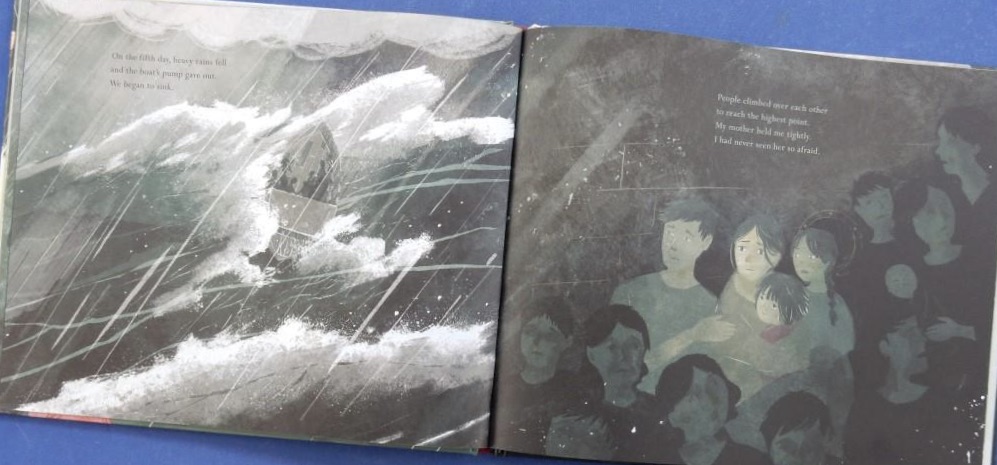
The Endless Sea

This is a heartrending story of having to leave your home and go in search of a new, safe place to live, told through the eyes of a young girl. She, her parents and sister lived in a Vietnamese village which they were forced to leave on account to being on the losing side of a war.

After a long and arduous journey walking under cover of darkness, the family eventually reached a wooden boat that was to carry them, crammed tight for four days, down a river. Then on the fifth day a fierce storm arose, the boat’s pump gave up working and the boat began sinking.

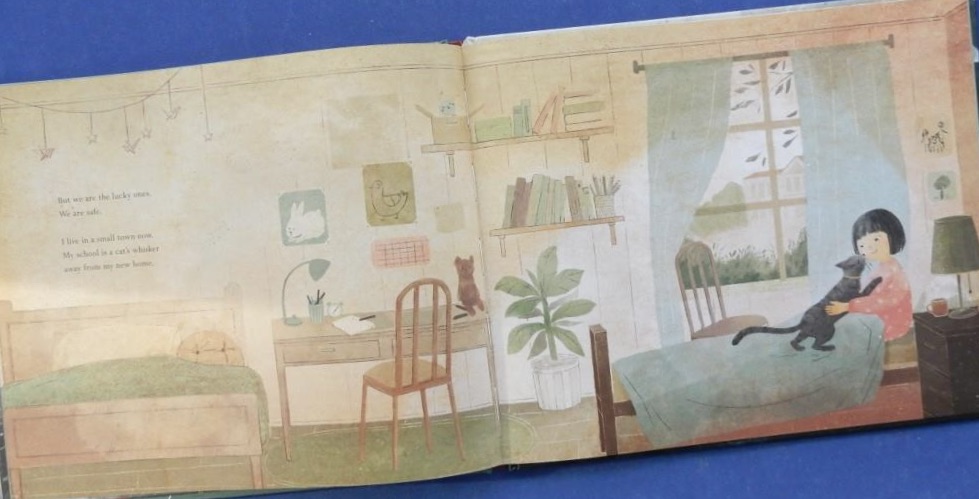
Eventually a ship reached the now rapidly sinking boat, a pallet was lowered and the family lifted to safety. The rescuing ship carried them to a refugee camp where they waited until they were flown to a new country and given a new home. Despite recalling the traumas they’ve been through, the young narrator considers how lucky her family has been

especially when a year on, they are able to celebrate New Year together, hungry no longer but hopeful and able to look forward to many more days together.

Author Chi Thai’s note at the end of the book makes it even more poignant as she writes of how she aged three and her family came to the UK as refugees, for which she is enormously grateful. She goes on to talk of the 36 million refugees there now are and reminds readers how crucial it is that they are treated with compassion. Linh Dao’s illustrations are appropriately sombre during the traumatic escape contrasting with the uplifting scenes of the family established in their new home.

A book to share widely in primary classrooms to help foster that vital compassion and understanding the author speaks of.

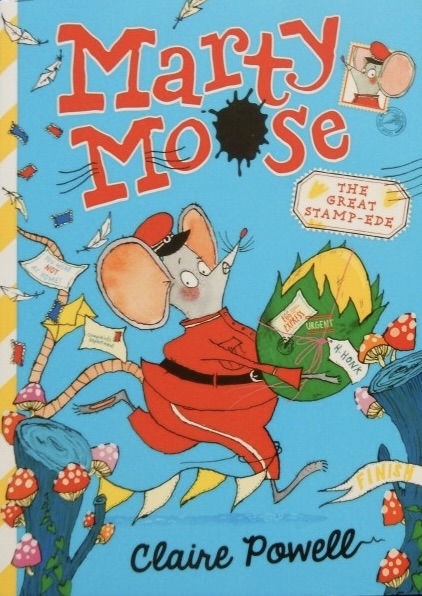
Marty Moose: First Class Mischief

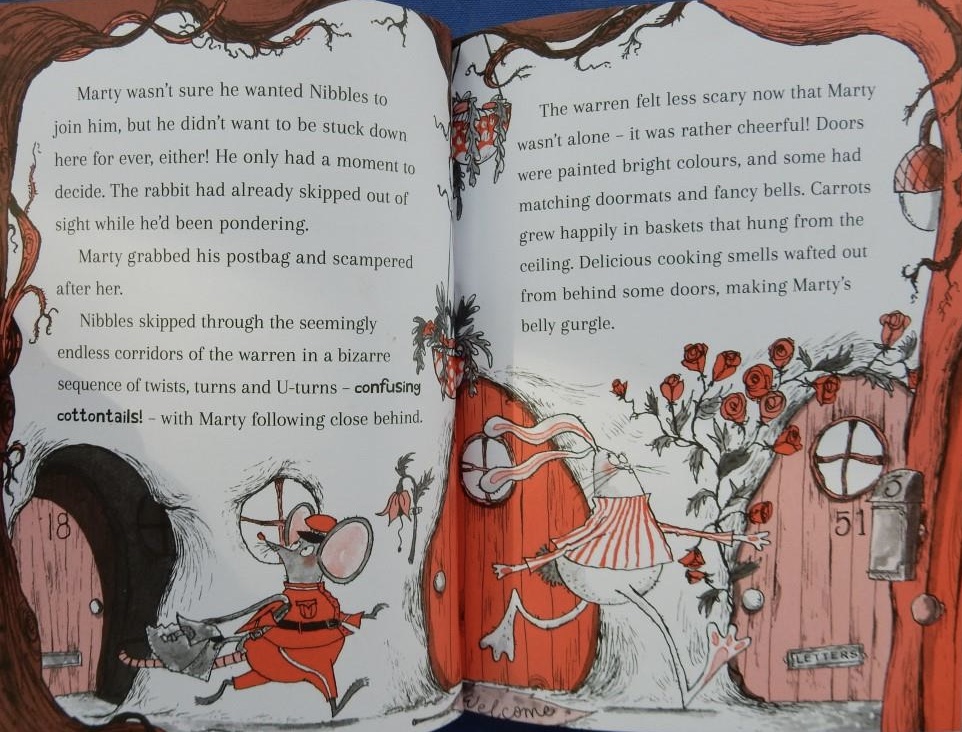
This is the first instalment in an exceedingly funny new series presented in two colours by Claire Powell. First of all don’t be misled, Marty is a mouse, not a moose – that was an ink blot on his birth certificate. We meet Marty on his very first day in the his first ever job – the very important role of Postmouse of Little Ditch. He’s particularly excited as his now retired Great Aunt Ada was reputed to be one of the best at the job.

Determined to be a first-class deliverer too, off he sets to the Post Office where his first encounter is with Cyril Snorter, employee of the month twenty seven times in a row. He also meets other members of the team who appear somewhat sneery. Then with post bag duly slung over his shoulder and instructions to leave no parcel undelivered and to watch out for rotten blueberries – no idea why – he’s on his route.
With several letters duly delivered, Marty is feeling upbeat but then he gets rather lost in a rabbit warren.

Fortunately however, he finds himself unexpectedly embraced by Nibbles Frizzly who is a trifle loopy but she does explain how the confusing number system works

and helps deliver the post. Before long they get stuck in what proves to be a booby-trapped garden where they’re caught between feuding toad siblings, Velma Carbuncle and her young brother. From booby trap to toady trap go Marty and Nibbles. Suddenly Marty recalls reading in an encyclopaedia of his, that toads are known to eat mice. Yikes! Surely his first day at the post office isn’t to be his last.
Light bulb moment! Is star employee Cyril behind all the problems and if so what should he, Marty, do?

Really fun, this zany adventure is told brilliantly both verbally and through Claire’s red and black illustrations. Younger readers (and many adults) will love this and eagerly anticipate The Great Stamp-ede, Marty’s next adventure.

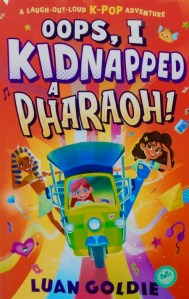
Oops, I Kidnapped a Pharaoh!

K-Pop obsessed Skylar and her best friend, Dana find themselves on a time-travelling adventure after being picked up from school by Skylar’s eccentric Nana in her tuk-tuk. One minute they’re driving back from school and the next they’re in the middle of a desert surrounded by date palms without Nana who runs a catering company and has vanished in search of ingredients for her famous ‘sweet’n’wild fig and falafel burritos’.

After their initial amazement that they’ve time travelled to Ancient Egypt, the friends start to search for Nana, adapting to the new, strange environment. On entering a large courtyard set up for a show of some kind, music begins and from behind a curtain shimmies a boy wearing a gold cloak whom they surmise is the main attraction. He proceeds to perform an amazing slick, synchronised dance routine and Skylar is inspired to join in with some K-pop style moves of her own. The crowd goes wild and the girls realise that the boy dancer is Tutankhamun aged about ten or eleven.

Having found Nana with her purchase and learned that the time travelling was a mistake, they go back to the tuk-tuk, jump in and return to their own time, only to discover that a small boy, aka Tutankhamun, has hitched a ride back to the twenty first century. What can they do about having a boy king from 1331BCE who appears to have a strange affinity with Skylar’s cat and a penchant for Nana’s burritos, to stay overnight? They put him in Skylar’s brother’s bedroom and the girls go off the Skylar’s bedroom and start chatting about their favourite K-pop stars. But there’s still the massive problem of getting the boy back to his own place and time as soon as they can. The trouble is their visitor wants some fun and when they go out, he quickly starts attracting attention at the K-Mania Food Village, so there’s not a minute to lose. It’s back into the tuk-tuk again and yes they do go to Egypt but not in ancient times, nor with the little pharaoh aboard.

With problems aplenty to resolve, the time travelling friends have encounters with Marie Curie, Shakespeare and Henry VIII, all the while making sure the tuk-tuk has the fuel to run on, in their mission to return to Ancient Egypt.

A very funny, fast-paced roller coaster of a read for older primary children or to read aloud with an upper KS2 class: I enjoyed it even more than the Headteacher story in the series.

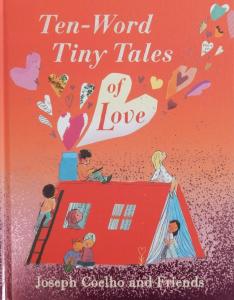
Ten-Word Tiny Tales of Love

This is former children’s laureate Joseph Coelho’s second Ten-Word Tiny Tales offering, this one having a unifying theme – love – and in an introduction, Joseph tells readers how the tiny tales came about.
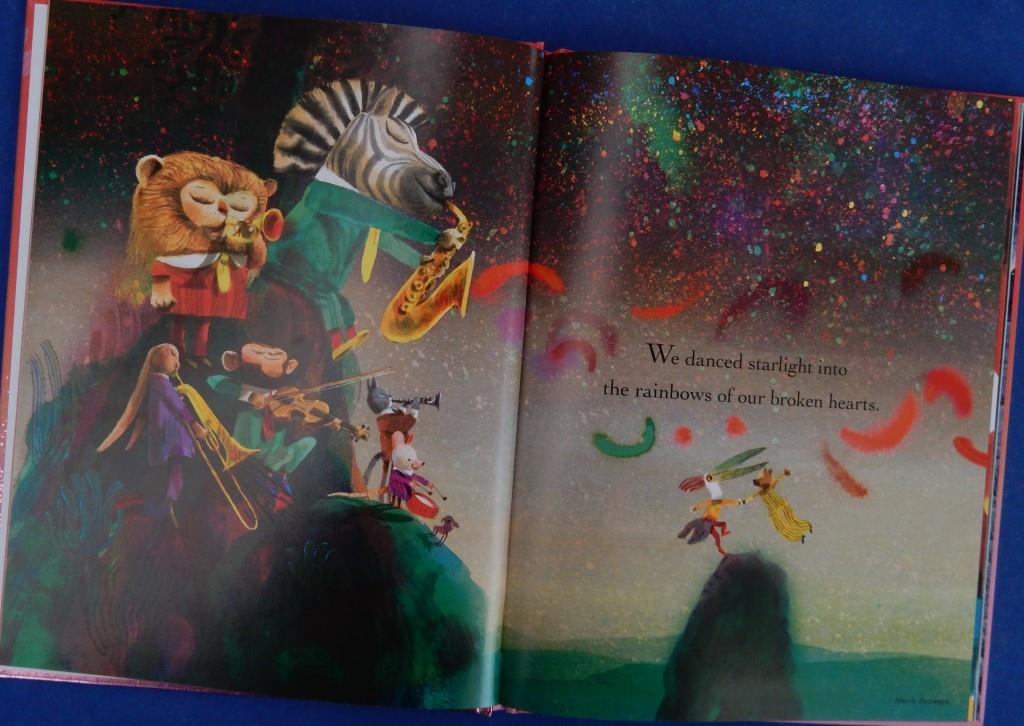
Each of the tales is moving in its own special way; you will find great sadness, tender parental and sibling love, spookiness, the fantastical, the humorous and more.

Coming from all over the world, each one of the talented artists has created an equally special, very different scene, thus making every turn of the page a verbal and a visual delight.

We see enigmatic and literal interpretations as well as ambiguity: there is love for such diverse things as a bike, baby birds and a brother,

but in every case the intention is to create a world – a space of awareness – that will spark the reader’s imagination.

To facilitate this, Joseph offers some story writing prompts in the final two spreads.
Altogether a treasure trove that holds within, a wealth of possibilities for creativity both in the classroom and at home.

Coorie Doon: A Scottish Lullaby Story

This debut picture book by renowned poet, Jackie Kay, has its roots in well-known folk songs. Subtitled ‘A Scottish Lullaby Story’, the author also uses some lyrical old Scots phraseology.
The story begins with Shona – a ‘wee bit bairn’ listening to her daddy singing Coorie Doon, till she fell asleep under ‘the huge eye o’the moon. (Corrie Doon’, the author tells us after the story means ‘snuggle in tight, tuck in.’)

This ritual happens every night and sometimes the song a parent sang would be The Tiree Love Song; other times it would be “Goodnight, Irene, … / I’ll see you in my dreams.”
As young Shona sleeps, readers too enter her dream world encountering in different places, her friends her black and white cat Flo, Marley her dog, baby Serenity and more.

Then, sixty years later it’s the turn of Shona to tuck her aged dad into bed and to sing to him, “Coorie Doon, Coorie Doon, wee Daddy” before going out the back door into the night to look at and wave to the moon.

That Shona is adopted is not referred to in the narrative but in a letter to readers at the back of the book, Jackie tells us that she imagined Shona being so, and that she too was adopted as a baby.
Gorgeously illustrated by Jill Calder, her soft, warm scenes help celebrate the small, childhood rituals and how they become embedded within us, a vital part of who we are.

Opposite the title page is a QR code so readers can watch an author video, and listen to recordings by folk singers Peggy Seeger, Claire Brown and Suzanne Bonnar. A treasure of a book.

The Greedy Wolf

Once there was a wolf (a greedy one as they often are in stories) and this one had a particular penchant for fresh young goats. So when walking past Mummy Goat’s house he heard her say to her seven offspring that she was going to get their favourite food for dinner, he was determined to make the kids his next meal. His first attempt to gain entrance was by pretending to be a post person delivering a parcel. Next (with a voice change) he told the kids that he was the ice-cream man, but again the kids kept the door firmly shut.

By now desperately hungry, the wolf resorted to pretending to be a talking rose bush with a flowerpot on his head, sent by Mummy Goat to babysit.

Finally the door started to open and the wolf, feeling particularly prickly, gained entrance, rushing inside with a roar.

Did this scare the little goats? Oh no it didn’t, they were busy cooking. Now the wolf was certain that he’d finally sate his appetite. This he did but who was the more satisfied when he departed from the goats’ abode?

Timothy Knapman’s funny updated telling of the Grimm Brothers, The Wolf and the Seven Little Kids with Jean Jullien’s illustrations of the mock-scary wolf are sure to make young audiences laugh (though the story will be most appreciated by those familiar with the original version). Serve it up in a KS1 class or at home and see how it goes down.

The Found Things / Guess How Much I Love You: I See Me

These are two Walker Books titles for very young children: thanks to the publishers for sending them for review.

One morning Rabbit wakes to find the sun shining brightly and decides to go for a walk. First though she needs to dress, but one of her socks is missing. The hunt all over her abode for its whereabouts sees Rabbit discovering various other items of clothing, each of which she dons,

but of the missing sock there is no sign. Rabbit decides she’ll sally forth without it, albeit looking somewhat strange. So strange in fact that when she encounters Squirrel and Mouse, they mistake her for a monster. However the two have a special surprise for their lapine friend. What could it be?

Young children will love Petr’s vibrant, mixed media illustrations with their cutaway parts and enjoy participating in the sock search. Adult sharers especially will endorse Rabbit’s parting joyful comment on the final spread. The book also offers a simple, interactive fun text for children just gaining confidence to try reading it themselves, once an adult has shared it with them.

It’s a lovely spring day and Little Nutbrown Hare and Big Nutbrown Hare are out together enjoying themselves. As they explore they play a game of I-spy. Between them they spot a butterfly, a baby bird in a nest and a tadpole wriggling around in the pond. While they gaze into the water Big Nutbrown Hare asks, “What else can you see in the pond?” I wonder what Little Nutbrown Hare’s response is? (The cover is a giveaway!)

A sweet story featuring team McBratney and Jeram’s two wonderful characters that celebrate their thirtieth anniversary appearance in Guess How Much I Love You, this year. (The Nutbrown Hares have also appeared in a couple of animated TV series of the same name.) Many of the adults who share this board book delight with their little ones will likely remember meeting the characters in the now classic original tale.

Magicalia: Thief of Shadows

Bitsy and Kosh’s second adventure begins with the best friends in a lesson at the European Conservatoire of Conjuring as part of their training to become conjurors – those able to wield magic by using a resource called farthingstone to create magicores. After the session they bump into Matteo, a friend who offers his help to get Kosh to his next session, Chrysalides. He ends up in a part of the Conservatoire he’s not seen before as does Bitsy who decided to go along too.

They are met by Chancellor Hershel and then two other members of staff and Kosh learns that he can choose his farthingstone. While there, the chrysalides are attacked by the Shadowsmith, a dangerous thief. Bitsy and Kosh work out what they are searching for and taking it with them, they escape from the chrysalides; but with the disappearance of the Shadowsmith, Kosh and Bitsy are deemed to be the thieves.

This leaves the two no option but to go on the run as they realise they must identify the real villain, bring them to justice and thus prove their own innocence. However, they’re up against a wielder of powerful, dark magic intent on a crime so heinous that it will affect not only the magical cosmodynamic community but also the cosmotypical world. Their mission takes them to various parts of the world – Barcelona, Sri Lanka and Washington and in so doing, will uncover long hidden family secrets and test Bitsy and Kosh both emotionally and physically as they face numbers obstacles and realise the vital importance of team work: can they succeed?

With the plot twisting this way and that, readers, like the protagonists, are on tenterhooks throughout the adventure. Jennifer Bell’s imagination is awesome and all those magical creatures, inspired creations.

I love the drawing by David Wyatt at the head of each chapter.

Mr Santa

A child wakes to discover Santa in their room delivering presents and then having ascertained it is really he, proceeds to bombard him with questions. ‘Did you read my letter? / And have you wiped your shoes?’ … ‘… want to hear me play? ? Can reindeer talk?’ …

‘Is your belly button inny or out’ (love that). Santa never gets a chance to reply so thick and fast come the questions from the inquisitive child. He agrees to a visit to his home in the North Pole, stopping en route to deliver more presents and what a magical experience that sleigh ride is. Was it real though?

What young child would’t relish such an opportunity, particularly one that offers them the chance to think up their own questions for Santa.

With his inimitable wit and whimsy, Jarvis delivers a very special seasonal gift for youngsters. They will love the dreamy nature of the ride with its open ended finale and the enchanting details such as the miniature Santa snow globe, Mrs Mouse sleeping peacefully in her hole in the skirting

and the elf guiding the reindeer to a safe landing as they reach Santa’s abode.

Imbued with the magic and warmth of Christmas, if you’re looking for a book to share with a little one, or in an early years/KS1 classroom in the last few weeks of term, this is one I’d highly recommend.

When the Stammer Came to Stay

This story is based on the author Maggie O’Farrell’s personal experience of living with a stammer.
Meet sisters Bea and Min who are very different from one another. Bea is neat and tidy and likes order; Min is scatty and loves to get messy; she’s also very fond of chatting. They share an attic room at the top of a tall, narrow house and complement one another extremely well.
One evening as the girls, their parents and lodgers are playing a board game, Min begins to speak but suddenly finds she can’t get the words out of her mouth.

Still struggling to speak some days later, Min sees something weird as she looks in the mirror: above her shoulder floats a creature and it’s seizing the words as they rise to her lips and cramming them into its mouth. How dare it, she wonders though cannot say those words. Now Min doesn’t even make the effort to talk at school, but at the weekend Bea notices that something is wrong with her sister. Bea then surmises that Min has a stammer

and so writes messages to her in a notebook She also realises that the grown-ups need to know. So begins a journey of discovery, Min and Bea working together to get to understand this creature and to try to find a solution, or rather a way to live peaceably with Min’s stammer, and to love their differences – all of what makes them who they are.
A powerful, beautifully told, hopeful book imaginatively and sensitively illustrated by Daniela Jaglenka Terrazzini.

Beanie the Bansheenie

Classic Irish folklore receives a modern twist in this wondrous tale.
‘Everybody in Ireland knows that banshees are supernatural harbingers of doom.’ Called ‘bansheenies’ when young, these little beings develop in pods that grow on the underside of a fairy bridge and when each pod becomes transparent the bansheenie will bond with the first human they see. One day though, now knowing everything about their person including when they will die, the bansheenie’s job is to appear in front of their person and ‘howl the banshee’s howl at them.’ This allows the specific person to put things right with anyone they need to and to bid loved ones farewell.

The Beanie from this story sadly has a problem; she’s knocked from her pod into the water during that vital bonding phase and thus cannot bond with Rose, her human, and absorb the information needed. Beanie does however make friends with the fish but then realises that she needs to find out more information about Rose. Months pass during which Beanie gradually forms a deep connection with the girl

but also discovers from the fish that an imminent wild storm will destroy Rose and her family’s cottage.

Can she warn her of her family’s fate and help them escape a tragic death? If so, what will be the outcome?

Steve McCarthy’s illustrations predominantly executed using a Celtic green palette, are magical in the manner in which they complement Eoin Colfer’s text and move the narrative forwards to its glorious ending.

An enthralling read for anyone from around seven or eight, adults included.

The Search for Carmella

From the author and illustrator of The Search for the Giant Arctic Jellyfish, comes a follow-up featuring a marine biologist with a passion – this time it’s Dr Rose who studies the ocean and everything in it.

Ever since she was a little girl paddling in rock pools, Dr Rose started learning that there’s joy in the very act of searching: one’s end goal is not the be all and end all, rather it’s the journey that is so amazing, indeed it becomes her way of life. In this story she seeks a sea creature rumoured to live deep in the hidden ocean depths, possibly a myth or maybe a real marine animal – Carmella.

The doctor and her team of scientists and explorers descend to the dark blue-black depths in a submersible, seeking, searching, seeing a multitude of weird and wonderful creatures in an almost pitch-black world but not ‘Carmella-y-enough’ until … it’s time to resurface.

After so many hours however, have they found Carmella?

Full of the awe and wonder of possibility and reality, and stunningly illustrated, this is a unique, almost magical take on being a marine biologist. Share with a primary class and who knows …

The Faerie Isle: Tales and Traditions of Ireland’s Forgotten Folklore

In this collection of Irish folklore you will meet all manner of faerie beings each of which has an introductory fact page that precedes the story. For example Giant tells of.their enormous height, awesome strength and fights, mentioning such as Fionn mac Cumhaill and the tale Stomping Ground relates how two cow eating giants, seen by a boy and his grandmother, fall asleep in a field. In the next field the grandmother keeps her beehives and she engineers that her bees should attack the giants, sting them so badly that they never go anywhere near her place again.

Then there are the shapeshifters of which there is an abundance in Irish folklore called piseoaitthe (charm setters) . One I found particularly fascinating is The Charmer, a silver-tongued faerie said to be the most beautiful of all the ‘good people’.

Also known as the ‘love-talker’ this mystifying faerie with his seductive voice, (supposedly a member of the leprechaun family), is able to leave a person trapped by unrequited love as was red haired Nora in the story that follows. One evening we read, she encounters a mysterious handsome stranger who charms her completely only to vanish almost immediately leaving the girl devastated to the extent that, so the story goes, she still walks the road whereon she met him, searching for her faerie lover.

Selkies, mermaids, a banshee and sheeries also wait to enrapture readers between the pages of this Faerie Isle. Anyone with an interest in folklore, especially those with some Irish blood running through their veins will be fascinated and enchanted by Sine Quinn’s text that has been richly illustrated by Dermot Flynn whose portrayals of the faerie folk range from utterly spine-chilling to alluring.

Grimm’s Fairy Tales

Inspired by her childhood in Germany, Sandra Dieckmann presents twenty of Grimm’s fairytales. most of which are well known, such as Sleeping Beauty, Rumpelstiltskin, Hansel and Gretel and Cinderella, others less so. The latter includes Jorinda and Joringel – about two lovers and a wicked sorceress, and one new to me, The Star Talers wherein a little orphan girl wanders the forest with just the clothes on her body and a piece of bread in her pocket. One day the lonely child meets a poor old beggar man asking for something to eat. She gives him the whole piece and then on coming upon a little girl who declares that she’s freezing, gives the little girl her hat. The third child she meets has no dress and the little girl gives hers to child three leaving herself clad in just an undershirt. Come nightfall, alone in the forest the kind girl stands staring up at the sky

and suddenly something magical happens: she’s clad in a new shirt of the finest linen and has sufficient gold coins to make her rich for life.

Strikingly illustrated throughout with a mix of presentations from a double spread devoted to a single picture of Sleeping Beauty to beautiful borders, with its subtle feminist twist, this is a wonderful book to buy, to treasure and to give.

Doctor Fairytale

This is a rhyming spin on favourite traditional tales wherein a young girl physician and her assistant spend a rainy day administering to popular fairytale characters. The first is Cinderella – poor thing, her feet are covered in large blisters and her toes red and raw; Goldilocks’ bum is full of splinters after breaking a wooden chair and her tongue scalded from porridge she consumed hastily.

The big bad wolf has some very nasty burns having tumbled down the three pigs’ chimney into a fire;

Snow White falls into a deep sleep after biting into a rosy apple but during the doctor’s visit it’s not the patient but the doctor who ends up feeling poorly.

After a hectic day the little physician gets caught in a heavy downpour and reaches home soaking wet and feeling really ill herself. She retires to bed and as she rests she gets a big surprise: all the patients who received her care during the day have come to pay her a visit, something she well deserves after giving each of them her kind consideration and tender care.

I love the playful treatment of the fairytales and the way Catherine Jacob cleverly adjusts some of their endings, something children will delight in I’m sure. Hoang Giang’s warm, slightly quirky illustrations range between double page layouts to vignettes and youngsters will enjoy all the playful details and spotting the additional fairy tale characters not mentioned in the text. A gem of a book to share with those who are already savvy with the original stories.

Relic Hamilton Genie Hunter

Twelve year old Relic lives in London’s Soho with his grandfather who runs an antiques business under their home. From things we learn early on it’s evident that the boy is being bullied.

One day as he’s sorting through items in the basement, Relic comes upon a box containing brass oil lamps, six small ones in the middle of which is a larger one. As he starts to polish the large one Relic unleashes a genie – a powerful one of the evil kind that feeds on people’s hopes. “What do you wish for Relic Hamilton?” he asks Relic starts to feel strange and the next thing he knows his grandfather is lying on the floor beside him, unconscious. After that he loses consciousness again and wakes to discover that he is being whisked away in a jet called Aladdin with his grandfather who is lying in a bed. Also on board are two people, The Professor and Raphaela who tell him that they are members of the Hermitic Sodality of Genie Hunters and so is his grandfather.

Meanwhile, Ravenna, the genie Relic has unleashed is taking over Taya Porter, a girl with lots of wishes. Every time Taya makes a wish her power over herself diminishes. Seemingly such genies will stop at nothing to get what they want and to thwart the evil Ravenna, Relic is plunged into a thrilling but dangerous adventure that takes him back in time. He meets pirates and giant squid as he gradually discovers more about himself and the world, in his endeavours to save his beloved grandfather.

With creepy illustrations by Hyun Song We, this fabulously exciting story ends on a cliff hanger that will leave you eagerly awaiting Grandfather’s revelations and what they lead to in the next book. You’ll certainly never think of genies in the same way again