Everybody Counts


Everybody Counts
Kristin Roskifte (translated by Siän Mackie)
Wide Eyed Editions

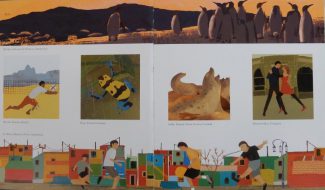
This immersive book subtitled ‘A counting story from 0 to 7.5 billion’ is the 2019 winner of the Nordic Council Children and Young People’s Literature Prize. It’s easy to see why. It’s like no other counting book, that’s for sure and what is counted is people, people from 0 (no one) to 7.5 billion – the entire world.

The people are members of groups and many belong to two or more groups and so stories evolve around the characters, starting with a boy and his family making a total of 5.

You can follow these characters through the book, seeing how their various life stories intersect and diverge.

The narrator makes brief comments about people in their settings, for example in the classroom scene, of the 20 children ‘One of them is thinking about all the people who’ve lived before us. One of them has lost the class teddy bear. One of them is dreading football training. One of them will become prime minister.’

However, much is left unsaid so there are sufficient gaps for readers to fill and likely fill differently, on each reading.

Dive in, get lost in the pages, stop; study each one thoughtfully, and move on; eventually you’ll have met 2768 people. Then perhaps move back; the ‘spotting section’ at the end will certainly encourage you to do that.

Most importantly though, whatever other interpretations readers make, the indisputable messages that emerge are, that we are all part of one enormous, interconnected world group – the human race – and that each one of us has our own unique story, for as the title says, Everybody Counts.

Just imagine how many philosophy for children sessions might evolve if you start exploring this ingenious, visual festival of a book in the classroom.
Story Worlds: A Moment in Time

Story Worlds: A Moment in Time
Thomas Hegbrook
360 degrees

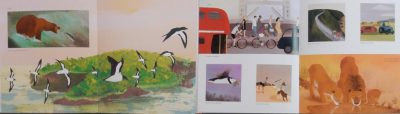
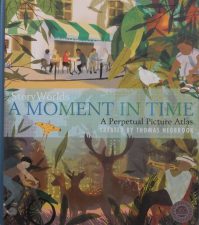
Through this Perpetual Picture Atlas, Thomas Hegbrook takes readers on an amazing global trip that enables us to see, through a series of freeze frame images, what is happening all over the world – in thirty nine time zones – at precisely the same instant in July.

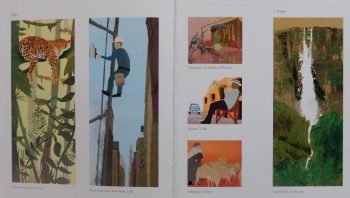
The first spread is a world map that shows and explains these zones and we can then begin our exploration at 6am on two minor outlying islands of the US with curlews taking flight, or perhaps join some children on their walk to school in Honolulu where it’s 8am. Alternatively by moving on a few spreads we find ourselves in the Amazonian rainforest in Brazil where it’s 2pm as it is in Havana, Cuba, in New York and at Angel Falls, Venezuela.

Start at the back and we pay a visit to a Delhi market place still busy at 11.30pm, or watch two boys play a board game in Bangladesh. In Samoa however, it’s 7am and we can share a family’s breakfast or watch children feeding the hens in Tonga. Meanwhile in London it’s 7pm and people are hurrying home from work, whereas across the channel in France it’s 8pm and some Parisians are relaxing with a drink.

The enormous variety of life both human and animal is amazing.

You can also choose to open the book right out and this provides opportunities for comparing and contrasting various parts of the world at a single glance, savouring being in the moment in up to a dozen locations simultaneously.

This fascinating volume (from a Little Tiger imprint) offers learning opportunities aplenty. I envisage groups of children lying flat out on a classroom floor, or sitting around a table with the book standing up, exploring, storying and excitedly discussing each of Hegbrook’s wonderful painterly spreads, all of which offer exciting viewpoints and different layouts. There is also a pictorial index giving a little additional information about the pictures.

Ingenious and absorbing, this is high quality non-fiction with a difference and deserves a place in every classroom collection and on family bookshelves.

I’ve signed the charter