The Magic of Forests

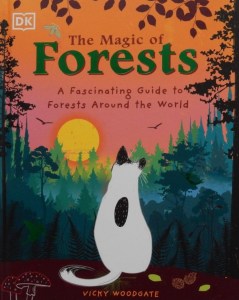
In this book, written and illustrated by Vicky Woodgate, readers are taken on a fascinating journey around the world and through different kinds of forests and things foresty, guided by Mimi, the cat.
Gorgeously illustrated double page spreads explore the various kinds of forest, what a tree actually is (explaining the difference between angiosperms and gymnosperms), the subterranean communication network between tree roots and networks of tiny fungal threads and then looks at different kinds of leaf shapes.

Then comes a section entitled ‘History, folklores, fairy tales’. That includes a timeline going right back 470 million years to the first land plants; but it took another 181 million years for the ginkgos to begin to grow. It took way, way longer though for the wood from trees to become central to human life, to be used for making fires, tools, weapons and wheels, as well as being pulped and made into paper. I was astonished to read that 10, 000 sheets of paper can be produced from a single 14 metre tall pine tree. You’ll encounter some weird and wonderful beings on the next three spreads including the Leshy, a forest spirit from the Slavic regions that is said to defend trees and the animals that live therein. 
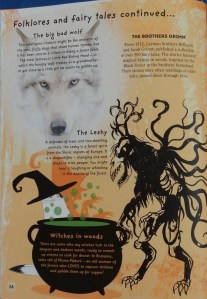
Super scary is the Jersey Devil, a creature said to bear some resemblance to a kangaroo, only it has a horselike head, horns, horrible claws and emits a blood-curdling, high-pitched scream: I don’t think I’ll go wandering in the Pine Barren Forests of New Jersey.

Next, readers are introduced to some of the environmentalists, activists and scientists who have done sterling work defending the world’s forests, and or, planting trees; some including Jadav Payeng aka the Forest Man of India and Marina Silva (a native Amazonian/politician) continue their work today.

We also visit different forest habitats such as a pine forest, a mangrove forest, a cloud forest, 
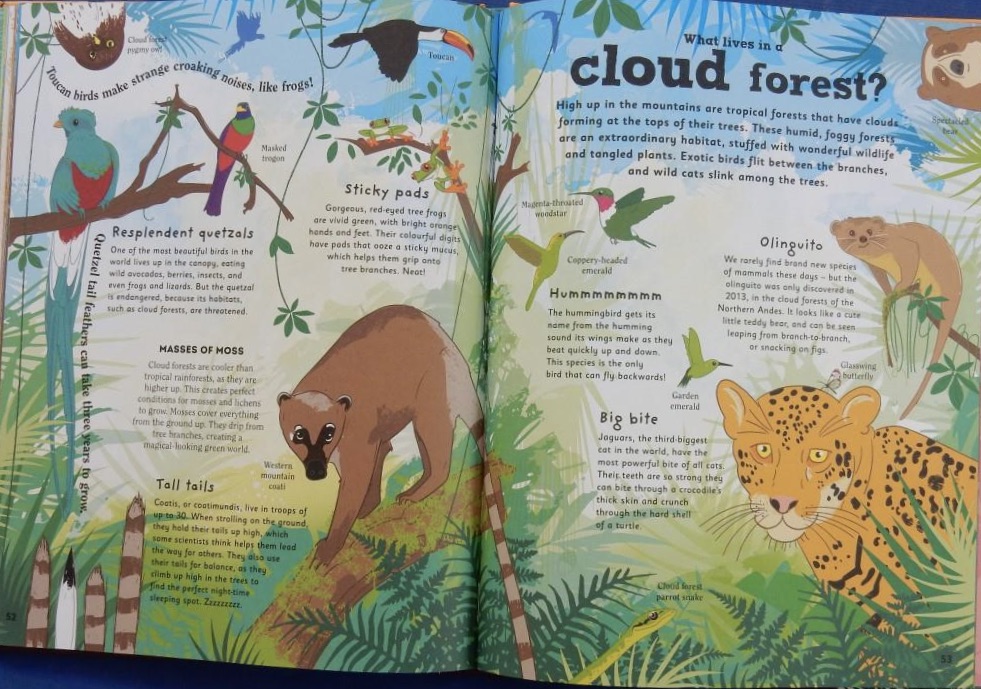
a rainforest and an underwater forest and meet some of the weird and wonderful animals that live in them and the final part of the book reminds us of the positive effects being in a foresty place has on how we feel.

Immerse yourself in this book with its facts, activities, quizzes and more, and enjoy the author’s illustrations too: You’re sure to find plenty to interest you; I certainly did.

I Can See Nature’s Rainbow

This image has an empty alt attribute; its file name is dscn9793-2.jpg


There’s a kaleidoscope of vibrant colours to be found in the natural world and that’s what author/artist Vicky Woodgate celebrates in this book.


Starting with blue, a spread is allocated to each of eleven different colours. Yes we all know that sometimes the sky is blue but did you know that there is a blue daisy and a blue starfish?
Thanks to chlorophyll, there is an abundance of green in nature’s flora; there are also lots of green insects, quite a few birds and animals. Among the snippets of fascinating information is the fact that ‘the world’s heaviest parrot (the kakapo) weighs as much as a brick. You probably won’t be surprised to discover that kakapos don’t fly.
Keep going through the book and you will come upon lots of other things of interest.


Have you ever thought about why there are so few purple animals? You will find the answer on the relevant spread as well as being introduced to several purple bugs, birds, flowers and a peculiar Indian frog that spends just two weeks above ground each year and clucks like a chicken: it’s not surprising I’ve never seen one on my frequent visits to India.


These are just a few of the delights you will encounter as you turn the pages towards the final spreads, one showing rocks and minerals, which explains how they get their unique colouring and the last pages explain what colour is and present some arty activities.

A visual feast for younger primary readers.

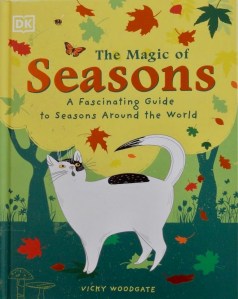
The Magic of Seasons

The Magic of Seasons
Vicky Woodgate
Dorling Kindersley

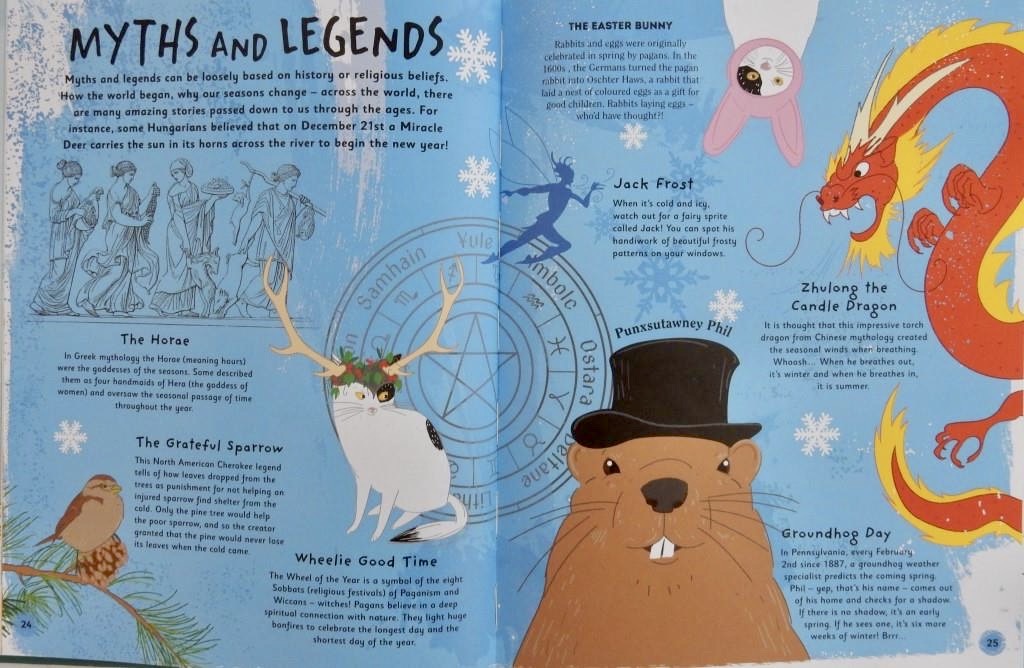
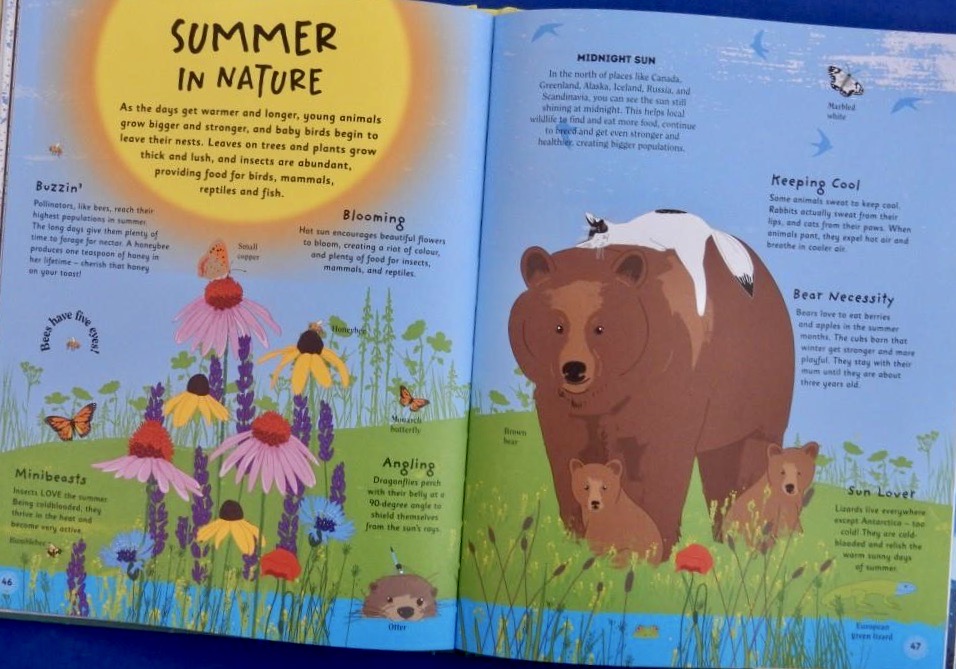
From this veritable cornucopia of a book about the changing seasons in our world, with Mimi the cat for company, readers can experience seasons- related science, history, geography, myths and legends.

First comes a scientific explanation about what exactly is meant by the seasons, after which is a quick generalised look at in turn, spring, summer, autumn and winter, as well as a spread explaining how for many places in the tropics, there are just the wet and the dry seasons, (these seem to be getting a bit blurred though for, according to my friends in Udaipur city in India, it’s rained every single month in the last year.)

My favourite part was the ‘Seasons in Nature’ section that gives more detailed information about the incredible changes and different delights that characterise each of the seasons – be they the four we have in temperate climes or the tropical two, rainy and dry.

This part also encompasses information relating to animal migrations by land, sea and air as well as seasonal effects on the world’s ocean life.

Throughout, Vicky Woodgate’s text uses language appropriate for most key stage two children, and visuals – illustrations, maps and charts that make every spread enticing, so that readers never feel overwhelmed. There are also occasional quizzes, tips and activities.

A book for classroom use as well as one parents and children can enjoy browsing together.

Birds and their Feathers / A World of Birds

Birds and their Feathers
Britta Teckentrup
Prestel

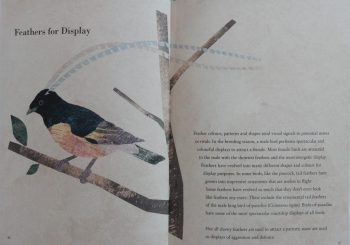
Following on from The Egg, Britta Teckentrup has created another bird book with a difference, approaching the subject via plumology – bird feather science.
Its ninety or so pages are packed with fascinating feathery facts.

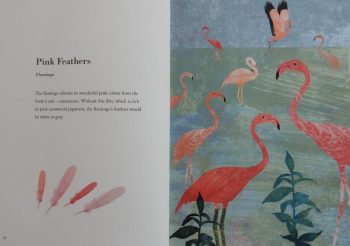
Each double spread is devoted to a particular aspect including feather development, structure, types of feather, colour – did you know flamingos are pink thanks to the carotenoid pigment in the crustacea they eat?

She also looks at wing types, flying strategies, heat regulation and many more topics relating to form and function,

with the final pages devoted to how humans have been inspired by, and exploited, feathers in creating myths, dreams of human flight, for decoration and warmth, a feather was even taken to the moon.

The subject allows full reign to Britta’s amazing artistic talent and her beautiful paintings are a delight to peruse and gaze upon in wonder.

A book for the family bookshelf, for bird lovers, art lovers and school collections.

Taking a more conventional approach but also well worth getting hold of is

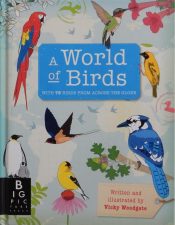
A World of Birds
Vicky Woodgate
Big Picture Press

In her follow up to Urban Jungle wildlife enthusiast Vicky Woodgate starts with some general ornithological information giving facts about classification, anatomy, flight and eggs.

She then takes readers on a whistle stop tour of seven locations around the world – North America, Central and South America, Africa, Europe, Asia, Oceania and Antarctica – wherein we learn about different bird species, some resident, others migratory. Every one of the 75 birds selected is representative of its wider family, the author explains.
Each geographical section begins with a map of the location along with a brief description of the climate, habitats and conservation issues.

The first location is North America, which, with habitats as varied as tropical rainforest, hot deserts and frozen plains has a huge number of different species, partly because it encompasses four major migration routes.

All the other sections too have both resident and migratory species, though Antarctica, has the most challenging conditions for its wildlife and thus fewer avian species.

Central and South America in contrast has an enormous variety of birds and new species are still being discovered although sadly, due to human action, some of the most beautiful such as the Macaws are now on the endangered species list.

The same is true of some of those featured in the African section the continent of Africa being home to some of the world’s largest and most colourful birds.

Europe is home to many species that have adapted to urban environments; Asia, with its varied climates and habitats has, despite the fact that many Asian cultures revere birds, a big problem with the pet trade and hence a fair number of threatened species, whereas the biggest threat in Oceania is that from introduced and invasive bird species – an issue conservationists are earnestly tackling.

Beautifully illustrated and packed with fascinating information, this is a book pore over, to immerse yourself in and enjoy.

Explanatorium of Nature / Urban Jungle

Explanatorium of Nature
DK

This definitely isn’t a book to carry around in your school bag unless you want to do a bit of weight training; it’s an extremely heavy tome (more than 2Kg) with over 350 pages including contents, glossary and index.
Its conventional structure takes readers through ten sections starting with The Basics of Life, followed by a journey through living things from Microorganisms and Fungi right through to Mammals and taking in, by turn, Plants, Invertebrates, Fish, Amphibians, Reptiles, Birds, and finally, Habitats.
As you might expect, The Basics of Life covers the origins of life, reproduction, cells and how they work, DNA, evolution and classification, each being allocated a double spread.
Thereafter, each section is further broken down into one or two double page spreads per topic, ‘Algae’ for example or ‘How chemical defences work’, and includes a main photographic illustration and information surrounded by smaller pictures, labels and additional facts.
The photography is amazing and the book is packed with a great deal of fascinating information presented in a manner that makes the whole thing feel inviting without being overwhelming.

There’s even a superb die-cut cover.
It works well as a book to browse through or to seek specific information from, and would be great to give a budding young biologist.
One for the family bookshelf or school library.

Urban Jungle
Vicky Woodgate
Big Picture Press

My goodness, this is a large volume but it’s one animal lovers in particular will enjoy spending time exploring, along with author/illustrator, Vicky Woodgate, who is passionate about wildlife and travel. Herein she takes readers on a whistle-stop tour of 38 cities on six continents exploring the plethora of animals to be found there.
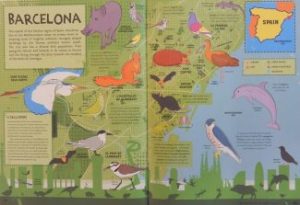
Each of the enticing city maps depicts fauna large and small, some commonly seen, others seldom sighted. Barcelona for instance has a wealth of birds – peregrine falcons in the bell tower of the Sagrada Familia for instance – something I’ve not appreciated in my numerous visits to the city and its environs.

I was however aware of the presence of leopards in Mumbai, another city I’ve visited on many occasions, although I’ve never seen a leopard roaming. I have though seen the three-striped palm squirrels whizzing around, and the beautiful purple-rumped sunbirds.

Most familiar to me is the rich variety of birds and animals in London and the suburbs that it’s all too easy to take for granted wandering through say, Richmond Park with its herds of deer and those pesky parakeets; or the red foxes that roam the streets looking for rodents, or rubbish bins to rummage. Then there are those majestic swans one frequently sees on the Thames; but I’ve never seen, or was even aware of there being a short-snouted seahorse living in its waters.
I found myself getting drawn into this stylish book, turning first to the 8 maps of the cities I’ve spend time in, and then going on to explore other urban jungles. I’m sure children will love browsing its expansive pages, enjoying the portraits of the animal residents of each city, as well as discovering the fascinating facts about them. An expert from each location has fact-checked the information to ensure that this walk on the wild side of the world’s busiest cities is accurate as well as exciting.