All About Feelings

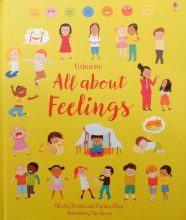
All About Feelings
Felicity Brooks, Frankie Allen and Mar Ferrero
Usborne

Emotional literacy is now part and parcel of the school curriculum right from the early years, yet seldom does a week go by when we don’t read or hear of the increased concern about children’s mental health and well-being, something we in education have been highlighting for many years. So, it’s good to see a book aimed at young children to help them become aware of, and thus better able to cope with their feelings and emotions.

It’s very visual and full of bright illustrations by Mar Ferrero that make it immediately alluring to its audience be that an individual, a nursery group or early years class.

Each colourful spread is given over to a different aspect and the language used is spot on for young children.

Sections include identifying how you feel (with reference to colours of the rainbow);
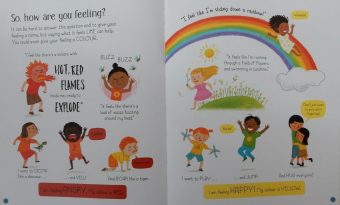
why do you feel a particular way; how would you feel if? (with helpful word clouds)…
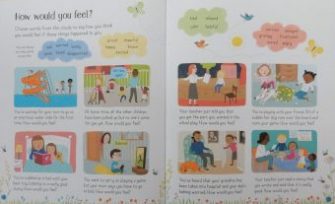
how feelings can change during a day; ‘jumbled up feelings’ and discussing your feelings.

There are suggestions for things to do that help you remain in control;
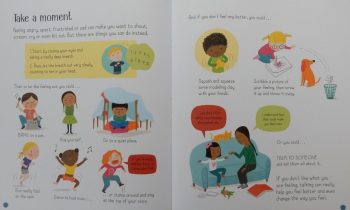
ideas to alleviate worries; ways to express feelings and emotions; ‘being kind to yourself’ and ways in which an individual can help others of all ages feel good.

The final page is for adults – notes on how best to help youngsters; things to try at home (could equally apply at school or nursery) and some on-line resources.

Young children most definitely can learn to become more mindful of how they feel and thus be better in control of their feelings. The authors of this book have done an excellent job of facilitating this and I’d strongly recommend a copy for family bookshelves and all settings where young children are learning.

One thing that struck me about both it and The Unworry Book was that little is said about the benefits of being outdoors. I highlight this after returning from a walk around Ruskin Mill in Nailsworth, near to where I live. This is in part, an establishment for neurodiverse young adults that does amazing work educating its students, with a focus on the outdoors. And, I know from experience that being outside is of enormous benefit to people of all ages from the very youngest children.
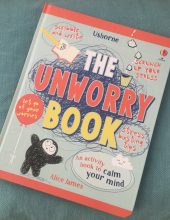
The Unworry Book

The Unworry Book
Alice James and Stephen Montcrieff
Usborne

Enormously reassuring and full of practical ideas for managing stress is this alluringly presented book written by Alice James, with expert advice from clinical psychologist, Dr Angharad Ridkin, and designed and illustrated by Stephen Montcrieff.

Having explained that we all worry from time to time and why, the book devotes the next few spreads to working out how you really feel – worried, excited, or nervous perhaps? It’s really beneficial to become emotionally aware (an emotional map is included to help) and know the kinds of things you can do to alleviate your worries.

Next comes the wealth of coping suggestions, many of which are designed to develop mindfulness. Most require nothing more than a pencil or pen like those on ‘Peaceful pencils’ which takes a multi-sensory approach -listen to the sounds of the writing implement brushing across the paper; ‘notice the glistening wet ink … or grain of the paper as your pencil draws across it’; smell – the book’s pages, the wood of your pencil or ink of your pen; feel the pencil’s ridges, or barrel of the pen; feel the textures of the page and how it seems?

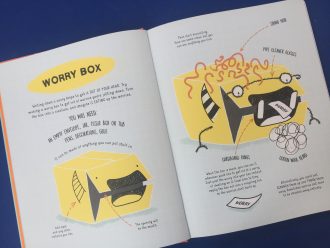
What about making a decorated worry box – an example is included here – I love the idea of it being a creature that can eat up worries.

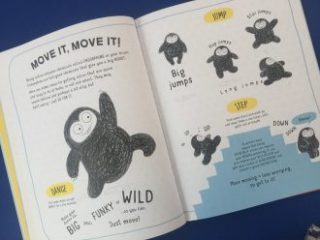
It’s impossible in the space of a fairly short review to include all the excellent strategies offered so I’ll just mention a few. There are pages highlighting the importance of breathing and laughing (both are yoga techniques) to help cope with excess adrenalin, as well as a spread with an amorphous creature demonstrating a sun salutation.

A couple of ‘arty’ ones are tearing up paper (preferably rubbish) and using it to be creative; creating peaceful patterns being mindful of the shapes and how the space is filled. And doodling is a great stress reliever – how many of us doodle our way through stressful meetings I wonder?
It’s well accepted now that being physically active is good for our mental well-being; it releases those mood-boosting, feel good endorphins so get moving.

There’s a focus on language too – some starting lines for limericks (great fun) an instant giggle inducer I think; a focus on the physicality of writing various words in different ways; a (behind the door) story starter; as well as a host of brain puzzles.

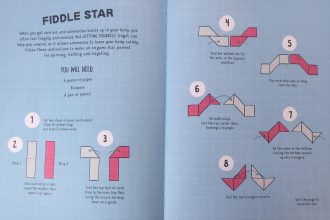
Another smashing idea is a ‘fiddle star’ – the making of which is a worry distractor,

as is the finished article.

Getting off to sleep tips form the final pages; while in conclusion are a ‘helping hand’ and a ‘who to/where to go’ for times when worries become overwhelming (including a link to the publisher’s website).

Stress among children – even very young ones is on the increase – I refrain from elaborating on the negative effects of the current ‘numbers before children’ education system, though it is a huge stress-inducing factor. There are others of course and a veritable gold mine such as this book is invaluable for both youngsters and those who live or work with children.