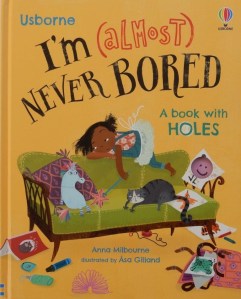
I’m (almost) Never Bored

I’m (almost) Never Bored
Anna Milbourne and Åsa Gilland
Usborne

This is a wonderful celebration of the power of childhood imagination, in this case called into play when one wise father decides to curtail a little girl’s screen time. Furthermore his response to his daughter’s “I’m BOOORED!’ is “Oh, that’s great … being bored comes right before having a Really Good Idea.” And so the young narrator discovers, first when she spies a large cardboard box among those her dad is unpacking. This she turns into a magic train by using coloured pens
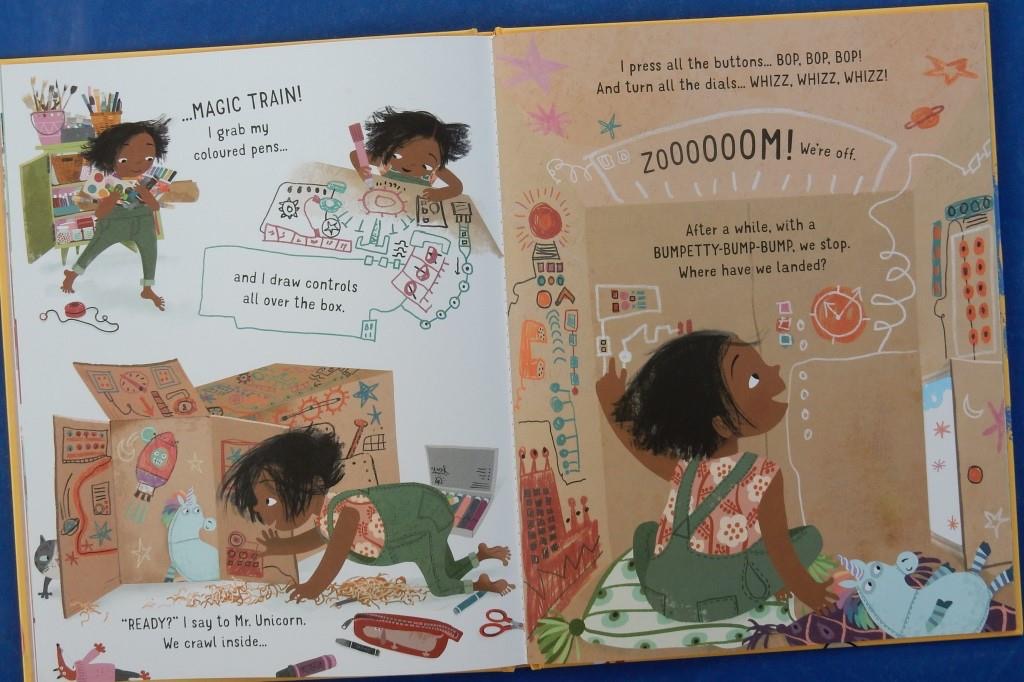
and then most importantly, in the company of Mr.Unicorn, imagining a wonderful adventure that involves visiting all manner of strange places – a land of wibbly-wobbly jellies, for instance.

Fortunately the girl’s mother is of the same mind and she responds in similar fashion to her daughter’s complaints about being bored. This time pens and mind conjure up a massive monster with a seemingly insatiable appetite. And so it goes on until our young narrator is sufficiently convinced by what she’s been told by her parents that she is ready to give a confident reply to the boy next door’s “I’m bored!” and you won’t need to use much imagination to guess what she says …

Åsa Gillard has clearly used her imagination to bring Anna Milborne’s text to life in exuberant scenes (with strategically placed die-cuts) of the little girl’s wonderfully playful flights of fancy.
If any parents/ carers have doubts about the necessity to limit young children’s screen time, then this story will surely convince them to do so. Most certainly a smashing book to share both at home and in foundation stage settings.
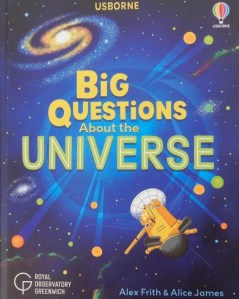
Big Questions About the Universe

Big Questions About the Universe
Alex Frith and Alice James, illustrated by David J. Plant
Usborne

Written in conjunction with experts from London’s Greenwich Royal Observatory this book addresses both the common and some of the less common questions children ask about outer space and the universe. Readers join two inquisitive children and a friendly robot programmed to do just that; though to answer ‘… where does gravity come from?’ help is required from Albert Einstein.

It starts with the basics: Where is space? What is in it? How far does it go? Where does it begin? Here and throughout the book, the bot is up front about the answers given, saying that it’s not always entirely possible to give a straight answer to such questions; then going on to show how to approach those that are unanswerable. To their question ‘How BIG is the universe?’ comes this opening to the response, ‘Unknown. Completely unknown.’ Further explanation follows of course including that the universe is constantly expanding. There’s a spread about telescopes of various kinds, another looking at the spherical nature, or not, of things in space, a look at how the universe began, big bang – or not?

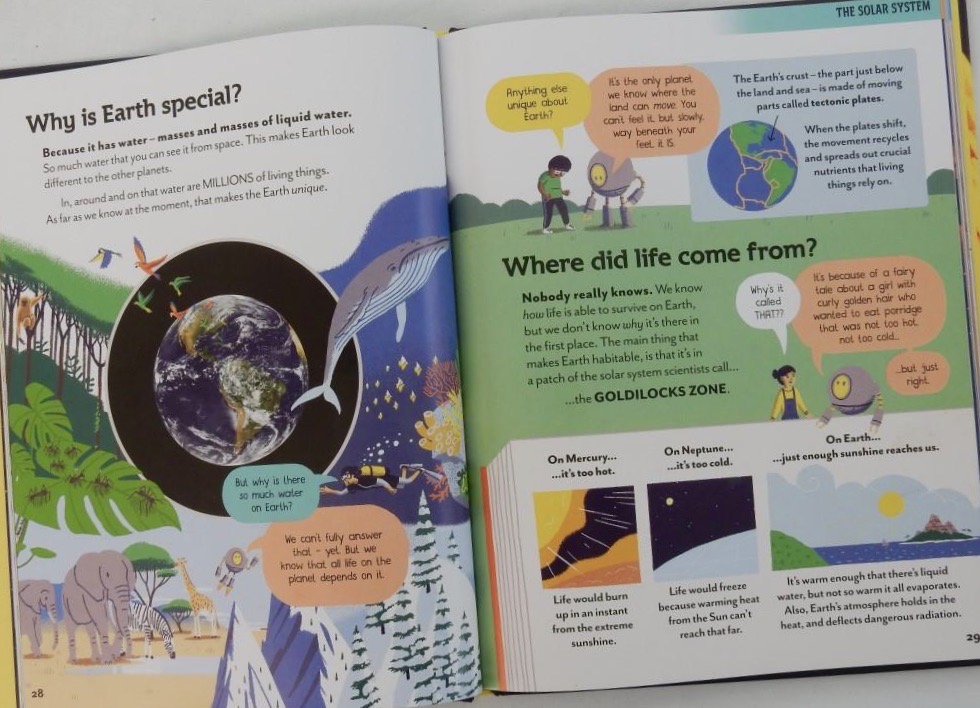
The next chapter is devoted to the solar system. Did you know that 1300 Earths could fit inside Jupiter, or that astronomers have discovered over 200 moons in our solar system and that Jupiter has at least 80 of them? So far as we know Earth is unique in having so much water: why this is so is a tricky question and it leads on to a mention of what scientists call the Goldilocks zone – I love that name.

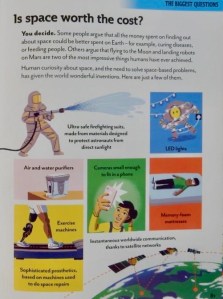
Stars and their secrets has a whole chapter, as does ‘People in space’ and ‘The Biggest questions’ are left to the last chapter. I like the way readers are left to answer for themselves whether or not the vast amount of money spent on space research is worth it; what the authors do is put forward the spin-offs such as air and water purifies, mobile phone cameras and instantaneous world-wide communication through satellite networks.

Though packed with information, its presentation with photos, diagrams, cartoon style illustrations, dialogue boxes and blocks of text, is never overwhelming and draws the reader in and through its pages on a fascinating journey of exploration and discovery. Perfectly pitched for upper KS2.