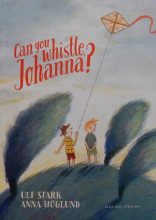
Can You Whistle, Johanna?
Ulf Stark, illustrated by Anna Höglund
Gecko Press
Here’s a book from Swedish author Ulf Stark that will surely touch your heart.
The boy narrator of the story, Ulf has a grandfather he visits regularly. His friend Berra doesn’t have a grandfather but wishes he did so he could enjoy a similar relationship, so Ulf tells him that he knows just the place to find one.
The following day, he takes Berra to visit an old people’s home and there they find an elderly man, Ned

who although initially surprised, is more than happy to accept Berra as his grandson.“There I was, just sitting and feeling a bit lonely, and then you came along!”
A wonderful connectedness develops between the two with Ned remembering his wife, Johanna, and things about his world – the smells, colours and simple joys, as well as those that are now too much of a challenge. The boys learn from Ned new skills and they have tremendous fun

including sharing special ‘birthday’ celebrations …
although there is one particular skill that Berra finds difficult to master – hence the book’s title.
This leads to the boys’ visits to Ned becoming less and less frequent but not before the boys give him a very special birthday celebration.

Finally, after several weeks Berra is ready to demonstrate to Ned his whistling prowess but when he boys get to the home they learn that Ned has died. Berra is devastated.
Despite being profoundly affected by his loss, Berra wants to go and say a final farewell at Ned’s funeral and it’s then that he whistles the old man’s tune.
We see how this special relationship has enriched the lives of both Berra and Ned, and that’s what shines through this sensitively told story despite the boys’ loss. Equally moving are Anna Höglund’s wonderful droll illustrations that support the text splendidly.

Too Small Tola and the Three Fine Girls
Atinuke, illustrated by Onyinye Iwu
Walker Books
This is the second enchanting book of three short tales starring Tola, the youngest of three siblings who live with their grandmother in a crowded, run-down flat in Lagos.What she lacks in stature, Tola makes up for in spirit and determination. Money is short and so Grandmummy spends almost all her time selling groundnuts at the roadside to earn sufficient for the children’s schooling but little else.
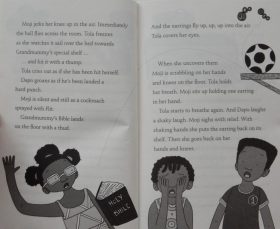
The first story takes place on a Saturday with all three siblings indoors but only Tola doing the chores. As she squats picking out the stones from the rice, her brother Dapo is using his knees to play with his football (strictly forbidden inside) while big sister Moji is studying on a computer on loan from her school.
Ignoring her warnings to stop or incur Grandmummy’s wrath, Dapo dislodges the contents of a shelf with a wild ball sending her gold earrings flying into the air. One is quickly retrieved but can they manage to find the other one before Grandmummy returns?
In the second episode Grandmummy falls ill with malaria and the siblings resort to desperate measures to buy her the vital medicine she needs; and Dapo surprises everyone by using his skill to make money.
The three fine girls of the title are cool, indulged young misses in their fancy gear that Tola notices when she’s out and about. The same three posh ones that she manages to impress later on when she accompanies Mr Abdul to the masquerade.
There are so many things to love about young Tola especially her resourcefulness and ability to think on her feet; but her entire family are a delight. Onyinye Iwu’s black and white illustrations are a delight too, filling in some of the details about the life of this Nigerian urban family.


 Red Reading Hub - Jillrbennett's Reviews of Children's Books