
Adder, Bluebell, Lobster
Chrissie Gittins, illustrated by Paul Bommer
Otter-Barry Books
I was intrigued by the title of this collection of “Wild Poems’ from Chrissie Gittins and delighted by the explanation for its choice. The author was inspired by the list of natural world words that were left out of the most recent (2015) edition of Oxford Junior Dictionary and replaced with 21st century terms So, this is Chrissie’s offering as part of the protest against their omission that was endorsed by almost 30 authors intent on the laudable aim to send a “tremendous cultural signal and message of support for natural childhood”.
The poems are arranged alphabetically with almost every letter represented, the exceptions being E, J, K, Q, U, X, Y and Z and every one is a treat for the ears and eyes. For A in addition to the snake of the title we have Allotment, which describes a wonderfully wet time: here are the first few lines: “When it rains the soil sighs deeply, / the leaves of the purple sprouting broccoli giggle as rivulets tickle their veins,/ rainbow chard reaches out to catch droplets in its wrinkles ,/ the strawberries smile – their redness becomes redder, their sweetness sweeter,/ broad beans swell inside their emerald pods/ waiting to be picked.”
What a splendid evocation of a downpour: and it’s vertically presented for extra effect.
For B there’s Bluebell, Blackberry – such a tasty treat with its wordplay –and its ‘luscious globules’ and ‘purple dribbles’; and the superbly bossy Beetroot shown in Bommer’s line drawing wielding a pot of red juice capable of causing ‘a red Niagara Falls’.
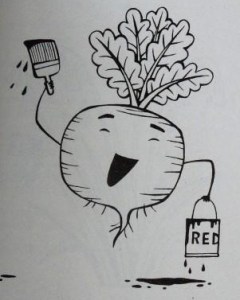
The fastest animal on land, the Cheetah races in and across the spread – ‘made for flight’ as one of the Cs and then we have a run of flora – Dandelion, Fern, Fungi – two species – and Gorse. I have to say I was shocked at some of the omissions; how can a dictionary for the young not have Hamster – surely a favourite pet, the majestic Heron ‘rigid as a cement pterodactyl’, Ivy, Lark, Lavender? All these and the many others herein are essential parts of childhood – Newt, Poppy, Violet, Willow, Wren. Oh my goodness, I got more and more sad and angry as I continued reading; but thank goodness for Chrissie Gittins’ wild and wonderful, sometimes wacky words; and she’s ably abetted by artist Paul Bommer with those stark black and white illustrations – some funny …
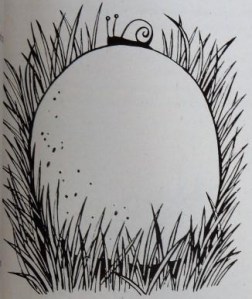
some beautiful …

and all apposite, on almost every spread. I have a feeling this will be read to extinction/destruction fairly fast; it’s such a tongue-tingling assortment of poetic forms and fanciful phrases: what a way to ‘turn sows’ ears into a silk purse’.
A must have for all primary classrooms, for the family bookshelf and for anyone who loves words, the natural world, and those who, like me and the creators of this book are eager to help play a part in saving from extinction, these names from nature. Long may they reign and remain…
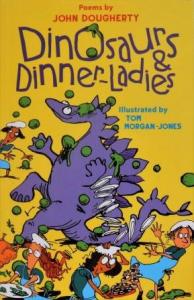
Dinosaurs & Dinner Ladies
John Dougherty illustrated by Tom Morgan-Jones
Otter-Barry Books
This is a debut foray into poetry collection created by the author of the popular Stinkbomb & Ketchup-Face series of stories, John Dougherty, whose humour is evident in each and every offering. Many of the preoccupations of school children, most notably school and what happens therein are featured and in some instances superbly sent up in his verses. Take for example The Alliterative Alligator who: ‘lurks languidly, looking like a lazy log/ by the bank, beneath the blue/ wavy waters, waiting, wanting,/ hunting hungrily but unhurriedly,/ seeking something satisfyingly savoury.’ This is cleverly juxtaposed with an impatient Alligator that –and who can blame it – ‘hates the crime/ Of bending words to force a rhyme.’ (I hope those responsible for the current Primary English curriculum are listening.) And I absolutely love his Note to an English Teacher, an oh-so-telling offering comparing a poem with a hamster. You’ll need a copy of this splendid collection to relish this one yourself (relish, if like me you are party to, and hate, what’s currently served up in many classrooms in the name of English. Teachers feature quite frequently in one way or another by the way.
Slow Reader provides a view of what reading might look like to one such (you have to read each line backwards) and I have to say, it makes about as much, or as little sense, as a phonic book for beginners. Don’t you just love Tom Morgan-Jones’ visual representation of same?

Not all the poems are school-themed however: there are natural world poems, Seeds being one; another is this Lonely Haiku: ‘Bare autumn branches/ The emptiness of lost leaves/ The long wait for spring.’ . There are pets such as Next- Door’s Cat, a creature with ‘attitude’ and ‘fat cattitude’, Dogs, some of which are liked, others definitely not; and poems about faces, food-related verses and an exciting lunar ‘Countdown’. I think if I had to choose a favourite, it’s Sail Away Between the Pages that includes this; ‘Their words are not enough to name the blessings/ that they bring/ The wonder of their pictures or the songs their poems/ sing./ And their prose by any other name would have/ as many flavours/ So I can’t think of a better thing to do/ Than sail away between the pages.’ (of the books read).Good on you, John Dougherty. If you want to turn children on to poetry, then grab a copy of this and share it; buy a copy or more and give it; which ever – JUST DO IT!
And I’m interested to read at the back of the book, that its author now lives in Gloucestershire and is an ex-primary teacher.




 Red Reading Hub - Jillrbennett's Reviews of Children's Books