These are two adventure stories set in Scotland and both with an environmental theme: thanks to Owlet Press and Harper Collins Children’s Books for sending them for review.
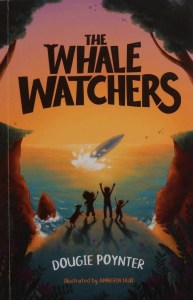
The Whale Watchers
Dougie Poynter, illustrated by Amber Huq
Owlet Press
It’s the start of the school summer holidays and Finn is anything but pleased to be travelling by train to Scotland to study whales along with his marine biologist mum and younger brother Jesse who is really excited about the prospect of whale watching. Who wants to go to a cold, rainy place at the end of nowhere when you might go somewhere hot like Spain or France? But it’s part of his mum’s job to collect data on the various kinds of whales, minke whales in particular. Moreover, the thought of such creatures and ideas of plastic pollution in the oceans and endangered animals makes Finn’s stomach churn: contrary to what his mum believes Finn thinks the world is already doomed.
However when he arrives next morning things don’t seem quite so awful: the cottage where they’re to stay is right on the beach. Then while on the shore the boys meet Skye and Rain, her dog. Gradually as they spend time together sharing experiences and an adventure neither will forget,
their friendship grows strong and Finn is able to see things differently.
After all his misgivings he has an unexpectedly incredible summer holiday and has a wonderful surprise even before his train home has reached its destination.
Dougie Poynter, himself an avid conservationist, cleverly weaves information about the marine life of the Moray Firth and the impact of pollution on its waters and the wider environment into his splendid story: everyone can make a difference and although it might seem small to the individual, the impact of each person together can be huge. I was horrified at the comment from a colleague of Finn’s mum, ‘just a single one-litre plastic bottle can break down into enough tiny pieces of plastic to put a piece on every single mile of beach on the planet.’ Amber Huq’s illustrations add to the dramatic impact of the tale.
There’s also an excellent final factual section reinforcing the novel’s message that includes lots of ways that everybody can help contribute to the cause of marine animals and the environment in general.
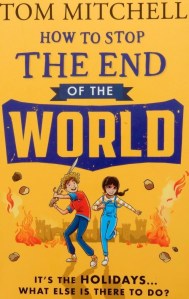
When Things Went Wild
Tom Mitchell
Harper Collins Children’s Books
From the quote from Tennyson’s The Eagle before the story begins I knew I was going to enjoyTom Mitchell’s latest book; it even exceeded my high expectations.
With his parents and irritating younger brother Jack, Kit has recently moved from Nottingham to an old house in Granton, in the highlands of Scotland, a place he describes as in the middle of nowhere. He has a lot to contend with: the wi-fi is rubbish, he’s starting at a new school and now his mum is wanting him to join them on a walk. It’s on said walk however that pesky Jack stumbles upon an unknown object and later on when PC Lennox comes knocking on their door, the boys learn that the object they found is a tracker that has been removed from the leg of a missing golden eagle named Adler.
Then a school project is announced and everyone in Kit’s class is expected to produce an idea to investigate. Is there perhaps a chance he could become ‘Kit Brautigan, bird detective’? Apparently the killing of these awesome birds is fairly common and when the brothers realise there is actually a pair of nesting eagles under threat, they feel they must do something. Before long the school’s most popular pupil, Tamora, becomes involved as does her younger sister, Bea.
But who wants to harm the eagles and why? The main suspects are a local farmer McNab, the sinister game keeper Mosby and landowner Lord Cavendish, (father of Tamora and Bea.) Can the city children catch the killer culprit?
With mishaps and mayhem aplenty, Tom’s gently humorous tale – a whodunnit but so much more – is a timely reminder that we all need to take responsibility for protecting our precious environment and its wildlife.


 Red Reading Hub - Jillrbennett's Reviews of Children's Books