
International Book Giving Day is coming up soon. You can down load this lovely poster and also bookplates from the www.bookgivingday.com
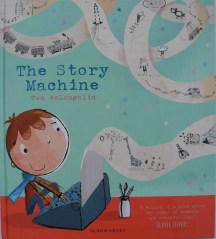
The Story Machine
Tom McLaughlin
Bloomsbury
Visual story telling can be as powerful and exciting as stories told with words: this book is a celebration of the power of pictures to tell stories.
Elliott is a small boy who takes pleasure in finding things but he is mystified when he comes upon a strange machine in a box; a machine with no ON/OFF button that neither bleeps nor buzzes. When he accidentally makes it work, out come strings of letters, letters that make words. Could it be a story machine perhaps? Elliott sets to work. Despite his best efforts though, his words just keep on getting jumbled up and that’s truly dispiriting. Not for long though, for what should emerge from amongst all those letters but a picture. And that’s just the start of things; Elliott is soon producing pictorial images almost non-stop and best of all, his pictures tell a story. Then disaster – the story machine suffers from excess usage and grinds to a halt. So, is that the end of Elliott’s story telling? Happily not for it is then that he discovers something even more exciting and more important than the machine. It’s he himself, not the typewriter that is the creator of the stories, and a pretty good storyteller he is too.
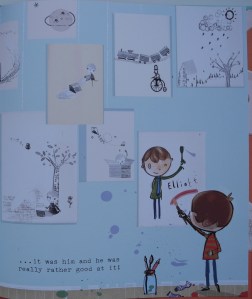
This unusual book is based on the author’s own memories as a boy with dyslexia combined with discussions with children in schools. Many of the boys among his audiences told him that they disliked writing stories but enjoyed drawing and comic-making so McLaughlin set out to show them and many others like them, that they are indeed storytellers, they just use a different medium for their stories. His cleverly constructed pictures with their iconic images formed from typed letters offer an alternative approach, removing the straightjacket of the more conventional practice.
My experience as a teacher of young children has shown me that many boys (not just those with dyslexia) most certainly are imaginative story tellers but they later come to dislike story making because, rather than being allowed to continue using their preferred iconic mode (telling their stories in pictures), they are forced into using the symbolic mode too quickly. Sadly many of them, like those Tom McLaughlin talks of, never think of themselves as storytellers; indeed thanks to the pressures of the education system, they are often made to think of themselves as failures in this respect. I hope that this book will go some way to demonstrating to such children that this is far from true.
Buy from Amazon
Find and buy from your local bookseller: http://www.booksellers.org.uk/bookshopsearch
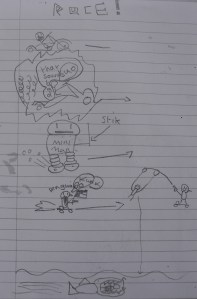
Here are examples of boys in KS2 from a school I’ve been in recently, who don’t find writing easy but are given regular opportunities to create stories that are largely pictorial. They love doing so and clearly think of themselves as makers of stories.

 Red Reading Hub - Jillrbennett's Reviews of Children's Books