How To Teach Grown-Ups About Pluto

How to Teach Grown-Ups about Pluto
Dean Regas, illustrated by Aaron Blecha
Britannica Books

If you’ve ever wondered why Pluto lost its status as a planet over fifteen years ago, then here’s a book for you. It’s written in an amusing child-friendly style by astronomer, TV presenter and more, Dean Regas, and illustrated with suitably funky, blue tinged, cartoon style art by Aaron Blecha.
Having briefly introduced himself and the work of an astronomer, in his tongue in cheek style, the author explores the contentious case of Pluto and its demotion from being one of the nine primary planets in our solar system, thus losing its status as a full-blown ‘planet’. This was something even he initially found hard to accept.

Before that though we read of Tombaugh’s discovery of Pluto; how an eleven year old girl came to name it. But then comes it’s downfall – not literally of course. ‘so small, so far away, so alone, so off-kilter and so cold’ was it that ‘people rallied to defend Pluto against anyone who wanted to take away its planethood, … Never before had the public embraced such an inanimate space object as their underdog’, says Regas.

He then ingeniously goes on to explain how the constantly developing nature of space science means that many youngsters’ knowledge of our solar system is likely to be more accurate than that of lots of grown-ups. Having read this book such youngsters will be able to tell any doubting adults that Pluto is a Kuiper Belt Object (KBO) and one of five dwarf planets. They’ll be able to introduce them to Sedna too, as Regas does to readers herein.

So cool and utterly brilliant. If this book doesn’t get youngsters interested in astronomy then I might have to eat my own copy, timeline and all.

The Queen’s Lift-Off

The Queen’s Lift-Off
Steve Antony
Hodder Children’s Books

Those of us who watched the opening ceremony of the 2012 London Olympics will probably recall that Her Majesty the Queen was, so we were led to believe, parachuted into the stadium.
Who would have thought that just a few years later she’d find herself blasting off into space aboard the rocket she’s just helped the little prince and princess to build?

WHOOOSH! goes the Queen, zooming faster than the speed of light, first to Mercury. After which, comet-like she soars to Venus,

before coming to land on the Moon’s surface

from whence it’s merely a matter of a single giant leap to the Red Planet.

Then she boldly takes flight towards Jupiter before she’s off again to spin rings around Saturn.

Zipping on past Uranus and Neptune, not forgetting little Pluto, she’s suddenly sucked into an enormous black hole.

Surely that cannot be the end of Her Royal Highness?

Not so: thank the universe then, for a passing spaceship that succeeds in safely beaming her up and depositing her safe and sound and none the worse for her awesome adventure, back in the palace garden, where it just happens to be afternoon tea-time. Hurrah!

And who, or what, should be there to serve it up …

Into his seemingly simple story Steve manages to weave some wonderful textual references to Star Trek and the American moon landings.

As always however, it’s the awesome illustrations that carry not just one, but many stories (as well as visual starting points for children’s own storying). However many times one looks at them there always seems to be something new to discover and enjoy. In this story there’s the ever -increasing number of loyal companions the Queen has on her journey, as well as a little alien and his flying saucer which appear from time to time.
Oh and of course, in each and every scene there’s a royal corgi complete with space-helmet, looking as though he’s thoroughly enjoying every minute of the adventure, Oddly enough, her highness just happens to have some dog biscuits (along with her lippy, perfume spray, specs and the various other necessities she carries in her handbag).
I’m guessing since its near loss, she’s never parted from this vital article of personal storage.

I think this series just keeps on reaching new heights; this one is my favourite thus far, although I was probably predisposed so to think because I was lucky enough to have my review copy signed and handed to me by Steve himself. You can’t get better than that – until the next one, perhaps.

Voyage Through Space

Voyage Through Space
Katy Flint and Cornelia Li
Wide Eyed Editions

In the company of a little astronaut and her dog, readers are taken on a journey of adventure in space starting at the Sun, the centre of our solar system.

So it’s space suits and helmets on and off we go exploring the planets, our first stop being Mercury, closest to the Sun and the smallest planet in our solar system. We learn that its surface is covered in craters on account of the meteors that have crashed into it over millions of years; we discover that its temperature varies dramatically; it’s ‘blisteringly hot’ by day and very cold at night. Did you know that on Mercury a year is a mere 88 days long?

Venus is next closest where temperatures can go as high as 460 ℃ – OUCH! This is the hottest planet, has no moon and is impossible to explore.

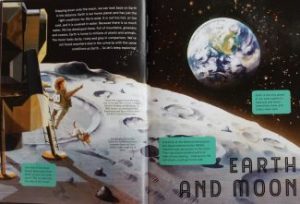
Next stopping place is the moon, whereon American astronauts Armstrong and Aldrin were the first to land, a good place from which to observe Earth.

The red planet, Mars is the next stop; a place prone to fierce dust storms . A sol (Martian day) is approximately 39 minutes longer than an Earth day.

Passing through the asteroid belt takes the explorers to the largest planet in our solar system and fifth from the sun. NASA’s Juno spacecraft is currently studying Jupiter with its liquid surface and clouds of toxic gases.

The ringed planet, Saturn is the next destination. There strong hurricanes rage and the surface is mostly liquids and swirling gases. I was amazed to learn that a year on Saturn is more than 29 Earth years.

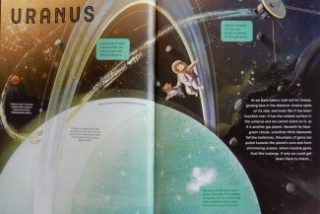
Uranus glows blue when seen in the distance from Saturn. That’s the next place viewed. Its surface is the coldest in the universe and the explorers are unable to stand thereon as its surface is gaseous, although beneath the blue-green gas clouds, scientists believe enormous gems are to be found. If only …

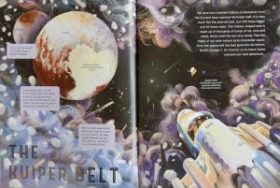
The final planet on the journey is Neptune, even windier than Jupiter and the furthest from the Sun. Voyager 2 took a whole two years to reach Neptune from Earth. Thereafter the adventurers reach the ‘frisbee-shaped Kuiper belt … Time to head home.

All this information is provided in easily digestible bite size chunks scattered on the relevant spread, most of which is taken up with Cornelia Li’s powerful and intriguing illustration. You can almost feel the intense heat coming from some of the pages and taste with swirling gases from others.
In addition there’s a glow-in-the-dark, fold-out poster at the back of the book to further excite young readers.