The Old Forest Path

This story is the first for young readers by musician Jamie Catto.

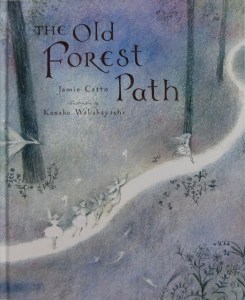
Once upon a time, deep in a magical forest lived fairies: delicate, graceful and ballerina-like is how Kanako Wakabayashi portrays them. The fairies delighted in dancing among the flowers and shrubs and were mindful of doing as their elders had taught them – to stay on the path and return home each evening. However, there was one fairy who was so captivated by the forest music that she would stray from the path, unaware of the concern of the other fairies.

One afternoon a piper arrived playing tunes so enchanting that all the fairies were completely enthralled;

but there was one fairy who was so completely transfixed by his music that she stepped forth, the two joined together in a dance that lifted them high, high above the forest canopy never to be seen again. Meanwhile the forest path disappeared completely leaving the remaining fairies free to go wherever they wished in the forest.

A demonstration of the power of music to transform, lyrically told and beautifully illustrated in delicate watercolours, this unusual book with its echoes of Arthur Rackham and Cicely Mary Barker’s Flower Fairies sent me back to my childhood days.

For older picture book lovers I suggest.
One Sweet Song

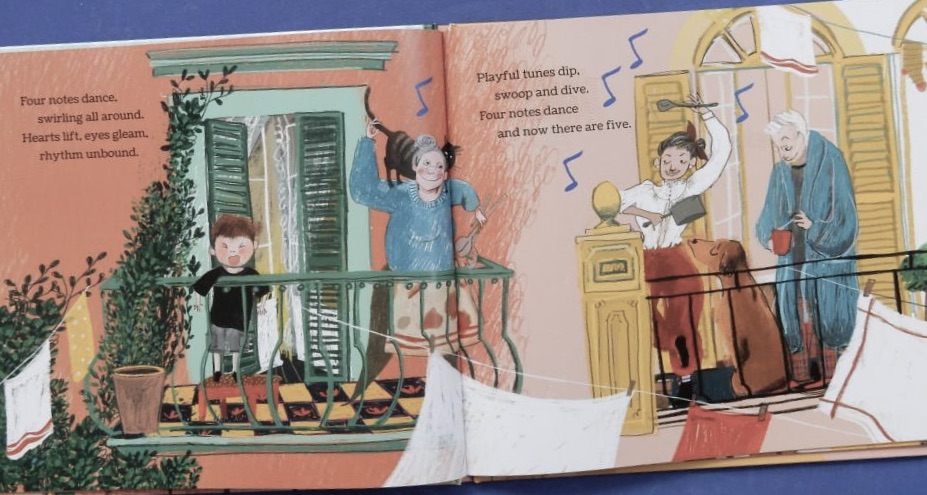
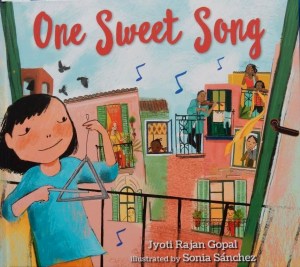
Across the city, its diverse residents stay within the confines of their homes. On a balcony a woman plays a note on her flute – ‘One note trills … / floating in the air.’ It’s heard by a child nearby looking through her window who picks up her triangle, steps onto the balcony and ‘rings a chime,/ soft and true./ One note trills, and/ now there are two.’ This prompts another neighbour to play his violin and then other people and their instruments including a saucepan and spoon,

a cello, a ghatam, a morsing, and bottles join as the music rises until the rhyming text reaches ten, voices young and not so young, sing out and the entire area feels connected and alive with a harmonious sound. “One sweet song that fills the space, / one sweet song, / a warm embrace.’ Then slowly, one at a time the instruments come to rest once more,

leaving everyone at peace with themselves and the world.

Powerful rhythms and lilting rhyme combined with spirited illustrations that have coloured swirls and musical notes weaving in and out of the homes, make a once separated community united by joy.
Author Jyoti and illustrator Sonia have together created a wonderful celebration of the healing power of music and its capacity to bring people together even in difficult times such as the recent pandemic.

Mrs Noah’s Song

Mrs Noah’s Song
Jackie Morris and James Mayhew
Otter-Barry Books

The third in this series wherein Jackie Morris’ lyrical words are visually sung in collage style art by James Mayhew, is again gorgeous. Together they tell a magical tale about how Mrs Noah brings song back into the world. Music and song are a way of connecting people no matter where they are and Mrs Noah assuredly unites her family by singing to the children, morning, noon and night, while Mr Noah listens enraptured.

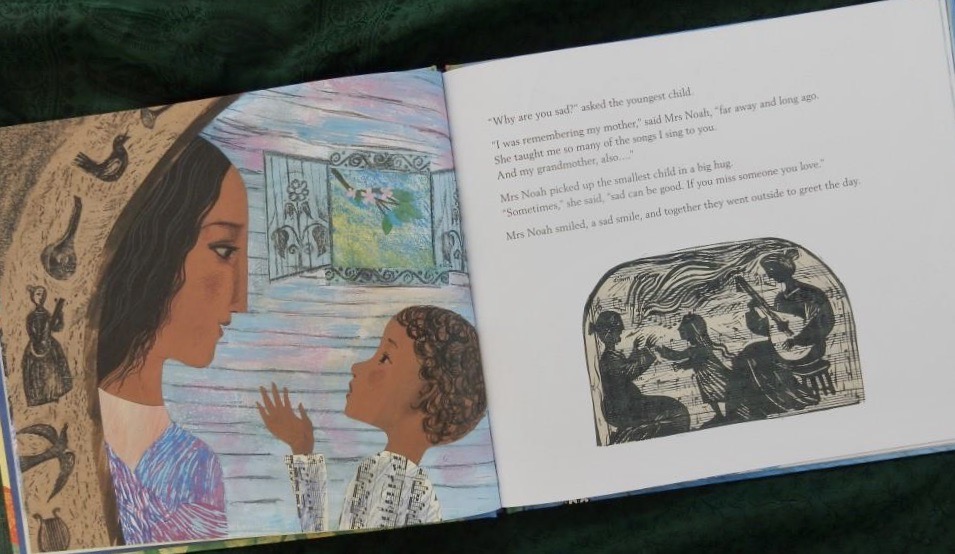
One morning the children ask Mrs Noah where she learned to sing and she tells them sadly that it was “Far away and long ago.” Called by the sunshine, the children then leave, save the youngest who asks the singer, “Why are you sad?” Having given an explanation about remembering her mother and grandmother, Mrs Noah says that-sometimes the sadness caused by missing somebody you love is a good kind of feeling.

They then both venture outside to greet the day watched by Mr Noah who had heard what was said.

Outside it’s time for a singing lesson, which must start with learning how to listen properly – eyes closed, ears open wide, wide. After a while the youngest child joyfully announces, “I can hear the garden singing.” And, it most certainly was, with birdsong, humming bees, dragonfly wings rattling and a gentle breeze setting the leaves in musical motion.

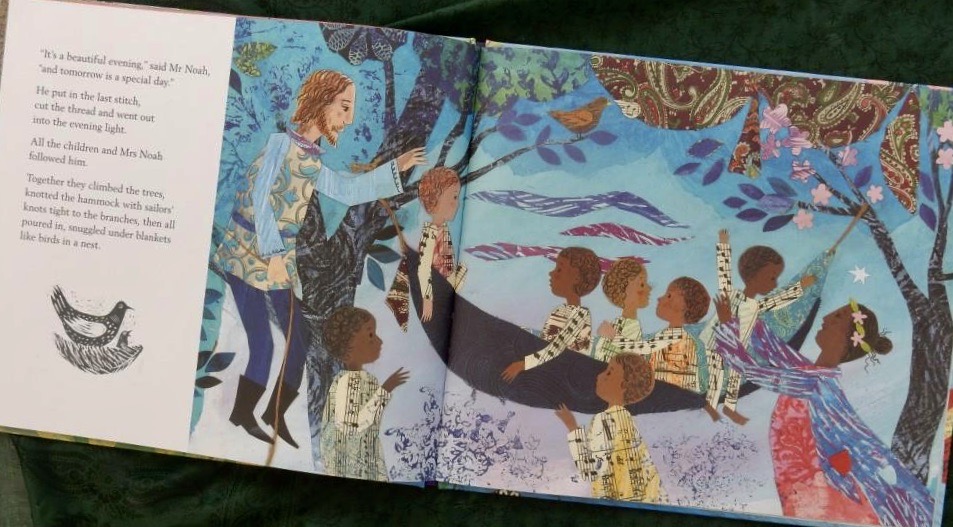
Mr Noah gets busy fashioning a huge hammock and they all spend a blissful night under the stars listening to the magical music created by the natural world together with Mrs Noah’s songs.

Next morning having slept soundly, to everyone’s delight they’re woken as the sun rises, by the dawn chorus. United in song, united in music, united in love. If only it could be so the world over, if only …

Like many people in our current turbulent world with wars and people forced to flee, Mrs Noah was actually a refugee who had to start her life anew in an unknown place; she knew that music could be a way of helping her children develop a sense of belonging in a new land. Music speaks a universal language, one that transcends barriers and that’s something that’s vitally needed in our divisive world. “If music be the food of love, play on.” So said Duke Orsino in the first scene of Twelfth Night. Let it be so.

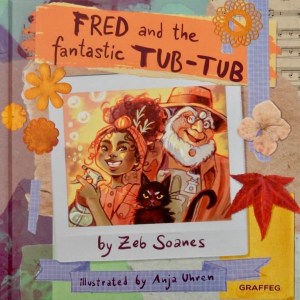
Fred and the Fantastic Tub-Tub

Fred and the Fantastic Tub-Tub
Zeb Soanes, illustrated by Anja Uhren
Graffeg

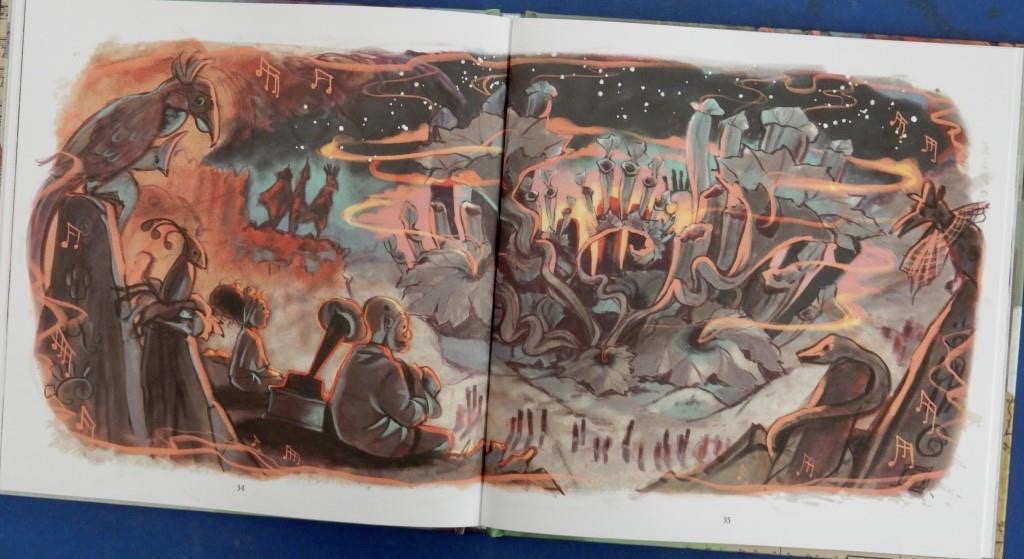
Fred is staying with her grandfather in the countryside for the summer holidays. Grandpa is a botanist who lives in a messy farmhouse around which are dilapidated greenhouses housing all manner of plants from all over the world. Imagine her surprise when one night she hears a banging sound outside and when she investigates, discovers her Grandpa attached to a sausage-shaped balloon.

Even more surprising is his announcement that this contraption is to take them to Papa Nupi a distant island whereon it’s said the rare Tub-Tub plant grows. This plant blooms just once every two hundred years when it is reputed to produce the most amazing music.The last time it bloomed was two hundred years ago the following week so time is of the essence and as Grandpa says, “There’s no time like the present.”

So begins a magical adventure that embraces the threat plastic pollution poses to wildlife as well as showing the transformative possibilities of music and the difference one small hand held device can make.

Which all goes to show that Grandpa was absolutely right when he said at the start of this unusual story, “Music is a language everyone can understand.”

The engaging tale had its origins in a project between the author Zeb Soanes and composer James Marangone. The latter wanted to create an inclusive narrated adventure that inspired children to explore sound no matter their musical ability. To go alongside the music, Zeb included in his story ‘audio clues’ that children can listen for in the text.

With the addition of Anja Uhren’s fantastic quirky illustrations, this became a tale told through illustration, music and writing. The orchestral performance, which includes narration of the story by Zeb alongside James Marangone’s music, will be premiered by Orchestra Sinfonia later this year.

(Related facts and some suggestions for reusing plastic are given at the back of the book.)

The Song for Everyone

The Song for Everyone
Lucy Morris
Bloomsbury Children’s Books

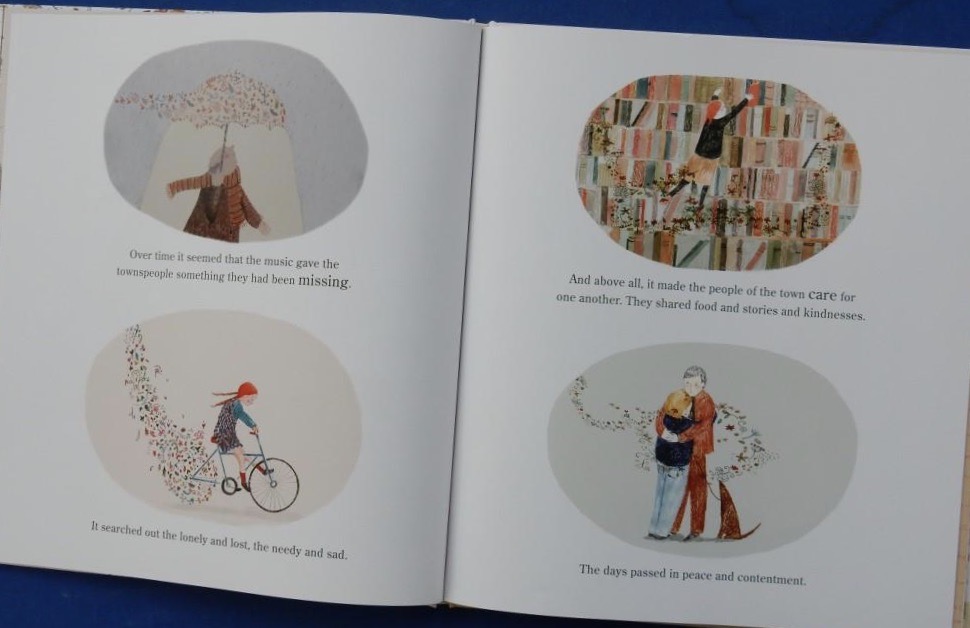
This story starts high up in a tiny window one morning when a sweet sound issues forth. A boy on his way to school stops to enjoy the music and in so doing his loneliness is forgotten. He though, isn’t the only one affected by the beauty of the tune: an old lady is enlivened and filled with joy,

and gradually as the music continues to float on its way, all the townsfolk receives something that has been missing from their lives. Most important though, is that they start to feel a sense of connectedness as they ‘share food, stories and kindness.’ It takes just one small thing to change an entire perspective.

Then one day unexpectedly, the music stops: total silence fills the town.

Dispirited, the townsfolk come together to discuss the absence of the magical music and the lonely schoolboy takes it upon himself to climb up to the window and investigate.

Two days pass and then joy of joys, a sweet sound drifts out through the window and once again the townsfolk are transported by the beauty of music flowing through the streets and through their lives : truly a song for everyone. And the identity of the singer? It’s revealed on the penultimate spread, but story spoiler I won’t be.

A gentle tribute to the power of music, of community and of loving kindness, all of which are more important than ever in our lives at the moment. Without actually using musical notation, Lucy Morris has created a wonderful representation of music as it flows across the pages and over the story’s characters on its transformative way through the town There’s lyricism too in the words Lucy has used in this lovely debut picture book.

A Story Like the Wind

A Story Like the Wind
Gill Lewis and Jo Weaver
Oxford University Press
Gill Lewis has woven a wonderful novella with an up-to-the-minute feel to it. Stories of the refugee crisis continue to feature in the news with desperate people continuing to attempt seemingly impossible journeys in inflatable boats: this fable is such a one and this particular boat is filled with hopeful passengers young and old, ‘clutching the remains of their lives in small bags of belongings.’ The boat’s engine has failed and the boat is adrift on the Mediterranean; but the passengers, their resources dwindling minute by minute, are alive. Even so, they are willing to share what they have. Among them is fourteen year old Rami: he has no food to share so he refuses what the others offer him. What he does have though, is his precious violin: fragile; intricate; beautiful.

I took the only thing I could not leave behind,” he tells the others when asked why he refuses their offers.
Tell us a story to see us through the night,” requests mother of two young children, Nor.
What Rami performs for those beleaguered passengers is, so he tells them a story of Freedom, a story like the wind, a story that begins on the highest plains of the Mongolian desert, known as the ‘land of a million horses’. His story – essentially a Mongolian folktale about a young shepherd and a white stallion that he rescues as a foal, – is powerful, drawing in each and every listener (and readers) and as it progresses part by part, the passengers make connections with their own lives. Carpet seller, Mohammad tells of trying to sell a flying carpet to the woman who is now his wife. Others too have stories to tell but eventually, Rafi’s magical telling is done. It’s brought his audience together in a shared bond of happy memories, of sadness for those they’ve loved and lost, but most of all, of freedom and hope.

With what I fear is an increase in overt racism, in hate crimes and fascism, not only here in the UK, but also in many other parts of the world, this affecting book deserves, (I’d like to say needs), to be shared widely and discussed anywhere people come together in groups.
Music has the power to transform – that is clear from the story;

and it’s something many of us know from experience: so too do words. Let’s hope Gill Lewis’s poignant words here can work the same magic as those of Rami. They certainly moved me to tears several times as I read. But let’s not forget the power of pictures: they too can bring us together, sometimes in shared understanding, sometimes, shared appreciation or awe. Seamlessly integrated into the story, and adding to the sense of connectedness, Jo Weaver’s illustrations rendered in blue-grey shades are at once atmospheric, evocative and intensely moving, as befits the telling.

I’ve signed the charter  

The Bear and the Piano & Little Bear

DSCN5251 (800x600)

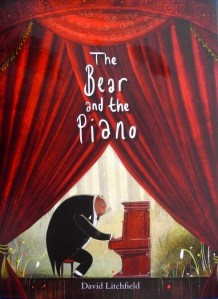
The Bear and the Piano
David Litchfield
Frances Lincoln Children’s Books
There are some amazing picture book debuts this season: here’s one from David Litchfield that absolutely oozes style and panache.
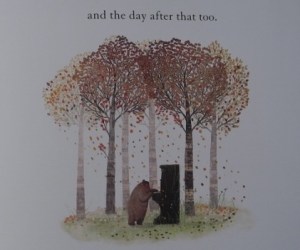
A young bear cub discovers something unexpected in the forest one day and it’s something that, once he gets his paws on it, draws him back again and again and again for days,

DSCN5250 (800x600)

weeks, months and years as his plinking and plonking slowly becomes beautiful music with a power to transport him to magical places far away from his arboreal home.
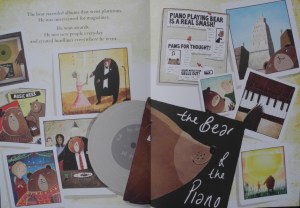
Now a large grizzly, his musical prowess attracts other bears and then, some talent spotting humans. Thus, he leaves home and heads for the bright city lights of Manhattan …

DSCN5249 (800x600)

and stardom …

DSCN5248 (800x600)

What price fame and fortune though without your friends? Time to head for home thinks the bear and back he goes bursting with tales of life as a celebrity. But all he finds when he reaches the forest clearing is …

DSCN5247 (800x600)

Surely it can’t all have been for nothing, can it?
Executed with remarkable finesse, a fine virtuoso performance all round. It has all the qualities of a classic in the making.

Here’s one that’s already established itself as such:

DSCN5374 (800x600)

Little Bear
Else Holmelund Minarik and Maurice Sendak
Red Fox pbk
Many moons ago in an edition of Learning to Read with Picture Books I featured this book in its previous I Can Read incarnation. It was the first of my key ‘Taking Off’ titles and I said of it, ‘a classic whose literary quality is indisputable.’
With four short stories in which Little Bear discovers the value of his own fur coat, makes birthday soup, visits the moon, and makes some wishes, together with its wonderfully warm illustrations by Maurice Sendak, this remains a book that all young children should encounter on their journey as readers. It’s great to see this Red Fox publication of a very special book.

Use your local bookshop    localbookshops_NameImage-2