Shadow Fox

Set in the harsh environment of secret islands of the Great Lakes in Minnesota, this story is told from the viewpoint of a female fox mysteriously calling herself YAAAARRRRAAAWWWAAAARRR.
Pitifully thin, extremely hungry and cold in the snow, said fox is looking for Nan, only Nan; all other humans she hates but gentle fingered Nan, provider of tasty trout has gone missing. Suddenly a voice calls out, it’s not Nan but a girl wearing one of Nan’s jumpers, who appears to be missing someone too.

Feeling let down by the only human she trusts, the fox teams up with the girl, Beatrice or Bee for short and together they set out to search for Nan and put the world to rights once again. An adventure unfolds, which takes them to a mysterious island and unbeknownst to the fox, she possesses magical powers which the islanders are hoping to tap into. They find themselves battling to preserve the beauty and natural integrity of their surroundings. But can they together work to restore natural harmony; it’s either that or the magic of the place will be forever lost.

Slightly surreal, this is a wondrous fantasy story, at the heart of which is the power of friendship, that will draw you in from the start. It’s beautifully written with quirky details of the intelligent, intuitive fox and a potent sense of place that will ensure that readers pick up the subtle message about the vital need for us all to stop abusing our planet and look after it.

Rita & Ralph’s Rotten Day

Rita & Ralph’s Rotten Day
Carmen Agra Deedy and Pete Oswald
Scholastic

Separated by several hills, best friends Rita and Ralph live quite some distance apart but they have established a daily routine, a ritual really. They both go ‘down the hill, and up the hill, and down the hill, and up the hill’ to meet under the apple tree between their houses. There they ‘high-five, pinkie-shake, do a cha-cha-cha, play zombie tag, and make daisy chains.’
One day though, they decide to play a new game, Sticks and Stones. Ralph accidentally knocks Rita who ends up with a very sore bump on her head and they both run off back home, Rita angry, Ralph sorry for hurting his best pal.


He wants to apologise so he makes the entire journey to Rita’s house. What a walk! ‘down the hill and up the hill … ‘He arrives feeling a tad grumpy and his apology doesn’t come across as very genuine so Rita’s door remains closed. Off storms Ralph back home leaving Rita feeling the need to say sorry. Off she runs – you know how it goes –

but her thoughts en route anger her and she also leaves without apologising. Now the two children are both mad and sad. What a rotten day and it’s followed by a sleepless night.
A new day begins and Rita and Ralph head out to their usual meeting place. Can peace resume? Of course it can for ‘best friends always find a way… ‘

Thoroughly engaging and what fun this will be in a story time session with all that upping and downing of hills, high fiving, pinkie shaking, cha-cha-cha’ing. The author provides a note showing how to play the ‘Mr Wiggle and Mr Waggle’ hand game after the story, a story which shows how anger can sometimes cause ridiculous behaviour and saying sorry to a treasured friend is a vital, often up and down, process. Pete Oswald’s digitally worked gouache illustrations skilfully uses the format, showing the hilly landscape, the contrasting homes of Rita and Ralph, not to mention occasional guest appearances of Ralph’s cat and Rita’s dog, and humorously depicting the feelings of both children in their constantly changing expressions and body language.

Food Fight

Food Fight
Alex Latimer
Oxford Children’s Books

Brimming over with wit and humour is this story of young friends Grape and Mushroom. These two have a problem though. Since way, way back in time and for reasons completely forgotten the Vegetables and the Fruits have been bitterly at odds, hurling insults at each other and attempting to put paid to the friendship between Grape and Mushroom. 

Now things have escalated so much that the two young ones hide themselves away during the fighting to discuss what, if anything can be done about this constant warfare.

They decide to ask the advice of the Wise Old Cheese – if such a being even exists – said to live, if the legend is correct, on the Top Shelf of the fridge. This entails scaling the heights on a perilous journey through blizzards and quicksands, each encouraging the other through the worst parts. (Beware of the puns). Finally, utterly exhausted Grape and Mushroom reach the object of their search. 

Wise Old Cheese, exceedingly old, stinky and a tad mouldy, is fast asleep on that Top Shelf. Having explained their plight, the wedge promises through its moustache to think about the problem, but then promptly falls fast asleep once more.
Very disappointed, the friends return, find the Fruits and Vegetables still battling and are about to part company when they become aware of a ‘mysterious milky light’ accompanied by ‘a familiar pungent pong’. 

All squabbling ceases as there before them is the wise Old Cheese. The mouldy wedge announces the purpose of his visit and draws their attention to Mushroom and Grape, wonderful examples of cooperation united in a single purpose.

And so it is that the two factions, impressed at what they’ve heard, decide they have rather a lot in common and resolve to try peaceable living.

With a plenitude of wordplay, speech bubbles, splendidly expressive garden produce and instantly recognisable kitchen equipment, this is a delicious story demonstrating the all-conquering power of friendship and the importance of focussing on similarities not differences.

Lost

Lost
Mariajo Ilustrajo
Frances Lincoln Children’s Books

When a polar bear finds himself in a bustling concrete city, he knows not how he got there but he does know that he is totally lost. His attempts to ask for help are ignored – everybody is too busy to take any notice, so Bear joins a queue. Rather than the help he’s hoping for Bear receives take away coffee and discovers it definitely isn’t to his taste.

All he gets from the help desk he tries next, is a tube map that’s thrust into his paw. His North Pole home isn’t marked thereon, so Bear boards an underground train and suddenly he hears a small voice greeting him with a friendly hello.

Bear follows the child and her mother when they leave the train and the little girl leads him into her home. She makes Bear feel welcome but despite the love shown, still he knows this can’t be his forever home.

Despairing that she has no idea where the North Pole is, Bear suddenly spies a book on the shelf, takes it down and shows his host pictures of where he’s from. Soon a plan is formed and equally quickly Bear is wrapped up and air-lifted

all that way back from whence he came. There a snuggly hug (if anything in such a chilly place can be called that ) from his fellow polar bears and he shows them something very special that he’s brought with him from his little human friend.

MariaJo’s story-telling style is a skilful synthesis of humour and touching emotion that conveys the comfort and support that a loving friendship can provide in a way that both children and adults can appreciate.

The book will certainly resonate with all of us concerned about the hostile environment that the UK is currently presenting to those who arrive on our shores feeling completely lost so far from home.

Felix After the Rain

Felix After the Rain
Dunja Jogan (translsated by Olivia Hellewell)
Tiny Owl

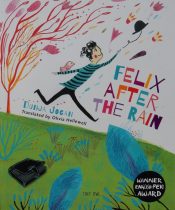
Felix is full of sorrow; in fact the boy appears to be carrying the weight of the world’s sorrows on his shoulders or rather in the huge suitcase he hauls around with him everywhere he goes. Each time something upsetting has occurred in his life, it causes his suitcase to increase in weight; so much so that it’s become almost impossible to move.

One day when it feels as though his sadness has become completely overwhelming, desperately in need of a rest, Felix stops and falls asleep beneath the shade of a tree.

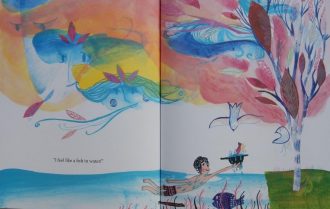
A small boy playing close by sees the case, opens it and all the pent-up feelings are released into the sky causing a tumultuous storm.

Very soon though, the storm abates leaving Felix feeling calm, light and happy. A total transformation has occurred

and with a joyful heart he goes back home mightily relieved and ready to share his happy feelings with everyone around.

With its themes of the power of the importance of friendship, and of letting go of baggage we carry and being able to move forward, this is a very powerful book that speaks to both children and adults.

Dunja Jogan’s storytelling illustrations are enormously potent too, and her colour palette is exquisite.

Families, school classrooms, early years settings, in fact anywhere that children might spend time – should have a copy of this.