
Little Answer
Tim Hopgood
Picture Corgi pbk
Most people have plenty of questions to which they seek answers but sad, lost Little Answer is desperate to find the question to which he is THE answer. Snail offers to help him in his search and off they go. The first encounter is with elephant; his question is (of course) a big one; “What makes the world go round?”
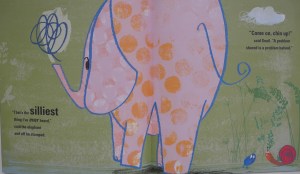
Elephant is totally unimpressed with Little Answer’s response of “Sausages!” Butterfly, Ladybird and Owl are equally unimpressed when they get the same response to their difficult questions.
Snail begins to have doubts about Little Answer fitting any question at all;
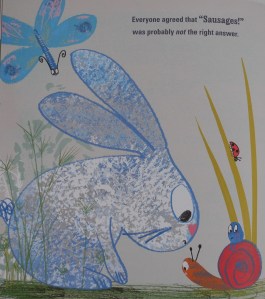
he certainly is not the correct answer to Rabbit’s “Where did everything come from?” No giving up now though, says Snail to a departing Little Answer but then along comes Daisy with something very important to ask …

This story is an absolute joy to read aloud and has had enthusiastic responses at every sharing with the children on the edge of their ‘seats’ as they anticipate Little Answer’s response each time. Not only is it very funny, it’s beautifully constructed and the tenor is spot on.
So too are the child-friendly illustrations created with simple outlines, shapes and strokes of brush, pen, crayon and pastel on mostly pale coloured papers.
Moreover, countless possibilities for exploration – artistic and philosophical – lie herein.
Buy from Amazon

The Dawn Chorus
Suzanne Barton
Bloomsbury Children’s Books
When Peep hears a beautiful song nearby he is determined to discover its singer. Off he flies, stopping to ask in turn, the owl, a mouse and then a frog. The frog directs him to its source – a tree atop a hill and there he finds a whole host of birds all singing. “We’re the Dawn Chorus,” one informs Peep. Peep immediately wants to join them and an audition is duly arranged for dawn the following day. Peep flies home and practices hard until he falls fast asleep. But next morning to his horror, he discovers he’s missed that day’s singing and begs for a second chance. The following day, having practiced so much and stayed awake all night, he is so tired he can only yawn at the audition.

It’s a very sad Peep that flies off home and as the sun sets he sings softly. His song is answered by a similar-looking bird.
“Why can I sing in the evening… but not … with the Dawn Chorus? “ Peeps asks. Thereupon he receives an explanation and at the same time discovers his true identity and most importantly, finds a soul mate.

It is possible to detect the Japanese influence on Suzanne Barton’s lovely, mixed media, almost child-like, illustrations. I particularly like the way she has worked those fabrics into her portrayal of the owl
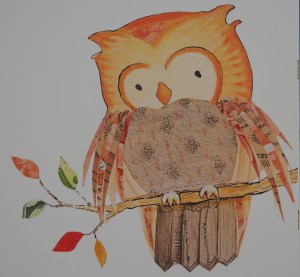
and Peep’s Indian woodblock print-looking wings.
Here assuredly is an artist to follow with interest; this debut book is a delight from cover to cover. The story itself sends out – like the birds’ songs – a powerful message about identity and belonging and discovering your true self.
Buy from Amazon
Little Tree
Jenny Bowers
The Big Picture Press
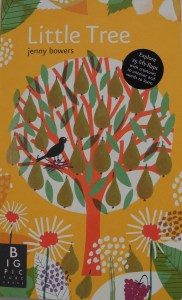
This book is a true wonder to behold. Superbly conceived, illustrated and designed, it takes readers through the seasons alongside Little Tree, showing its changes and those of the surrounding habitat during the course of a year.
Ingenious use is made of the flaps, which serve in a similar fashion to more traditional labels, drawing the attention to particular features the names of which are revealed when the flaps are lifted.

Nina and Rosa spent ages exploring the wonders of the spring.
Even more ingenious though, is the placing of the developing Little Tree in the same position on each right hand page, while on the left each time we are shown a mature tree and the seasonal changes that undergoes, further enhanced by a strategically placed flap. For instance, in winter, the mature tree has an insect resting in a hole in its trunk covered by a flap in the shape of a seed head; on the next (spring) page the same hole harbours a birds’ nest with first ‘eggs’
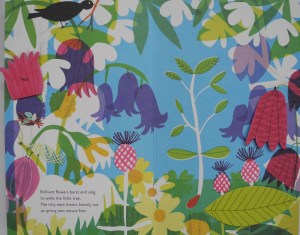
and then chicks, are discovered by lifting the flaps. Summer brings the birds leaving the nest,; in autumn a squirrel eating an acorn is beneath a leaf in the same spot and winter has a mouse nestling in the place the birds have abandoned Thus seasonal change and revelation go hand in hand as a child works through the book.

 A real sense of awe and wonder is evoked as the sturdy board pages are turned and children explore the delights contained on each and every spread and hear the gentle poetic accompanying text.
A treasure trove of opportunities – artistic, poetic and scientific and of course, discussion, is contained within the covers of this gem of a book. No primary classroom should be without at least one copy.
Buy from Amazon
Find and buy from your local bookshop: http://www.booksellers.org.uk/bookshopsearch
Nominations for The Queen of Teen 2014 award are called for. For further information visit: www.queenofteen.co.uk


 Red Reading Hub - Jillrbennett's Reviews of Children's Books