That’s My Flower!

That’s My Flower!
Alice Hemming and Nicola Slater
Scholastic

The rather possessive rodent and his feathered friend from The Leaf Thief return in a new story.

When Squirrel wakes one morning he’s excited to discover that the leaves are back on the trees: hurrah! it’s spring.

Suddenly Squirrel is surprised by unusual buzzing and cuckoo-ing sounds. Then a strange bird flies at his head. Fortunately Bird is close by to explain about spring’s arrival being heralded by a bumblebee, a cuckoo and a swallow.
Then Squirrel notices a small, yellow flower that reminds him of the sun: another sign of spring explains Bird. By now Squirrel has decided that he likes spring but goes on to claim ownership of the flower and starts trying to protect it.

It mustn’t get wet, nor be attacked by bees, he decides until Bird tells his pal that the flower needs rain and that visiting bees help flowers. Moreover, “Your flower is a wild flower … It’s there for everyone to enjoy,”

Still Squirrel continues his safekeeping activities by covering the flower with a bucket, with disastrous results, he later discovers.

Happily though, Bird persuades Squirrel just to leave the flower alone. The following morning, a wonderful surprise awaits when the two wake up.

Bird’s gentle lesson has been a success. Such a fun lesson it was too, for young readers and listeners certainly. They will be sure to laugh at Squirrel’s lack of understanding regarding the natural world, made all the funnier by Nicola Slater’s portrayal of Squirrel’s custodial antics and his friend’s reactions.

Let’s hope Alice Hemming’s story will encourage respect for the natural world in children.
Patience, Miyuki

Patience, Miyuki
Roxane Marie Galliez and Seng Soun Ratanavanh
Princeton Architectural Press

I’ve not met Miyuki before although this book is a follow up to Time for Bed, Miyuki and it seems slightly strange to receive for review as summer gives way to autumn, a story about the magic of spring. Nonetheless it’s a beauty and so worth drawing attention to.

Miyuki is excited at the arrival of spring and cannot wait to revel in the joys it brings. On her walk with her Grandfather she notices a flower that is yet to open. “Be patient” she’s told, this delicate little flower needs the purest water.

At these words she’s off on a mission to find that water to make the flower burst into bloom.

Her quest leads to an encounter with a toad in a well, a pretty cloud, a beautiful waterfall

and a boy watering his garden who does provide her with what she seeks.

In her haste to return however she trips, hurts her leg and spills the water.

As a result she has to stop and in the silence of the moment she hears the song of the river. “Be patient,” it says promising to take her home.

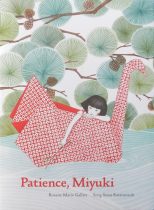
Lulled by the water, she falls asleep and the river keeps its promise carrying her home, borne by an origami swan to her Grandfather.

Next morning, the second day of spring, Grandfather is able to get her to be still

so that she can observe the wonderful surprise that awaits.

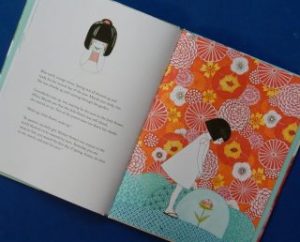
There’s a dream-like quality to this sweet, soft-spoken story that is reflected in Seng Soun Ratanavan’s beautiful jewel-coloured, occasionally playful, illustrations of the natural world, some of which include traditional Japanese objects.

Enjoy the moment is the message of this book, and it’s one we could all do with paying heed to in our increasingly busy times, whatever the season.

Rabbit & Bear The Pest in the Nest

%0a

Rabbit & Bear The Pest in the Nest
Julian Gough and Jim Field
Hodder Children’s Books
After the first wonderful Rabbit & Bear book, Bear’s Bad Habits, from this duo I did wonder whether the second could possibly be as good. The answer is definitely yes, every bit as brilliant and every bit as uproarious. Here’s a sample of the delights of the dialogue:
‘ “What?” asked Bear. “I’m angry! And I want to be calm! So I’m angry that I’m angry!” …
Why did you kick yourself?
Because I’m annoyed with myself!” said Rabbit. “Because I can’t change myself
But you can change your thoughts,” said Bear.
Change my thoughts? What’s wrong with them? My thoughts are PERFECT,” said Rabbit.
But your thoughts are making you unhappy,” said Bear.
No!” said Rabbit. “The world is making me unhappy! I must change the world … Stupid world! Change!” …
Maybe you could just think about the world differently,” said Bear. “Maybe you could … accept it
Accept! Accept!” said Rabbit … “What’s accept mean?
Saying, well, that’s just the way it is,” said Bear. “Not try to change it.
No!” said Rabbit. (a creature after my own heart; don’t an awful lot of us feel like that right now with everything that’s happening around us?) Bear though, is entirely right when she tells her pal, “Your brain is getting into a fight with the World.
As you’ll have realised – if you weren’t already aware from book 1 – these two characters are pretty much polar opposites with cantankerous Rabbit and reasonable, reasoning Bear.
What in particular though, in this tale, has made Rabbit so tetchy? Only that he’s been woken from his slumbers by a TERRIBLE noise and his place of repose (Bear’s cave) is full of light. No, it’s not thunder and lightning as he fears however, but Bear snoring and Spring sunlight illuminating the cave.

%0a

That’s just the start of things though: worse is to follow. There’s an intruder in his burrow – not the snake he feared but still not wanted …

%0a

and newcomer to the valley, Woodpecker’s ‘BANG! BANG! BANG!’ is utterly infuriating.
Thank goodness then for Bear and her words of wisdom. She has a wonderfully tempering effect on Rabbit and although he won’t, despite what he says, remain “Calm and Happy and Wise forever!” he does now at least have some coping mechanisms: for Bear’s snoring anyway “Mmm, maybe I should think about it in a Different Way. … Yes! I shall stop thinking of it as a Nasty Noise. I shall think of it instead as a nice, friendly reminder that my friend Bear is nearby.” And suddenly the sound, without changing at all, made Rabbit feel all happy and warm. (Must try that one.)
As well as so much to giggle over, Gough give his readers (as well as Rabbit) plenty to ponder upon in Bear’s philosophical musings about the manner in which they react to things: perspective is what it’s about essentially. Field’s visuals are equally sublime in the way they present both the humour and pathos in the relationship between the two main characters, and the situations they are involved in.

%0a

A brilliant read for newly independent readers, but also a great read aloud: adults will enjoy it as much as listeners I suspect.

WNDB_Button localbookshops_nameimage-2