Terrible True Tales: Saxons / Terrible True Tales: Victorians

Both books are published by Bloomsbury Education: thanks to the publisher for sending them for review.
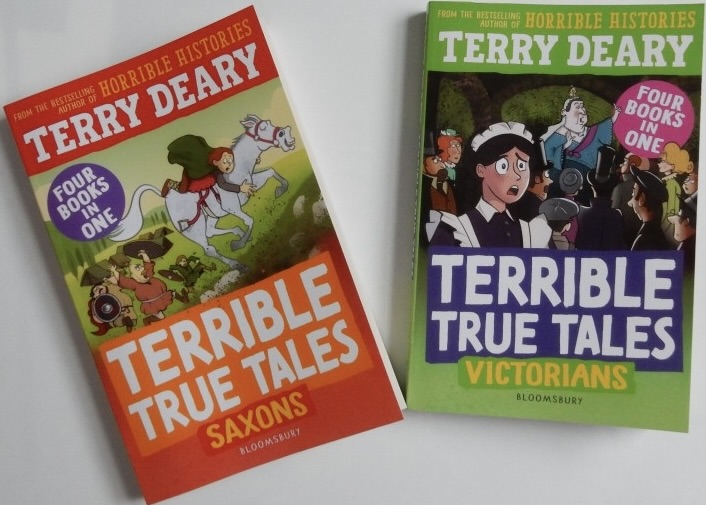
Continuing the Terrible True Tales series, Horrible Histories author Terry Deary presents two new four in one titles, each accessibly written in his chatty style.

The four Saxon Tales are set in turn in Yorkshire, Maidstone (Kent) and the Kingdom of Mercia (the Midlands of today). The first is related by Ardith Hutton whose father, a tanner died from plague. Ardith, narrowly escaped being burnt alive in their home and was taken in by Wilfred a kind neighbour, became his apprentice and then almost got burnt alive again. Eventually after Wilfred died, Ardith took on his role and in turn found an apprentice.

Fictional children are the main focus in each of the other tales so readers are given a glimpse of what it was like to be a youngster in Anglo Saxon times. Figures from history include King Offa (of Mercia), King Athelstan (of England) and the foolish King Vortigern and topics mentioned are medicine, magic and healing, bandits and the work children did.
Following each story comes an afterword that puts the tale into a historical context and some ‘You Try’ activities for children.
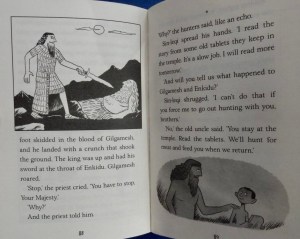
With Tambo’s black and white illustrations further illuminating the text, this is a smashing way to encourage primary age children to engage with history that could otherwise perhaps be dull and dry.

Also told in Deary’s captivating style and bursting with information is Victorians wherein the focus is on travel during the Industrial Revolution.
The stories are about in turn, the first powered airship set in Paris invented by Henri Gifford, the first steamship the Sirius, to travel to America, the Staplehurst rail crash in Kent (Dickens features herein) and finally, the Big Stink that tells the story of the London sewers and related to it, the invention of the London Underground.
Like the previous book, children play an important role in each tale and this book is illustrated in an appropriately dramatic style, by Helen Flook
Terrible True Tales: The Stone Age/ Terrible True Tales: Greeks

The Great Storm is set on Skara Brae, Orkney, 5000 years back. There live Tuk and Storm both of whom are tired of eating fish and set out to catch a bird for a bit of red meat. On returning to the village, there’s nobody around so they head to the Great Hall where a meeting is underway and learn that their father, Orc, has been accused of theft. Can they uncover the real thief before the villagers serve up their own form of justice?
In The Great Flood, we meet Jay and her family at the end of the ice-age. They live off the land catching deer and whatever else they can. One evening after Jay and Moor’s return from the hunt had involved crossing a rapidly rising river, they sit watching two bands of hunters fighting over deer. Grandfather proceeds to tell the story of Noh, Aye his wife and the building of the ark to survive the great flood. This he then relates to their own experiences of rising water levels and what they must do to survive.

Exciting tales all, wittily told by Terry Deary who uses engaging language play, each being based on historical/ archaeological evidence. Also included are lots of drawings by Tambe. There’s a fact file for each tale and some activities to extend the learning.


The same is true of the companion book, Greeks, illustrated by Helen Flook.

In the four stories herein, Terry Deary breathes new life into fables and legends, each title being an indication of his witty take on a well-known tale. We have The Tortoise and the Dare, The Lion’s Slave, The Boy Who Cried Horse and The Town Mouse and the Spartan House.

Both books deserve to be in KS2 classrooms and should help turn even those disinterested in history, into enthusiasts.

Terrible True Tales: Romans / Terrible True Tales: Egyptians

Having watched his parents slain by the Romans, the boy narrator of the first tale The Captive Celt, is taken from Britannia to Rome as a slave, not to a Roman but to Celtic hero Caratacus.

There he learns vital fighting skills and three years later, his master frees him to return to his homeland.
With maternal death, human sacrifice, brutal corporal punishment, genocide, and child slavery this is pretty terrifying stuff but Terry Deary’s dark, wicked sense of humour shines through it all and children love it.
They will also enjoy the three other stories – The Fatal Fire, The Grim Ghost and The Goose Guards. The Fatal Fire gives a short account of the burning of Rome and of the Emperor Nero.
The Grim Ghost refers to the subject of a tale told to a young boy, Pertinax as he keeps the great Pliny company in the garden. The Goose Guards tells of a boy priest who is determined to get his revenge on fellow pupil Flavia for making him look stupid during a lesson with the head priest.
Each story has an afterword giving a factual historical summary, as well as a ‘You Try’ activity or two.

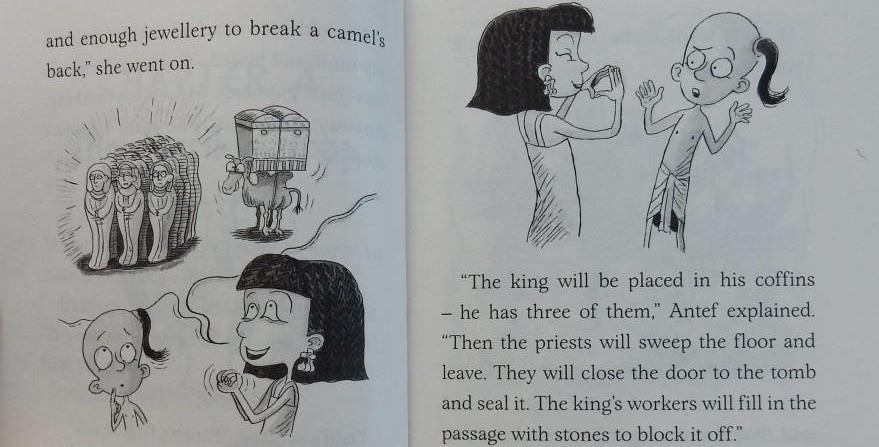
Egyptians too has four stories loosely based on real events. The Gold in the Grave is told from the viewpoint of Paneb a tavern owner’s son, renowned for his thieving skills. In the robbery he’s aided and abetted by Dalifa,

Both are tasked with getting the treasure out of Tutankhamen’s tomb after the funeral ceremony. You could say of some concerned with this thievery, greed comes before a fall.
The Plot on the Pyramid centres on the pyramid builders, with farmers being required to work for the Pharaoh building a pyramid during Akhet, the time of year when the river rises, flooding the surrounding fields. We read of the trials and tribulations of one farmer, Yenini, member of a gang working under the direction of the bullying Ahmes. With lots of gory details, many young readers will relish this.
In The Magic and the Mummy a father tells his young daughter Neria she’s to assist him in the House of Death where mummies are made. To her surprise she is asked to mummify the pharaoh’s cat so it can accompany him to the Afterlife. There’s a big problem however: this cat looks very like her own cat, Katkins so there’s no way she wants to kill and gut the creature. Is there any way she can save the cat and not get caught and punished for so doing?
The Phantom of the Nile sees Menses, a bit of a chatterbox, training to be a scribe in the local temple. In order to earn extra money to buy his father a much-needed new boat for fishing, he takes on another job, to help Maiarch get rid of the phantom that haunts her new house. When Menses visits the woman a second time he is accompanied by his friend Ahmose who quickly surmises that it’s no ghostly being that is alarming Maiarch. So who is it and what is the intruder’s purpose? Can Menses come up with a plan to expose him and even earn the money his family so badly needs? Greed and doing the right thing are at the heart of this story.

Irreverent and huge fun – the fun being added to by Helen Flook’s illustrations. Put both books in a primary classroom and children will be clamouring to read them.