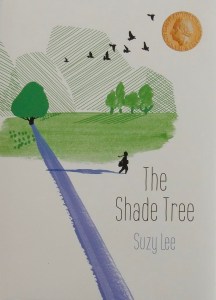
The Shade Tree
Suzy Lee (translated by Helen Mixter)
Greystone Kids
This is a re-telling of an old Korean folk tale wherein we see how a young traveller tricks a rich but heartless man into selling him the shade from the tree that grows on the latter’s land. The rich man considers he’s made some very easy cash but hasn’t considered the effects of the lengthening shadow of his house as the day progresses.Whatever the shade touches is thus owned by the traveller, and he can share it with whomever he wishes. Furthermore when the shade covers the rich man’s house, the traveller can enter that house, which he does,

eventually causing the wealthy one to move out. Once the house is vacant the traveller settles down and enjoys life as the new resident.
Much of the power of this thought-provoking telling lies in its simplicity, simple too is Suzy Lee’s art; it’s almost abstract in style and uses a limited colour palette to effect. With its dramatic gatefold, this is altogether an unusual book that feels at once both old-fashioned and contemporary. It would probably appeal most to older readers especially those with an interest in folk stories.

Rapunzel
Sarah Gibb
Harper Collins Children’s Books
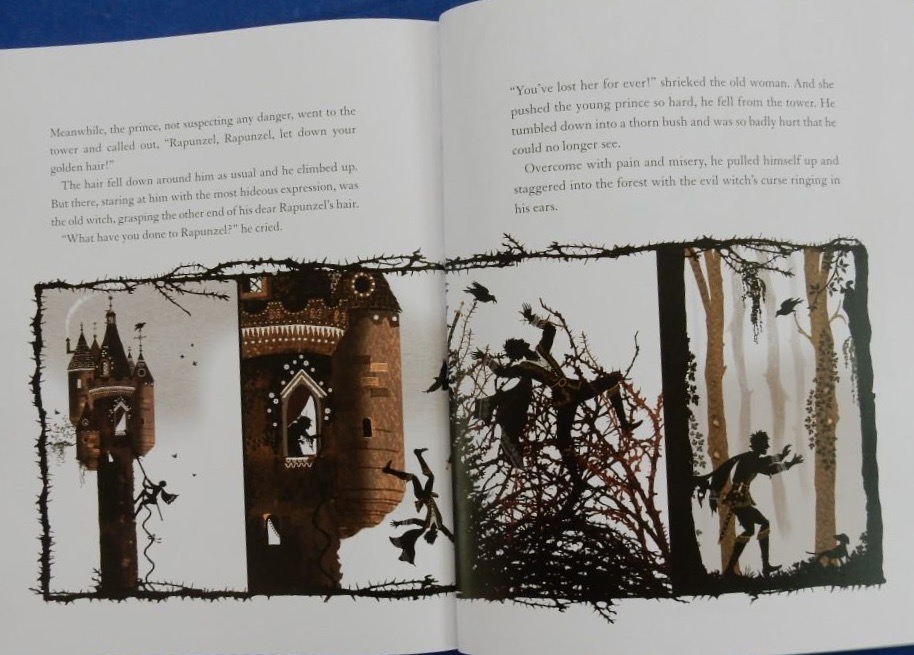
Sarah Gibb has taken the original classic fairytale and turned it into a visual feast.with a mix of gorgeous silhouettes and delicate, detailed colour illustrations, without losing any of the essential elements of the plot in her simplified telling. We still have the drama: the witch discovering the young husband helping himself to the salad leaves from her garden to cure his ailing wife and his promising to give her the baby when born in return. And romance: the baby Rapunzel becoming a beautiful girl incarcerated in a tower, who is visited by a prince and the two eventually marrying.
Rapunzel’s tower is illustrated in true fairytale style, with turrets and weathervanes, vines and roses
and the contrasting silhouette style prince staggering through the forest having been seriously hurt as a result of his fall from the tower.
Recently reissued with a new cover, I suggest that if you are looking for a highly pictorial version of the fairytale, look no further than Sarah Gibb’s offering.


 Red Reading Hub - Jillrbennett's Reviews of Children's Books