Smugglers’ Fox

This image has an empty alt attribute; its file name is dscn9600-2.jpg


Smugglers’ Fox
Susanna Bailey
Farshore


It took just a few minutes for Susanna Bailey’s wonderful word weaving to engulf me in a cocoon, unwilling to emerge until this story, with Keith Robinson’s splendid cover illustration, reached its conclusion.


Johan (nearly eleven) considers it is his role to look after his four year old brother Rio, especially after an incident on the beach, following which their Mam disappears and the social workers say she isn’t coming back this time.


It’s not long before Johan learns that the two of them are to be split up and he is to go and live with long-term foster carer, Mimi, in a little house at Robin Hood’s Bay. ‘I need a plan … me and Rio are stitched together like threads in a jumper . If they pull us apart , we’ll both unravel, and we won’t be Rio or Jonah any more. We won’t be anything,’ he tells readers, going on to call himself ‘Bad-Luck Jonah,’ Nevertheless move he has to, but not before making an unbreakable pinkie-promise to Rio that he has a plan.

At Mimi’s Johan spends a lot of his time making a book of illustrated stories for his brother to show he’s not forgotten him and because it’s part of his three part plan. The second part is being co-operative and helpful to Mimi and the third is trying not to worry about the sea. It’s far from easy when Mimi takes him for a walk to buy something tasty for a treat and while they’re out, a fox suddenly appears, a hungry-looking one, which Johan can’t help but feed. So begins the building of a bond between boy and fox.


Then Mimi shows Johan Grandpa Ted’s secret box containing what might be a treasure map: could this help him keep this promise to Rio? But then things get too much for the boy; he runs off and as a result meets Freddie in what he learns is his Dad’s allotment. Freddie is also familiar with the fox and it turns out that Mimi knows Freddie too. The more time Johan spends with his new friend, the more he’s convinced that Freddie is hiding something.and eventually he shares his troubles with Johan.


A few days later, Johan finds himself in a very dangerous situation and as he says, ‘Digging for Rio, For my friend Freddie. Digging for my life.’


Sometimes the way Johan describes his feelings is so poignant I felt raw inside, but this book ends with the boy accepting things he never thought he could because ‘whatever happens, we’re always part of one another. Jonah, Rio, Freddie. And the smugglers’ fox.’ That is because this haunting story comes from the heart, not only Jonah’s but that of Susanna Bailey too, for she was once a fostering and adoption social worker.
Raven Winter

Raven Winter
Susanna Bailey
Farshore

Having enjoyed both Snow Foal and Otter’s Moon I was anticipating another treat with Raven Winter and was not disappointed. Susanna’s lyrical prose sweeps you away from the start but with themes of domestic abuse, coercive control, hurt, and loneliness this is anything but a comfortable read despite the sensitivity with which difficult issues are presented.

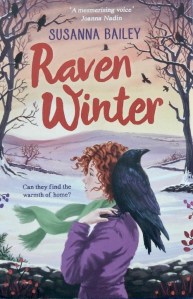
The story is told from the viewpoint of Billie whose father is in prison and whose mother has allowed her new man, Daniel, to move into their flat making life a misery not only for the girl but also her Mam.
Eventually Billie decides that her life has become unbearable (Dad’s letters have stopped coming months back, but she doesn’t believe he’s stopped loving her) and she decides to run away. But then she finds a badly injured raven in the woods where she goes to feel closer to her Dad. She takes the bird home to care for it endangering herself and forcing her to defer her plans but in so doing she finds hope. Hope in the form of letters which her mum must have kept from her, with an address that she’s never before seen. This increases her determination to find her Dad, but now she’s even more conflicted inside.

Meanwhile Bille has met Nell, also something of a loner, who lives nearby with her Nan. At first Billie brushes aside her approaches but little by little a bond develops between the two girls.

There are many strands to this powerful story and binding them together is a celebration of nature and its power to heal: what the author has achieved is a fine balance between sadness and beauty. Not everything is resolved but father and daughter are reunited and there’s hope for the future. There’s also a reassuring message to any reader in a situation similar to Billie about the importance of going to a trusted adult for help.

Otters’ Moon / The Tipple Twins and the Gift

Otters’ Moon
Susanna Bailey
Egmont

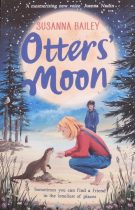
I was hooked by this story from the very first page; there’s something magical about Susanna Bailey’s lyrical prose that gently draws you in and keeps you turning the pages right through to the end. The narrator is Luke, led by his mother to believe that holidaying on a remote Scottish island with his photographer mother is just the thing to help them get over a break-up with Luke’s dad. The place promises outdoor summer delights, she tells him.   

The boy’s first reaction is far from favourable – the island children seem hostile, but he does strike up a conversation with a girl who introduces herself as Meghan -Meg for short – and says she lives in a dilapidated boathouse on the beach. He later hears of her absent parents – marine biologists – and that she’s residing with her Grandad who seems rather muddled, calling the boy David, mistaking him Meg says for her own father. A puzzle for sure, thinks Luke. Even more puzzling is when Grandad later says, as he looks skyward, “Remember laddie … Remember the Otters’ Moon.”

Next day, despite her instructing him not to, Luke follows Meg to a distant rocky outcrop where there are puffins. Displeased at his appearance, she realises Luke is determined to stay at this hidden place and tells him that there are also otters in Puffin Bay, although nobody but she knows of their return. She tells him too that her parents both disappeared without trace off this coast.

With a hint of hostility, a friendship develops between the children, Luke also raw about the absence of his father, becomes more observant of and concerned for, his mum; and he wonders whether Meg’s situation, with its strange secrets, is as bad as his own. Slowly, slowly he starts to change his mind about the island: perhaps it isn’t quite the boring place he first thought.

Then the two children (“city boy” and “island girl”) manage to rescue an injured orphan otter pup, incapable of surviving on its own and they name it Willow. But it’s no easy task taking care of the creature and preparing her to go it alone in the potentially dangerous waters.

Just to complicate matters, Luke learns that his new baby sister is very poorly and needs an operation to survive. Shortly after though, it’s Luke’s survival that is in question and there’s only Willow to depend upon.

As the wonderful, poignant story ends, the visitors prepare to leave the island, but we see that some things endure: hope, friendship and love can transcend the most challenging circumstances.

The Tipple Twins and the Gift
Michelle Cordara
Matador Children’s Books

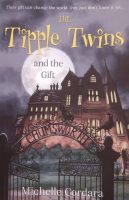
The Tipple twins are the only identical twins in England, all other twins having mysteriously disappeared never to be seen again. Also mysteriously disappeared is the twins’ elder sister Caitlin, whom nobody has seen for two years.

Suddenly, out of the blue, who should arrive but their Uncle, Aunt and their daughter. The parents announce that they’re off to to Egypt, demanding that Beatrice stay with her cousins as she’s been discovered using magic at school, hence the hasty exit.  Then comes the news: all three girls are to start at Chumsworth School, a very dark place so Boo, their ‘pet’ ghost informs the twins.

On arrival they’re greeted with warnings about avoiding a certain room thirteen, the whereabouts of which nobody seems to know. They quickly learn that the head, Miss Snippings, has a particular aversion to identical twins.  With the feeling of a hidden presence watching them things get increasing strange . Then Miss Snippings announces that the end of term play will be about the Salem Witch Trials. When she discovers that identical twins have just joined the school, Jenna and Jessica know that big trouble lies ahead. Already they’re being victimised by their head teacher; but who is she really? And what does she want with the twins?

Occasionally nightmarish, but not overly so, this atmospheric story is full of foreboding but there’s some humour too; for KS2 readers who like their fiction dark and mysterious.

Snow Foal

Snow Foal
Susanna Bailey
Egmont

It used to be said that Philippa Pearce was the queen of short sentences; now newcomer Susanna Bailey is a serious contender for that title. Her debut story Snow Foal is absolutely beautifully written, with lots of poignant moments and deeply affecting.

During a very cold winter, eleven year old Abbie is sent to stay with a foster-care family in a remote farm on Exmoor. She’s hurting badly inside, angry and mistrusts the people around her especially Sunni, another foster child of Ruth and Sam. What’s more she’s convinced that her stay at the farm is to be a very short one, despite what her social worker and others tell her.

Then one day Abbie rescues a little wild foal that has become separated from its mother too; now it seems that in him she has found a kindred spirit.

Their friendship grows and Abbie becomes increasingly determined to reunite the foal with his mother, putting herself into all kinds of danger so to do.

Ultimately though despite disappointments for Abbie, this story is one of love, healing, hope and friendship: a tale where although you’re eager to discover what happens, you’re forced to slow down and savour the writing of such passages as this: ‘But she couldn’t go now. She felt paper-thin; as transparent as a wind- blown leaf. Everyone would be able to see right inside her.’

This book would make a superb Christmas present; I suggest reading it snuggled under a cosy blanket.