Sorrell and the Sleepover

Sorrell and the Sleepover
Corrinne Averiss and Susan Varley
Andersen Press

Have you ever kept something about yourself or family a secret from a best friend so as not to feel inferior? That’s what one  of the main characters in this lovely story decides to do.

It revolves around best friends Sage and Sorrel (squirrels). Pretty much everything about the two is the same: they like the same games, sing the same songs and say the same things at the same time. Even their tails have identical stripes.

Sorrel is thrilled when Sage invites her to stay at her house for a sleepover; rather than feeling nervous about her first night away from home, Sorrel is excited as she packs her overnight nutshell.

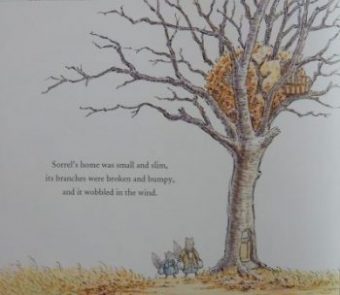
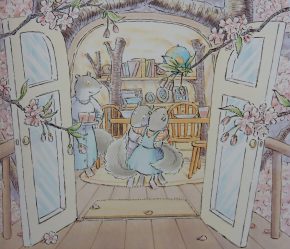
Sage’s home is impressive, a huge branching conifer that includes nests for her aunties and her cousins as well as Sage’s immediate family. But as the two friends snuggle up for the night, Sage’s comment about looking forward to a reciprocal visit causes Sorrel to worry so much about the difference between the two homes that she decides not to invite her friend back. Best friends don’t have differences, she tells herself.

Sage however is persistent and so Sorrel invents a series of excuses: a poorly mum, a burst pipe; the painting of their home resulting in the newly pink leaves being too wet for visitors to stay.

It’s this pinkness however that finally puts paid to further inventive excuses on Sorrel’s part. It also results in the truth being revealed about her home.

Sage, being a true and empathetic friend, isn’t at all concerned about their difference; to her it’s a cause for celebration.

Telling it with tenderness and understanding, Corrinne Averiss has created a story of two trees and two squirrels that will particularly resonate with under confident children who have done the same as Sorrel, but it’s a book that needs to be shared and discussed widely in schools and early years settings.

Susan Varley echoes the warmth of the telling in her beautiful illustrations. I’ve been a huge fan of her work ever since Badger’s Parting Gifts: her art never fails to delight and so it is here: delicate, detailed and utterly enchanting, every spread.

Lovely Old Lion

DSCN4970 (800x600)

Lovely Old Lion
Julia Jarman and Susan Varley
Andersen Press
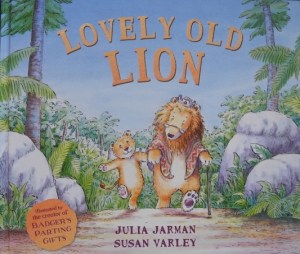
What a gorgeous book but one would expect no less: its illustrator, Susan Varley is the creator of the classic Badger’s Parting Gifts. Here, she’s worked in partnership with Julia Jarman and the result is an equally sensitive picture book, on the tricky topic of dementia.
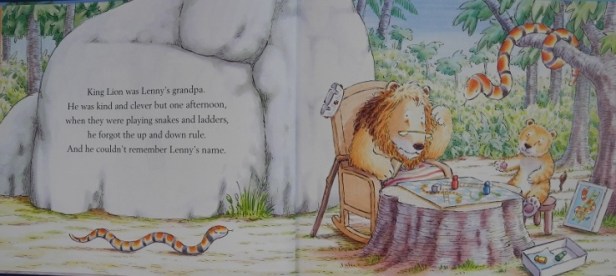
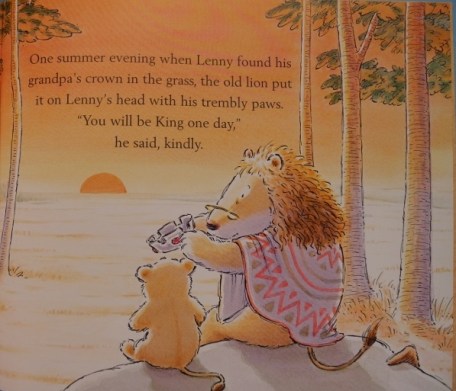
As with most grandchildren and their grandparents, there is a very special bond between young Lenny lion and his grandpa, King Lion. But lately Lenny has noticed changes coming upon his beloved Grandpa: he forgets the rules of games,

DSCN4971 (800x600)

what objects are used for and even, on occasion, Lenny’s name.
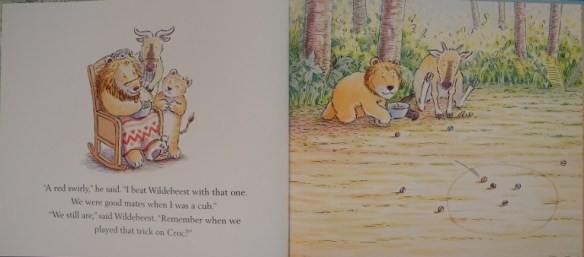
Gradually King Lion becomes more and more confused but young Lenny is determined to continue bringing light and life into his Grandpa’s days. First he chastises the other animals in no uncertain terms when they laugh at King Lion and then he enlists kindly Hippo’s help to ensure that for the remainder of his life, those neighbours and friends keep grandfather provided with objects that help trigger memories of his earlier years when for instance, he was able to outplay or trick his pals,

DSCN4972 (800x600)

or come to their rescue on occasion.

DSCN4973 (800x600)

Every illustration is suffused with tenderness; the details are gently humorous and enormously appealing to the young (and not so young).
Compassionate as the telling surely is, the essentials of the condition such as bad temper are dealt with in an honest straightforward manner. And, the final part of the story in particular serves as a reminder that no matter what our age, the whole of life is an inevitable cycle of growth, change, ageing and eventual loss.

DSCN4974 (800x600)

Adults can choose to fill in specific family details if relevant or, as one would hope, share the story with all young children and let listeners ask their own questions.
This one deserves a place on every family bookshelf and should be in every primary school library and early years setting.

For much older readers is:

DSCN5015 (800x600)

Stonebird
Mike Revell
Quercus
Moving home and starting at a new school, bullying, dementia and the power of stories and storytelling are some of the themes of this book. It centres on the eleven year old narrator Liam, who has moved with his sister Jess and mum, in order to be closer to his Gran who has dementia and now lives in a care home.
Exploring the locality of his new home one day, Liam comes across an ancient-looking stone gargoyle in the crypt of an old church. It’s this gargoyle, Stonebird, and a symbolic marble egg shaped stone his new teacher uses with his class during storytelling circle time sessions, that together play an ultimately transforming part in Liam’s life as he gradually comes to comes to terms with, and begins to cope with the changes he has to face in his new life.
Written by debut author Mike Revell, this powerfully affecting and convincing story is a haunting and ultimately, uplifting read.

Use your local bookshop    localbookshops_NameImage-2

RABBIT, RABBIT, RABBIT!

DSCN1936

Rabbits Don’t Lay Eggs!
Paula Metcalf and Cally Johnson-Isaacs
Macmillan Children’s Books
Bored with his lonely, dark burrow life, Rupert the rabbit hears happy farm sounds beyond the wall and decides to seek a new home there. He tunnels under the fence and POPS up just as Dora duck has finished her new nest, ruining her precious creation. Less than pleased, Dora endeavours to find Rupert something useful to do on the farm, no easy task despite Rupert’s confidence and enthusiasm.

DSCN1940

Such enthusiasm even leads him to believe he can lay an egg. He doesn’t, but after considerable straining and pushing, something else does pop out from his nether regions.

DSCN1939

So, what can Rupert do to earn his right to stay on the farm? Well, what are rabbits expert at? Getting under things that others cannot – like fences between hungry animals and fields of delicious juicy carrots. Now, there’s a job that will please his new friends, Dora included, so long as she thinks he’s ace layer of all those tasty vegetables… hmmmmm!

DSCN1937

Young audiences will love Rupert’s misunderstandings, the shared joke between the author, Rupert and themselves. And, like Rupert’s new-found friends, they’ll relish the visual treats supplied by the bold, bright pictures of Cally Johnson-Isaacs whose scenes, be they full spread or smaller vignette style, are both funny and full of charm, in this farmyard romp.
Buy from Amazon

DSCN1935

The Spring Rabbit
Joyce Dunbar and Susan Varley
Andersen Press pbk
I cannot believe this book is twenty years old. It’s a story I’ve always treasured since it first was published and kept as a special one to share, with fours to sixes especially, towards the end of the Easter term. It tells of young rabbit Smudge who lives with his parents in the woods and is the only one not to have a sister or brother. “Wait until the spring,” is his mother’s response when he asks why he has no siblings. Spring however seems a long way away. So, in autumn Smudge makes a leaf rabbit to be a brother but leaf rabbits cannot play chase, neither can the snow rabbit he makes for a sister in winter, join in a game of snowballs, nor the mud rabbit brother he builds as the snow melts, enjoy splashing in puddles with Smudge;

DSCN1933

in fact it is soon washed away by the rain.
At the first signs of spring, Smudge begins his search for his new sibling but he finds only baby mice, speckled eggs in a robin’s nest and frogspawn in the pond. Sadly he returns home to tell his mother but there awaiting him is a wonderful surprise;

DSCN1934

not just one baby brother but two … and a baby sister as well. Then it’s not long before they can all enjoy Smudge’s specially built, great big moss rabbit.
Smudge and his friends remain as adorable as ever. Susan Varley’s water colour pictures are infused with tenderness and just a hint of gentle humour making them the perfect complement for Joyce Dunbar’s sensitively told story of longing and new life.
Buy from Amazon

Miffy’s Play Date
Illustrations by Dick Bruna
Simon and Schuster Children’s Books
It was something of a relief to discover that thoroughly modern Miffy, who has a play date with her friend Grunty, looks almost the same adorable rabbit she’s always been, despite this new and very now, experience and her slightly broader, digitally rendered mouth. The two pals have fun building a block castle, playing hide and seek, role-playing and much more. All too soon, it’s time to tidy away and Miffy bids farewell to her friend.
Simple, cute and just the thing for the very young to enjoy with an older family member or friend who can not only read the story but also share the instructions to the sticker finding activities. I am at a loss though to understand why the publishers feel a need to flag up this as ‘Practise fine motor skills’ alongside, ‘Relate to a child’s first experiences’. Books should be allowed to speak for themselves – surely the instructions are sufficient anyway but to use ‘early years’ jargon as a sales tactic is, in my opinion, wrong and diminishes the prime purpose of such books, which should be enjoyed for their own sake.
Buy from Amazon

DSCN1928

Miffy at the Zoo
Dick Bruna
Simon and Schuster Children’s Books
Thankfully there is no such message on the new edition of this old favourite. Herein, Miffy and her Daddy take a train ride to the zoo where Miffy encounters animals large and small. Poet Tony Mitton has reworked the original texts with his consummate skill as a writer of verse, giving them a modern, yet timeless appeal that remains true to Bruna’s original voice. Personally, I’d start with this one and of course, Miffy.
Buy form Amazon

Find and buy from your local bookseller: http://www.booksellers.org.uk/bookshopsearch