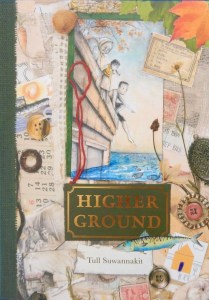
Higher Ground

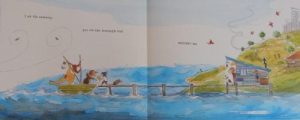
In this highly visual story we follow the lives of a grandmother, a brother (the narrator) and sister and their pet rabbit who are stranded in their city apartment as a result of what Grandma calls The Great Flood. Everybody else left before the water came and so there was nobody to see their rooftop message pleading for help. Thus this space becomes their entire world but Grandma tells the children they must never lose hope.

Day by day she teaches them everything she knows: things about sowing and planting, making repairs, fishing, reusing and recycling, observing their changing surroundings and more. The children seize upon her teachings with enthusiasm, optimism and creativity. The seasons change but so too does Grandma: little by little her strength diminishes. With the waters continuing to rise, the children start building a raft and loading it with produce.
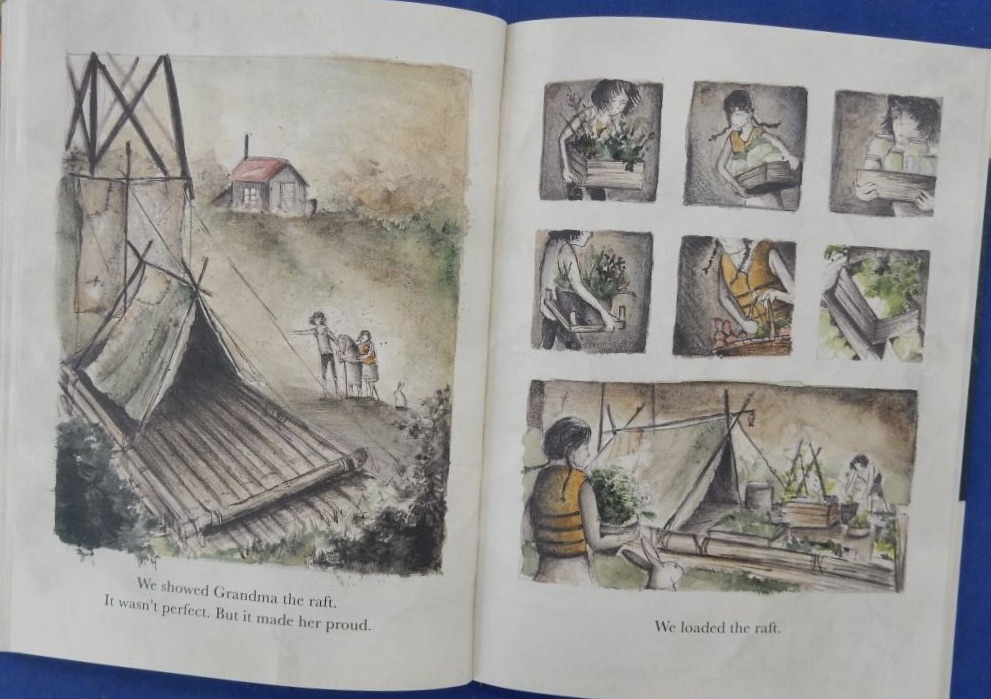
Grandma knows she has little time left so she encourages the children to sail away leaving her to protect their garden: ‘with each ending a new beginning unfolds’, she tells them giving her necklace to her granddaughter and saying that she’ll always be with them.

Weeks later, having been completely lost, battered by fierce stormy waters and on the point of despair, a seabird flying overhead reminds the siblings of Grandma and with lifted spirits they struggle on, eventually finding dry land and a new home among other people. Using their experiences they then show compassion towards other people who also find themselves lost, stranded.

Tull Suwannakit uses predominantly mixed media visual imagery to convey the story, skilfully blending wordless graphic novel sequences, some in black and white, beautiful softly hued landscapes
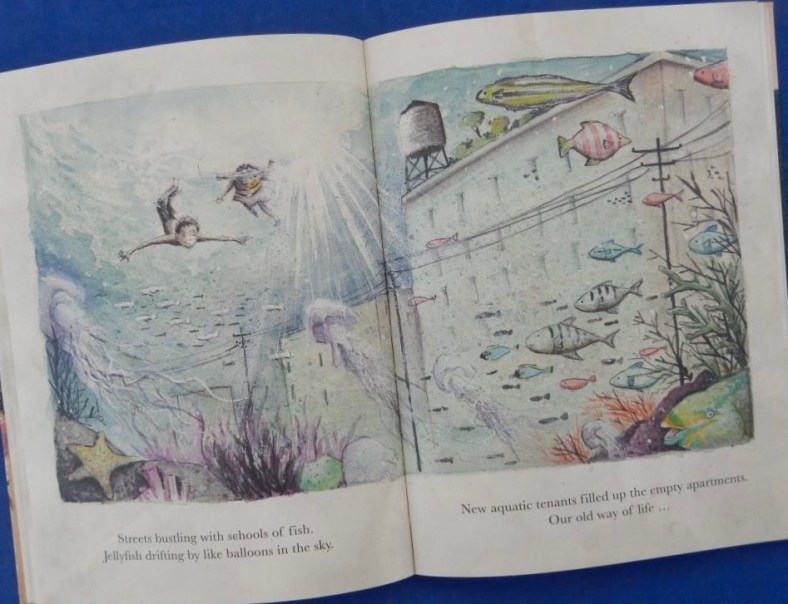
and double spread diagrams of instructions for such things as catching a fish. The result is a hugely moving account of how even under the very worst of circumstances, like those two protagonists, we should never give up on life.

Embracing such themes as home, belonging, loss, grief, refugees, self-sufficiency and the consequences of climate change, this is a book that deserves to be widely read at home and in classrooms.

Moth

Moth
Isabel Thomas and Daniel Egnéus
Bloomsbury Children’s Books

Interestingly this is the second picture book introducing adaptation and natural selection to children I’ve seen in the past few weeks – could a new trend be starting. I was first taught about these scientific ideas with reference to the Peppered Moth, the particular example used in this story, when doing A-level zoology donkeys ages ago, and now they’re part of the KS2 science curriculum – quite a thought.

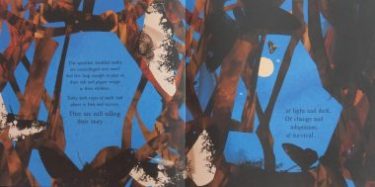
‘This is a story of light and dark. Of change and adaptation, of survival and hope.’ So says science writer, Isabel Thomas in the opening lines of her narrative, a narrative that seamlessly interweaves both science and social history.

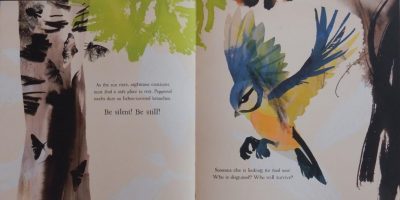
In the nineteenth century almost all Peppered Moths had light grey patterned wings that blended with the tree trunks and branches it frequented.

With the coming of the Industrial Revolution also came air pollution blackening buildings, monuments and trees alike.

In this new environment, the light-coloured moths became easy to spot and were gobbled up by birds.
Darker forms of the insect were less conspicuous and more likely to escape predation and to breed whilst the lighter form became extremely scarce.

With the advent of the Clean Air Acts in the mid-twentieth century air pollution from smoke and soot was greatly reduced, trees and buildings were no longer stained. Now the dark moths were more conspicuous and less likely to breed successfully, though both forms of the moth can still be found.

All this, Isabel Thomas recounts in her dramatic, sometimes lyrical text that ends with hope. A hope which, as we hear in the final explanatory pages, might lead to other living things being able to adapt to the changes, including climate change, that we humans inflict upon our planet.

Daniel Egnéus’ illustrations are as lyrical as the text, embodying at once arresting beauty and veritas, and instilling a sense of awe and wonder. It’s rare to see such an eloquent science-focused book that also embraces the arts side of the curriculum.

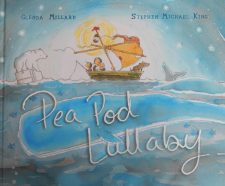
Pea Pod Lullaby

Pea Pod Lullaby
Glenda Millard and Stephen Michael King
Old Barn Books

A mother and baby, a little boy and a dog are fleeing for their lives. They board a small boat and set sail across the vast ocean.

Soon after, they’re joined by a bird.
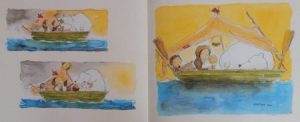
Some days later, they espy a polar bear adrift on what appears to be a fridge-freezer. The huge bear clambers aboard their small boat and after their initial apprehension, the passengers make him welcome,

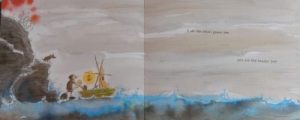
sharing what little they have with the creature as they journey onwards through wind and rain.
Their ursine passenger disembarks upon an ice floe where three cubs are waiting; and the boat sails on through night and day until wind-borne leaves herald their own landfall.

King’s eloquent watercolour and ink tapestry-like strip sequences punctuated by large, full-page spreads chronicle a journey from danger to safety. In combination with Glenda Millard’s prayerful poem (the two worked in close collaboration throughout on an art gallery wall project), the result is a powerfully affecting, deeply moving book that speaks to people of all ages.
It’s a poem for survival: survival of the homeless and displaced, for refugees especially (and sadly there are ever increasing numbers seeking safety in countries other than their own); for the survival of endangered animals too.
This sublime picture book offers a heartfelt message of caring, connectedness, love and hope; it’s one to treasure.

Circle and Oh, the Places You’ll Go!

DSCN7583

Circle
Jeannie Baker
Walker Books
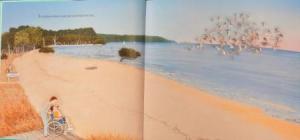
This moving story begins even before the title page with its narrator lying on his bed wishing, “Ahhhh – I wish I could fly!” When next we meet him he’s on the edge of the beach of a nature reserve watching the ascent of a flock of birds …

DSCN7584

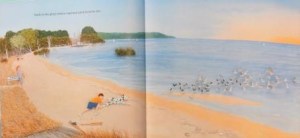
They’re shorebirds – godwits embarking on their long journey north. (In an author’s note at the end of the book we are told this species makes the longest unbroken journey of any animal in the world migrating 11,000 kilometres from Alaska to their southern home in Australia – where Jeannie Baker has lived for many years and where this book begins – and New Zealand.)
It’s a journey that will continue for six days and nights ‘until they know they need to stop,’ with each bird taking a turn as leader of the flock. Increasingly their familiar safe resting places have been replaced with high rise buildings …

%0A

so their search for food has become more and more difficult but eventually they find a place to stop and refuel, eating as much as possible from the rich mud at low tide. The focus is on the godwit with white patches on its wings and finally he flies solo on to the place he remembers. There he makes a nest, attracts a mate and a brood of four chicks duly hatch …

%0A

of which only one survives the ravages of a fox.
After many weeks, the chick is fully grown and again it’s time to move on, feed themselves up in preparation for when an icy wind heralds departure time for the godwit family and a returning flock, that now undertake the awesome nine day flight which takes them full circle back south ‘Following an ancient invisible pathway high above the clouds’ … to the other side of the world where a welcome awaits …

%0A

I learned a great deal from this beautiful book. Its lyrical text and stunning collage illustrations make for a memorable account of godwit migration and thought-provoking glimpses of the child narrator whose personal ‘flight’ is left to readers to interpret: seemingly he too has undergone a transformation.

There’s an altogether different journey in:

DSCF3009

Oh, the Places You’ll Go!
Dr Seuss
Harper Collins Children’s Books
From starting at playgroup or in a nursery class, this book, with its weird and wonderful landscapes

DSCF3011

and some strange and on occasion alarming encounters …

DSCF3010

can accompany you or your child through life’s journey with all its highs and lows, uncertainties and unpredictability. It’ll help you take risks, persevere against the odds, take adversity in your stride – (‘I’m sorry to say so/ but, sadly, it’s true/ that Bang-ups/ and Hang-ups/ can happen to you.’); because as Seuss, the rhymer extraordinaire asserts:
So be sure when you step,/ Step with care and great tact/ and remember that Life’s/ a Great Balancing Act. … And will you succeed?/ Yes! You will, indeed!/ (98 and 3/4 per cent guaranteed.) KID, YOU’LL MOVE MOUNTAINS!
Empowering? Yes. Thought provoking? Ditto!

Use your local bookshop   localbookshops_NameImage-2

WNDB_Button