Amazing Animal Tales: Little Tiger / Amazing Animal Tales: Baby Koala and Bugs / Space

Amazing Animal Tales: Little Tiger
Anne Rooney and Carolina Rabei
Amazing Animal Tales: Baby Koala
Anne Rooney and Qu Lan
Oxford Children’s Books

These, first of a new series, follow the survival stories of baby animals. You can use them either as narrative stories of each animal baby or, if you open the flaps (four per book) as a combination of story and information. Each has the additional interactive feature of a creature to look for on every spread and sometimes, a question which needs some investigation by the child to answer.
Little Tiger lives in the Asian tropical rainforest and when we first meet him, is snuggled up with his mother and fellow cubs in a safe warm den.
We then see the cub being suckled before venturing outside into the sunlight of the noisy habitat where there’s time for some playful fighting with the other cubs. There’s a near encounter with a noisy elephant after which Mama carries her tired cub back to the den. However this protectiveness can’t continue and Mamma Tiger must teach her cubs to hunt if they are to thrive.

That still leaves time for some playfulness and a quick dip before sleep time.

The Australian Bush is the setting for Baby Koala. This little joey, like other koalas, spends all its time in the eucalyptus trees sleeping and feeding, either suckled by its mother, or about nine months later, eating eucalyptus leaves. Dangers come in the form of hungry owls and forest fires caused by the intense heat but Mum koala still keeps a protective watch on her Baby Koala, even after it’s outgrown her pouch and instead is carried on her back.

The texts are engaging and will hold a young child’s interest and the illustrations from, in Little Tiger, Carolina Rabei and in Baby Koala, Qu Lan include lots of detail of the flora and fauna of the animals’ respective habitats to explore and talk about. Both titles would be good additions to foundation stage collections and home bookshelves.

Written in a totally different style and for an older audience:

Bugs
Space

Noodle Fuel and Rich Watson
Little Tiger

These two titles in a new Brain Bursts series are characterised by comical illustrations, simple, with quirky edge diagrams, and contained within fact boxes, a wealth of information is presented in a light-hearted style, complete with speech bubbles from the bugs themselves.

It’s incredible to read on the opening page of Bugs that insects make up almost three quarters of all animal species on Earth. Then after an introductory spread readers meet among others, bees, ladybirds, grasshoppers and crickets, damselflies and dragonflies, moths and ants. Can you believe that there are estimated to be ten quadrillion ants on our planet – 10,000,000,000,000,000 – that is indeed a ‘very big number’. I was amazed to discover that there are more than 10,000 different ant species.

Among the most bizarre facts though is one found on the ‘Top Ten Weird Bugs’ spread: did you know that honeybees have hairy eyeballs? There’s also a fun activities page, instructions on how to play Beetle – a game I’ve not played since I was a child – and a final glossary.

Space is similar in tone and covers such topics as stars and star maps, satellites, space travel, space junk (apparently there are such unlikely things as a pair of pliers and a spatula floating around somewhere in space), black holes and red dwarfs. Several space scientists and cosmonauts make an appearance and the book ends with some activities and a glossary. 

‘Boredom-free guaranteed!’ is claimed on the cover: I can’t imagine any child being bored by either of these books.
My First Book of Relativity

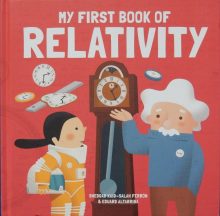
My First Book of Relativity
Sheddad Kaid-Salah Ferrón and Eduard Altarriba
Button Books

We had My First Book of Quantum Physics and now for a companion volume, its creators have turned their attention to another potentially complex science topic, that of relativity.

However, in the hands of this partnership, Einstein’s theory of relativity and other related aspects of connections between space and time are explained in such a way as to make them accessible to young readers. For, as it says on the back of this book, ‘it’s never too early to start exploring big ideas.’ So, how does one start?

The space-time theory, we read, can only be properly understood by first understanding what the two concepts mean in themselves; and then we’re in a position (like Einstein) to understand ‘the world through relativity’.

Time is succinctly explored – how it’s measured, by what means and the various units used.

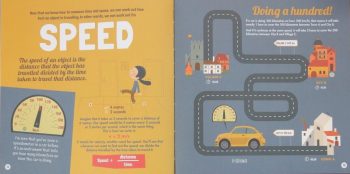
Speed,

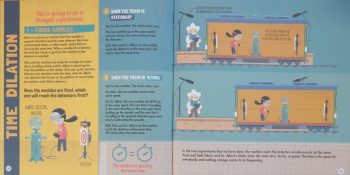
movement and the vital importance of frames of reference are explained, the latter using the example of a moving train and then a person in space.

There are spreads on adding up speeds and the speed of light, leading into Einstein’s two theories, special relativity and general relativity (his theory about gravity).

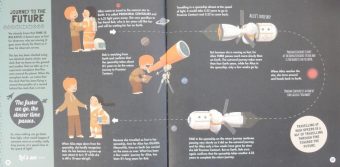
I love the ‘thought experiments’ relating to time dilation and clocks; and the wonderful spread whereon ten year old Alice travels to our nearest star Proxima Centauri, leaving her same aged friend  waiting for her on Earth and returning to find she’s still  ten whereas he is now almost 19, put me in mind of T.S. Eliot’s famous lines from Burnt Norton ‘Time present and time past / Are both perhaps present in time future / And time future contained in time past.’

If only physics had been made this fascinating back in the day when I was studying it at A-level (albeit only for a few weeks before deciding it wasn’t for me).

I’d not heard of muons before reading this book – a muon being an elementary particle of the electron family weighing around 200 times more than an electron, but again found the spread using a muon to check time dilation and length contraction totally engrossing.

The book concludes with how speed increases the mass of an object; the imaginings of the young Einstein (note the word imagined is used by the author, highlighting the crucial importance of the role of the imagination in scientific discovery) and a look at the mathematical equations Einstein used to describe his ideas of special relativity, the former taking mere weeks to find, whereas he took ten years to understand the ideas themselves.

The entire topic is mind-stretchingly incredible and brilliantly explained in this book, with the aid of Eduard Altarriba’s vibrant, graphics. Strongly recommended for budding scientists either for home reading or in school.

The Story of Space / 100 Steps for Science

The Story of Space
Catherine Barr, Steve Williams and Amy Husband
Frances Lincoln Children’s Books
Subtitled ‘A first book about our universe’ this follow-up to The Story of Life is an equally fascinating exploration of another ‘big’ topic: what is thought to have happened 13.8 billion yeas ago when the Big Bang created our universe; and what followed in space thereafter going right up to the present time …

even projecting future possibilities. We’re told how the sun came into being; how, over billions of years, stars ‘are born, grow old and die’; how the planets – and hence our solar system – were formed. As well as that, there is a spread on comets and asteroids; another on how/why the seasons vary in different parts of the Earth; and one looking at oxygen and how it supports life.

This awesome journey is taken in the company of two young space investigators who comment and ask questions alongside the authors’ main narrative. Both Barr and Williams have a science background and manage perfectly, to avoid talking down to primary school aged readers. Amy Husband’s vibrant illustrations have an exuberance about them, making the whole book all the more inviting for the target audience.
I’d most certainly add this to a home collection or primary class library.
The same is true of:

100 Steps for Science
Lisa Jane Gillespie and Yukai Du
Wide Eyed Editions
Ten STEM topics are explored in this fascinating book (written by a doctor of chemistry), that offers thoroughly digestible, bite-sized introductions to Space, Wheels, Numbers, Light, Sound, Particles, Medicine, Materials, Energy, and Life.
Each one is allocated several spreads wherein its evolutionary story is explored and the key scientists are introduced. In this way, what might for some, seem formidable topics, are given a human element making them more easily engaged with and intriguing. Add to that Yukai Du’s detailed visuals, which include some amazing perspectives …

and science becomes exciting for everyone.

I’ve signed the charter