If You Come to Earth

If You Come to Earth
Sophie Blackall
Chronicle Books

Award-winning author-illustrator Sophie Blackall’s inspiration for this book was her encounters with thousands of children she met while travelling the world in support of Save the Children and UNICEF – ‘a book that would bring us together’, she says in an author’s note at the end.

Her illustrations are truly breathtaking, as, by means of a child who is addressing a visitor from Outer Space, readers are taken on a journey through the solar system, down towards the surface of Earth viewing the various kinds of homes people live in, their families,
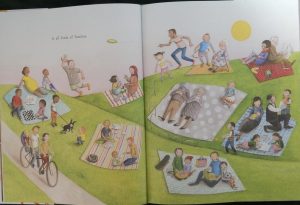
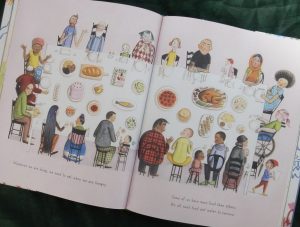
their bodies – each one different, their expressions as they think and feel, their clothing, weather both good and less so, transport, places of education and the work people do, how they spend their free time; we see some of the foods people eat. (Some of us have more food than others.’)
There’s an explanation of the importance of water, its sources and a stream of marine creatures swims majestically past. Then come Earth’s fauna: Those with feet and those with wings, leading us back to humans, their love of music making, their different ways of communicating (Some of us who are deaf talk with our hands and faces. Some of us who are blind read with our fingers’ caption a spread showing people signing and sign language, and braille with people reading it.)

With its incredible detail, each and every spread is truly a beautiful story in itself (or many) – there are natural things and those made by people, even invisible things. Sophie puts occasional humour into her narrative with such comments as ‘Some germs can make you sick. So … breathing in smoke or getting spat on by a slow loris’ (it’s venom really can cause great harm to humans).

Then come two spreads – one with fighting, the other facilitating, and the comment,’It’s better when we help each other.’( If only everybody stuck to that one)
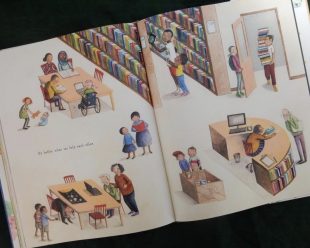
The only sentence I took slight exception to is ‘Babies are not very good at anything.’ Babies are VERY good at learning – they do it pretty much all the time they’re awake as I observed when spending time with Faith, a six-month old relation the other day.

It’s good to see attention being given to storytelling, be it older people storying about the past, or children imagining.

The author concludes that there’s much we don’t know but ‘right this minute, we are here together on this beautiful planet.’ A fitting end to a gloriously illustrated, wonderful message. The visual detail is awesome and the importance of seeing each person as a unique, valued human being worthy of our respect and care, and of the vital necessity too caring for the Earth, shine through the entire book.

A must have for school and home.
Hello Lighthouse

Hello Lighthouse
Sophie Blackall
Orchard Books

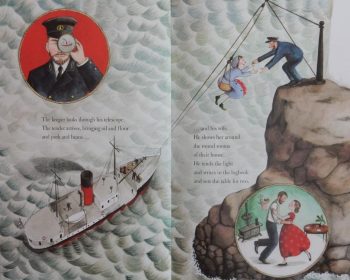
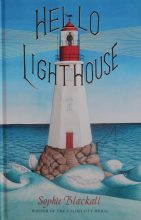
Standing on ‘the highest rock of a tiny island at the edge of the world’ is a lighthouse; it beams out a guiding light for ships at sea.

To this lighthouse comes a new keeper to tend the light, maintain the logbook, paint the round rooms.

He also finds time to fish for cod through the window, make tea, cook his meals and write letters to his wife, which, enclosed in bottles, he tosses into the waves.

It’s a lonely existence but one day a ship arrives bringing not only supplies but also his wife.

A fog descends covering everything; the keeper rings a warning bell, but one night a boat is wrecked and he has to rescue the sailors.

When the sea turns to ice the keeper is sick so then, in addition to acting as his nurse, it’s the wife who tends the light and keeps up the log.

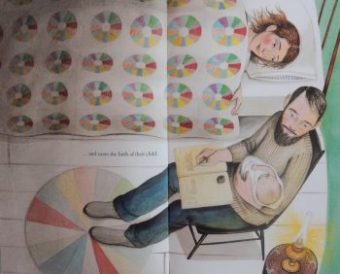
Before long there’s an addition to the family – also logged.

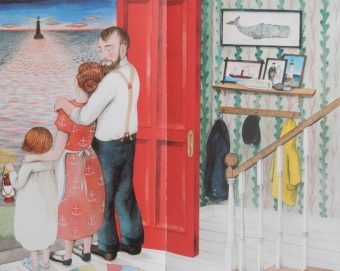
Then one day. the coast guard arrives with a brand-new light that is run by machine: the lighthouse keeper’s job is no more. It’s time to pack and leave, ‘Good bye, Lighthouse! Good bye! … Good bye! … Good bye!’

The dispassionate present tense chronicle reads like the keeper’s log and the vertical rectangular format of the book reflects the external form of the lighthouse itself. Opened out there’s space a-plenty for Sophie Blackall’s dramatic Chinese ink and watercolour seascapes, as well as scenes of life within the confines of the tall circular building. The perspectives she uses, many viewed from above, or seemingly seen through the lens of the keeper’s spyglass, echo the circularity of the rooms and some of the furnishings.

I found myself reading and re-reading these pictures, discovering ever more domestic details, and wondering at the power and majesty of the ocean and the amazing talent of this illustrator.

With its look at a bygone era, this book would be a wonderful addition to any topic about the sea: the author provides detailed notes contextualising many of the events in her story on the final pages.

Finding Winnie

DSCN5879 (800x600)

Finding Winnie
Lindsay Mattick and Sophie Blackall
Orchard Books
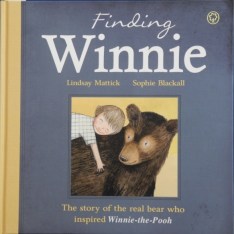
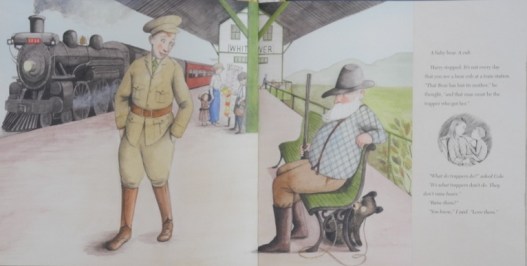
When already past bedtime, young Cole requests a story, a true one, about a bear he gets just that. And so do we in this enchanting book about one that became the inspiration for Winnie-the-Pooh. The story is told by the great granddaughter of Captain Harry Coles a vet ,who met and bought an orphan bear cub on a station just as he was about to depart for a World War 1 training camp.

DSCN5880 (800x600)

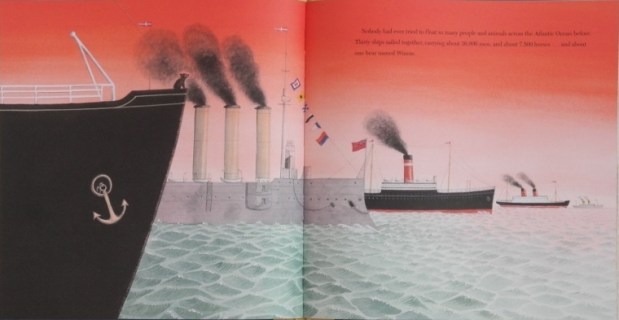
Named Winnipeg (after his home town), the bear captures the heart of Harry’s Colonel and is allowed to join the troops, becoming their mascot and eating them out of house and home. When they reach camp, Winnie becomes a fully fledged army member and even accompanies the soldiers across the Atlantic to England.

DSCN5883 (800x600)

Once there she has to contend with the rigours of regimental training on Salisbury Plain; but it’s there in the depths of winter that the call to fight comes. Harry then has a difficult decision to make; should he find a safe place for Winnie? It’s then that mind wins over heart: London Zoo is that safe place and there Winnie is soon charming its many visitors.

DSCN5884 (800x600)

There one story ends – kind of – and another begins for one of the zoo’s visitors is young Christopher Robin Milne. And the rest, we know is storybook literary history. A final ‘Album’ includes pertinent photographs (snapshots of Winnie, Harry and the soldiers, and Winnie and Christopher Robin), as well as some documents.
How deftly and magically the author weaves this historical story: it’s one that includes not only history but geography too. I particularly like the way Cole’s interjections move the story forwards: “ What do trappers do?” asked Cole.
It’s what trappers don’t do. They don’t raise bears.” comes the response.
Equally magical are Sophie Blackall’s watercolour illustrations. Brilliantly expressive

DSCN5882 (800x600)

and gently humorous, every one is a delight to behold.
A winning combination through and through.

Use your local bookshop          localbookshops_NameImage-2