
The Magic Callaloo
Trish Cooke and Sophie Bass
Walker Books
Inspired by stories of enslaved Africans who made patterns in their cornrowed hair, using them as maps to help them escape to freedom, Trish Cooke’s neo-folktale has its origins in Rapunzel, made popular by the brothers Grimm
It begins in a small village, long ago and far off where there grows a magical callaloo plant that would grant the wish of any villager who ate one of its leaves. Thus all the villagers had everything they needed; but one of those living in the village was selfish and greedy. One night this greedy man creeps into he square, uproots the plant and makes a wish: to have the plant for himself. He then proceeds to eat more and more leaves, making wishes for more and more things until he had so much he could barely move. His laziness of course, has an adverse effect on the callaloo: it shrinks until just one leaf remains.
Back in the village, a couple hoping desperately for a child, are greatly distressed at the disappearance of the plant as their hope was that it could provide them with their dearest wish. Then one evening a wise woman tells them where the last leaf is and with renewed hope they begin to search, eventually locating the plant. The Missis eats the final leaf and both she and Mister wish for a child. Before long, to their joy, a baby is born and they call her Lou.
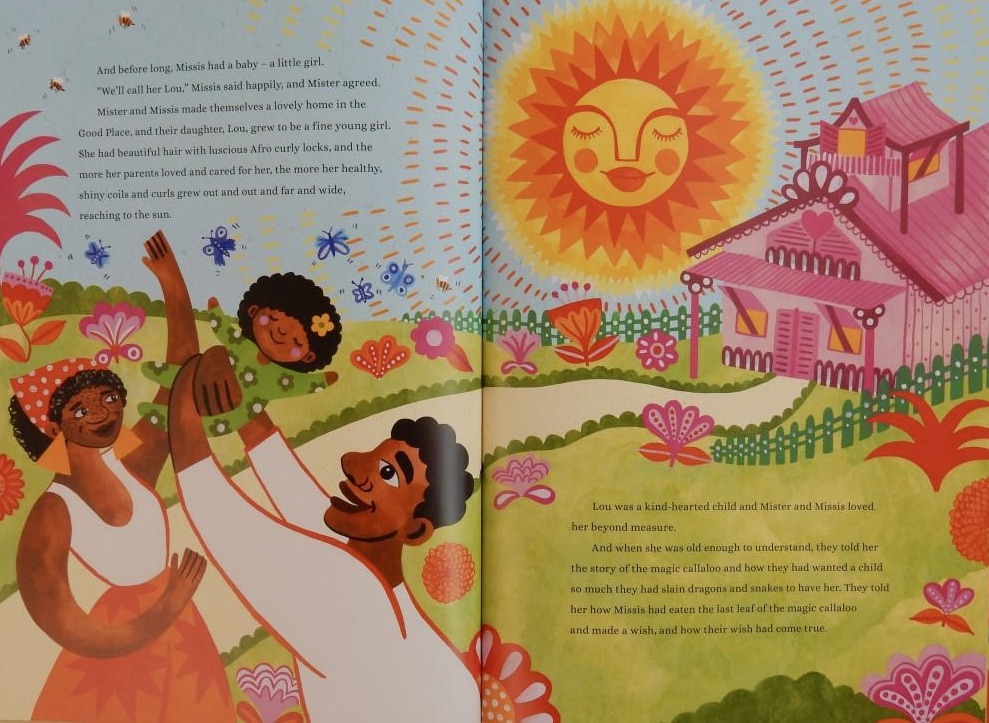
The girl grows into a kind, beautiful curly-haired girl and her parents tell her the story of the magic leaf. Lou makes up a magic callaloo song but her singing bothers her father in case someone overhears its words. Sure enough, the plant thief happens to pass through: he hears her song and snatches her away to his home where he keeps her prisoner, making her do all his work.
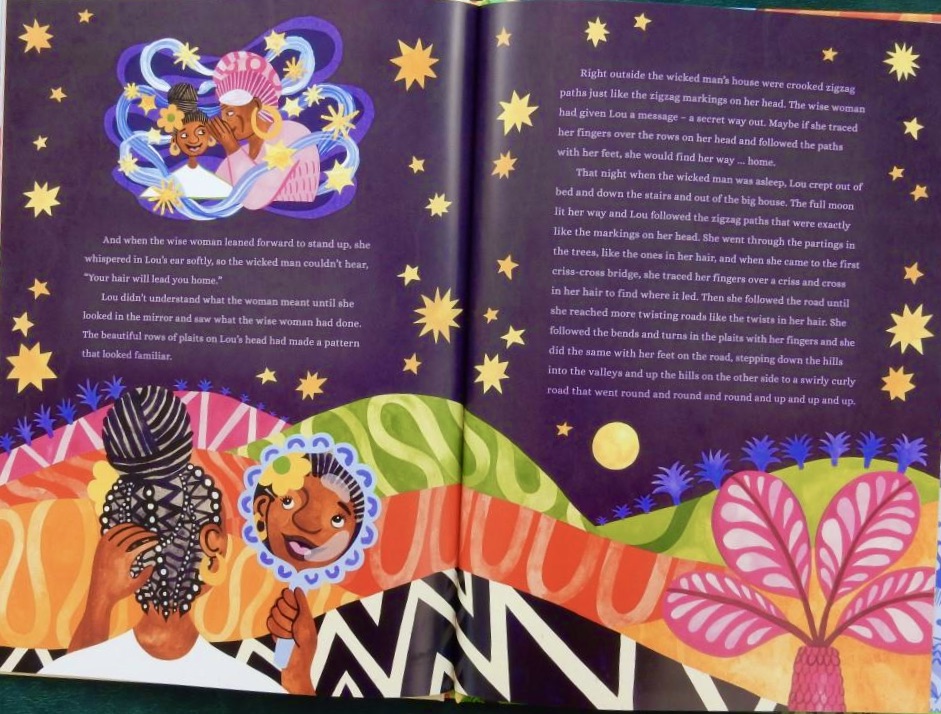
Both Lou and her parents grow ever more miserable, missing each other all the time, till years later who should come along again but the wise woman. Lou tells her of the cause of her sadness and the woman formulates a clever plan using the girl’s tresses which she twists into plaited patterns, quietly telling Lou, “Your hair will lead you home.”
However something else also returns with her.
With themes of longing, captivity and escape, Trish Cooke’s wonderfully woven tale is impressively embroidered with Sophie Bass’s art, which includes a wealth of flora and fauna in kaleidoscopic colours making every turn of the page a visual feast. This longish story will enchant readers across a wide age range.


 Red Reading Hub - Jillrbennett's Reviews of Children's Books