Sam, the Most Scaredy-Cat Kid in the Whole World

Sam, the Most Scaredy-Cat Kid in the World
Mo Willems
Walker Books

It’s over a decade since we first met Mo Willems’ Leonardo the Terrible Monster along with Sam, the boy who is terrified of everything other than Leo. Now they’re back with Sam, (just as scared as before), being in the limelight until he encounters these two .

Seemingly Sam has a rival in Kerry, for immediately both humans, terrified of one another, start screaming uncontrollably.
Irked by their behaviour, the monsters decide to leave the children to ‘Figure it out’ and wander off the page together.
Having explored their similarities …

and differences, the humans eventually do just that and they too come to a decision, a wise and slightly mischievous one. And the two monsters are certainly in for something of a surprise when they return.

If you’re familiar with the first Sam and Leonardo story, then you’ll love this as a companion volume; if not it stands alone as a wonderfully funny account of forging a new and unlikely friendship.
Willems’ sombre colour palette, stand-out capitalised fonts and comic-style characters serve as well here as they did before, making this another monstrous winner for the USA’s master of drollery.

I’ve signed the charter  

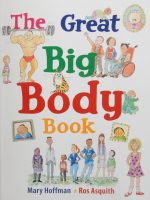
The Great Big Body Book

The Great Big Body Book
Mary Hoffman and Ros Asquith
Frances Lincoln Children’s Books
Everybody has a body and every body is different: this fact is acknowledged and celebrated in the latest Great Big book from the Hoffman/Asquith team.
Starting from those of babies, they introduce young readers to the bodies of new- borns …

toddlers, children, teenagers and adults, young, middle aged and old.
Spreads focus on such topics as gender in ‘Boy or Girl’ wherein it’s good to see ‘… a few don’t feel completely comfortable in the body they were born in and not everybody fits neatly into a “boy” or “girl” box. That’s OK – just be yourself!’
No matter which of the seventeen spreads one explores, we encounter both visual and verbal examples of the overarching premise that ‘bodies are both similar and different:’ We are all more alike than different’ one speech bubble reminds us: moreover we all develop at different rates and some are better at doing one thing than others;

but we all learn an amazing amount throughout our lives.

Emotions, as well as the physical aspects of bodies without and within, are considered and there’s a feline intruder that appears in every spread comparing and contrasting humans and cats.
Ros Asquith’s cartoon style illustrations are amusing, empathetic and all encompassing.
You really couldn’t get more inclusive than this book when it comes to the topic of bodies. It’s just right for sharing and discussing at home or in school.

I’ve signed the charter  

Under the Same Sky / This Is How We Do It!

Under the Same Sky
Britta Teckentrup
Caterpillar Books
I’m a big fan of Britta Teckentrup’s work especially her books with cut out pages so I eagerly anticipated this one. With its theme of connectedness, it’s absolutely beautiful.
We live under / the same sky … / … in lands / near and far.’ So begins the lyrical text, which accompanies superb, soft-focus animal images set against natural backgrounds.
Hugely impactful with its spare narrative and its strategically placed die-cuts on alternate recto pages, through which we see  elements of scenes of universally shared games, feelings,

hopes and dreams, this is uplifting and full of hope. Timely, and exactly what is needed when our world seems to be growing increasingly intolerant, fractured, and with too many people focusing on differences rather than what binds us all together – our common humanity.

Fuelled by this powerful and lovely book, let’s seize every opportunity, transcend those differences and come together for the ultimate good of everyone.
Share, ponder upon, delight in and discuss: it’s a must for every family, early years setting and KS1 classroom collection.

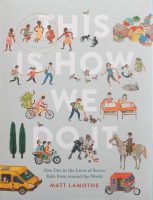
This is How We Do It
Matt Lamothe
Chronicle Books
Children are the focus of this fascinating book, children whose ages range between seven and eleven; children from seven different families, backgrounds and diverse situations tell their own stories. Let’s meet, Romeo (Meo) from Italy; Kei from Japan; Daphine from Uganda; Oleg from Russia; Ananya (Anu) from India, Kian from Iran and the eldest, Peruvian, Pirineo.
These narrators share information about their particular homes, their families, their clothes – in particular what they wear to school; breakfasts, lunches and evening meals (each meal has a separate spread); mode of travel to school.

We meet their various teachers and see how they learn (almost all classrooms looks very formal). Each child shows how his/her name is written …

We also see the children at play, helping at home and finally, sleeping.
Yes, there are differences, each country, each family is unique; but the most important message is that no matter where we are from, we all have similarities: we eat meals, we play and we go to school (at least those children we meet do) and all under the same sky.
At the end of the book we meet all seven families in photographs; and there is a final glossary, an author’s note on how he came to create the book and the endpapers have a world map showing where the children (and author) live.
This predominantly pictorial presentation celebrates our commonalities and our uniqueness. With world travel a commonplace nowadays, the book offers a great way to expand children’s horizons giving them insights into particular ways of life in addition to those in countries they might themselves visit.

I’ve signed the charter  

The Butterfly Dance

%0a

The Butterfly Dance
Suzanne Barton
Bloomsbury Children’s Books
The butterflies weren’t the only ones dancing: I joined them as I opened the parcel containing this alluring book. My dance though, fell far short of the dazzling show of the exquisitely patterned, winged creatures herein. It’s good to see Susanne Barton adding a book starring ‘flyers’ different from those in The Dawn Chorus and Robin’s Winter Song to her repertoire.
Two caterpillars, Dotty and Stripe share everything. Then Stripe pupates leaving Dotty feeling lonely, but soon she too makes a cosy bed and falls asleep. Dotty is first to emerge and cannot wait to show her wonderful wings to Stripe. He however, is already flying towards her, resplendent with his outstretched wings.
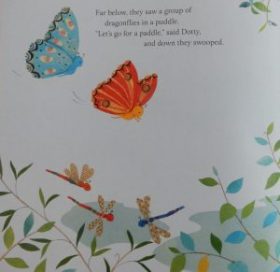
Then begins a dazzling gliding, looping, soaring, whirling, fluttering and chasing dance, which is interrupted by an untimely rain shower. Taking cover, the butterflies encounter a bee that tells them of a meadow full of flowers, and sends them on their way. Their route takes them through the woods where dragonflies dip and dart around a puddle

dscn0182

and there they learn of other butterflies the colour of Stripe. Further on though, Dotty discovers that there are also butterflies of her own blue colour and the two wonder if they should be playing with those that look like they do.
The best friends have a dilemma: should they seek their fellow look-alikes or stay together? They decide to part: Stripe plays with red butterflies, Dotty with blue. They miss each other. Can they remain friends but stay true to themselves at the same time? And, equally important, can they find one another again?

dscn0185

Inherent in this enchanting rendition are themes of self-knowledge, self-acceptance, friendship, reaching out to others, similarities and differences, and change. Every spread, be it a single scene stretching across the whole double page, one page, or a sequence of small vignettes,

%0a

is made visually captivating by Suzanne Barton’s kaleidoscopically coloured, signature mixed media, collage style art.

We Are Family

                              I’m excited to be part of Caterpillar Books blog tour for We Are Family.
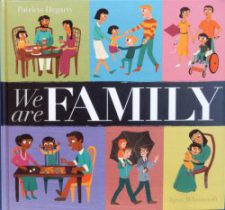
dscn9902

We Are Family
Patricia Hegarty and Ryan Wheatcroft
Caterpillar Books
This all-inclusive rhyming celebration of family life really does offer each and every child the possibility of seeing him or herself in a picture book: Ryan Wheacroft’s multitude of vignettes ensure that.
Whoever we are and whatever we do, / Our families hold us together like glue.
These opening words of Patricia’s text caused me to reflect on my concept of family and I concluded that it means many things and includes many more people than those I’m related to by blood.
Our family comes / From round the world: / Our hair is straight / Our hair is curled, / Our eyes are brown, / Our eyes are blue, / Our skins are different/
Colours too.

So begins a poem by Mary Anne Hoberman that I included in my compilation, Family Album published some 20 years ago and it resonates with my own view of family. At that time, I’d been given a six-month sabbatical from my job as deputy head of an outer London Primary School. I was to look at primary education in India in order to try and understand why the parental expectations of the majority of families from the Indian subcontinent whose children were attending the school I worked in, and others in the borough, were so very different from those of our teachers.
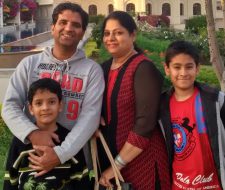
I stayed in Udaipur, Rajasthan in a small hotel – owned and run by a Rajput Indian family I very soon felt I had become a part of. At the time there were two brothers – one managing the hotel, the other a tour guide, both residing in the haveli (large family home) with their parents and downstairs, grandparents as well as various other people employed to help with the latter.
From the outset, the grandmother would send to my room at suppertime, dishes she thought I’d enjoy. Soon though, I was invited to share evening meals in the haveli: “You’re family now” I was told.

%0a

During those months I went to Navratri celebratory Garba Dandiya dances with female members of the family and shared in the family celebrations of Diwali.
That was the start of a family bond that has deepened, although altered (the grandparents and father are dead now) over the subsequent 24 years. Both brothers, (one of whom, Ajay, now truly is like my blood brother), have children of their own, two apiece. I hesitate to say they have their own families as, like many Indian families, they tend to grow into a larger extended family, rather that separate ones. And that’s due in part the to the fact that they still live in the same complex.
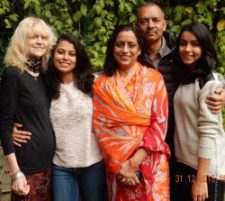
I also feel very close to Anu. Ajay’s wife and in particular, their two daughters, whom I’ve watched grow up. I saw both of them as tiny babies and one is now at university and the other at school and training, she hopes, to become part of the Indian shooting team for the next Olympics.
%0a

We visit them at least once a year, usually during the Christmas holidays; it’s more tricky during the summer now as even the two girls’ holidays don’t coincide, let alone Indian school holidays and English ones. They have stayed with us in the UK several times too.
During that same period of time I became involved with another Indian family too, more by chance this time. It started with a visit to an art gallery run by one member of an artist family, also in Udaipur. This family too took me into their home and hearts and the bond is still very strong. I visit the galleries of both brothers frequently when staying in the city as well as sharing meals and much more. For instance, I tie a raki around the wrist of the brothers at the festival of Raksha Bandhan (a festival of brothers and sisters), as well as being a source of books for both Shariq and Shahid’s children.
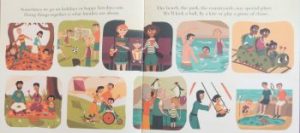
Sometimes we go on holidays or happy fun days out,
Doing things together is what families are about.

%0a
img_20161218_170229_hdr

Both brothers have stayed at our home in the UK several times for recreation and more. One visit that sticks in my mind is when Shahid, (who was to have some of his paintings exhibited in the UK) his wife and young son came one Christmas time and we had frost and a scattering of snow. Their little boy was around 4 (he’s now 17) and had never experienced such cold. Stepping outside he said, “Papa, I’m smoking” as the freezing breath came from his mouth.
In addition to being an artist, Shariq, who while visiting us in UK, did some art workshops in my own school and several others I was connected with, is also a musician and has invented and crafted, an amazing instrument

20170104_144136-2 4-5

and his two young sons are pretty awesome tabla players.
One thing that struck me almost immediately is the great respect accorded to older generations of a family in the Indian culture. Both Ajay’s and Shahid’s families found it strange that our parents did not live with us though my partner’s mother had her own house just ten minutes drive away. She invited them to tea and she shared meals with them at our home. On subsequent visits it was always obligatory for them to meet Marjorie to pay their respects. When, in her 80s, she accepted an invitation to Udaipur, she was treated like royalty with a party in her honour at Ajay’s hotel and requests to go for lunch, dinner and, in order to fit them all in, even breakfast at the homes of members of a cricket team Ajay had previously brought to play in the UK. All this very much echoes Patricia Hegarty’s final words of We Are Family:

Each family is different, it may be large or small.
We may look like each other – or not alike at all.
Money doesn’t matter, nor colour, creed, nor name –
In each and every family, the love we feel’s the same.

Be Who You Are

%0A

Introducing Teddy
Jessica Walton and Dougal MacPherson
Bloomsbury Children’s Books
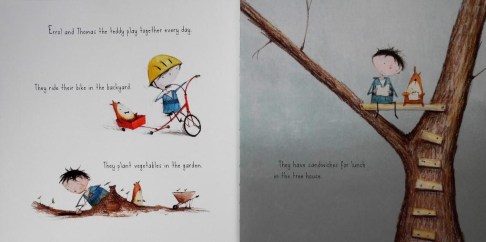
There’s been a fair bit about gender identity and transitioning in the media of late; finally it has become more acceptable: now here is a picture book on the theme. It’s subtitled ‘A story about being yourself’ and this is what it celebrates: something that is of vital importance to us all, whoever we are. Equally it’s a celebration of friendship and in particular the friendship between Thomas the teddy and his pal, Errol who play together every day.

%0A

One day though, Teddy seems sad. Errol hopes a trip to the park will cheer him up …
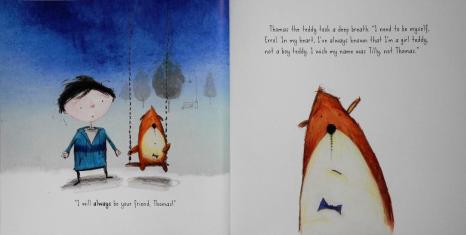
but even the swing doesn’t work its usual magic. “What’s wrong, Thomas? Talk to me!” Errol urges.

DSCN7488

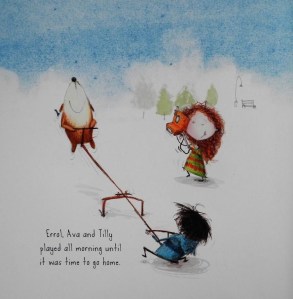
And reluctantly Thomas explains. “I need to be myself … In my heart, I’ve always known that I’m a girl teddy, not a boy teddy. I wish my name was Tilly, not Thomas.” Like the true friend that he is, Errol assures his pal that no matter what, Teddy and henceforward Tilly, is his friend. And when another friend, Ava arrives on the scene, Errol introduces the re-named Tilly to her. After minor adjustments to her adornments, Tilly joins the others in a session of swinging, see-sawing and generally enjoying being themselves …

%0A

Tenderly told and empathetically portrayed with just the right degree of gentle humour, this is a book to share with young children at home or in school.

DSCN7485

Colin and Lee Carrot and Pea
Morag Hood
Two Hoots
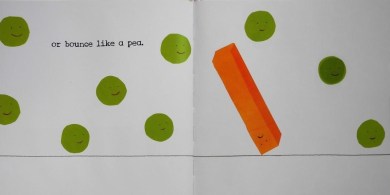
Lee is a small green pea; Colin isn’t. Unlike all Lee’s other pals, Colin is a tall carrot stick. They’re close friends despite the fact that Colin isn’t any good at rolling, bouncing …

%0A

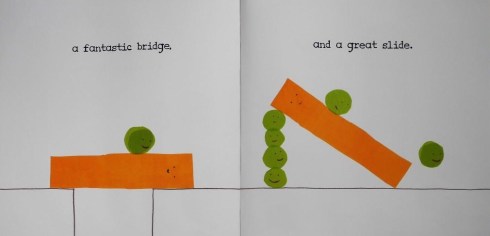
or playing hide and seek with the other peas. He does however make a superb tower as well as …

%0A

all of which combine to make him a smashing individual to have as a friend: those unique carroty characteristics are what count where friendship is concerned.
In this quirky celebration of individuality, Morag Hood – with her unlikely characters – brings a fresh spin on uniqueness and being yourself, whatever you are. I love the fact that she created her funny collage and paint pictures with the help of supermarket plastic bags. A great debut; I eagerly anticipate what comes next.
As well as being a great book to share in an early years setting, the simplicity of the text makes it ideal for beginning readers: they surely deserve unique books not dull, uninspiring fodder.

WNDB_Button

Use your local bookshop   localbookshops_NameImage-2