
Art Up Close
Claire d’Harcount
Princeton Architectural Press
Art enthusiasts of all ages wlll enjoy this search and find game based on twenty three famous works of art from around the world.
Each large spread is a high quality reproduction of one named artwork that is credited and dated, in the same border as ten to twelve floating bubbles each containing a small detail from the whole piece. It’s these tiny visual elements that readers are asked to search for, some being a whole lot easier to locate than others.
The arrangement of the selected works is chronological beginning with Egyptian papyrus paintings from the Book of the Dead (around 1300BC). This is followed by a 6th century Byzantine mosaic, an Arabic manuscript (1400s), the Limbourg brothers illumination (1416) and other 15th century European painters.
Then comes an early 16th century Aztec manuscript, a Flemish tapestry, a Bruegel (the elder) and a Veronese painting.
From the 17th century are the younger Teniers, and Jan Steen’s Village School. This chaotic classroom scene, which includes a child drawing on the wall and back end of a rat that is tucking into the contents of someone’s lunch basket certainly made the teacher part of me smile; and oh my goodness, the place is so dark, it’s hardly surprising that half the people therein look as though they’ve fallen sleep or are about to do so. All this and more while the two ‘teachers’ appear totally unaware of what’s happening around them.
There’s a Japanese woodblock print from the early 19th century; Impressionism is represented by a Renoir and an Ensor; and we then move into the 20th century with surrealist, Miró,

Picasso represents cubism and the final work is a 1952 Jackson Pollock, Convergence.
Then follow ten pages wherein D’Harcourt discusses each of her chosen examples individually; and the two final spreads have lift-the-flap mini paintings of each work that reveal the whereabouts of the details in the bubbles, and also provide short notes on the artists.
Of the 23 works, only five are non-western, but what disappointed me more was the lack of a single woman artist. Nonetheless, the whole enterprise is absorbing, educational, fun, attractively presented and well worth spending time over.

Vermeer’s Secret World
Vincent Etienne
Prestel
In what is an essentially introductory book, art historian and author, Etienne, traces the life and work of Dutch painter Johannes Vermeer, one of history’s most distinctive artists who lived in 17th century Delft for his entire life.
There are fifteen full-page reproductions of his works …

as well as eight smaller ones.
If you can’t manage to visit London’s National Gallery or one of the other galleries exhibiting Vermeer’s paintings, then this short book is a good starting point to begin to appreciate the Delft master, an artist whose focus was very much on people rather than places.

Trick of the Eye
Silke Vry
Prestel
Subtitled ‘How Artists Fool Your Brain’, this book offers a host of examples that demonstrate that deceptive imagery in art, far from being a new phenomenon, has been in use by famous and popular artists for centuries.
Vry uses paintings by, to name just some, Giuseppe Arcimboldo, van Gogh, Leonardo da Vinci, Hogarth, Turner, Vermeer, Paolo Veronese and Georges Seurat, as examples of optical illusions, as well as more modern artists including Salvador Dali, René Magritte,
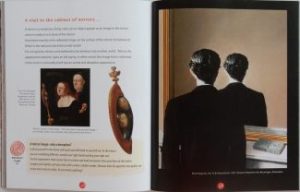
M.C. Escher, Bridget Riley, and Banksy.
In addition to paintings, some objects such as the Athens Acropolis and the Scala Regia in Rome are used.
The end pages offer solutions to the questions posed during the discussions of the various works of art, as well as instructions for some creative projects for readers to try themselves that were previously flagged up in the those discussions.
Absorbing, illuminating and a novel way of looking at some works of art.
For those readers of a more scientific bent:

Optical Illusions
Gianni A. Sarcone and Marie-Jo Waeber
QED
Both the creators of this fascinating book are experts in brain training and cognitive sciences, and herein they offer readers the opportunity to find out about the science behind the illusions that trick our brains.
After a brief ‘Is Seeing Believing’ introduction; the book is divided into five sections: Light, Lines and Space,

Motion, The Brain and finally, Experiments.
Each topic explores a variety of effects: for example Light demonstrates colour assimilation, complementary colours and after image, and colour contrast.
Since buying a book on MC Escher many years ago, I have been fascinated by the idea of optical illusions. This book has refreshed that fascination, but a word of warning: I spent ages poring over its hypnotic pages; don’t sit down with it unless you have plenty of time to spare – you’ll most likely be hooked, eyes and brain in sensory overdrive mode.
 Red Reading Hub - Jillrbennett's Reviews of Children's Books