Bringing Back Kay-Kay

When Lena’s older brother Kay-Kay fails to return from summer camp in Goa, despite rather enjoying feeling a bit special at home for a change in his absence, Lena knows she must find him. His parents are grief-stricken but believe that the police, who think he’s run away, are doing everything they can. His friends say they don’t know why he disappeared from the train back to Lamora but, convinced that Kay-Kay would never run away, Lena suspects that one, Samir, who also went to Wildlife Adventures camp, knows more than he is letting on.

Devastated by the idea of living without her brother and finding her parents’ pain unbearable, she decides to embark on a mission to investigate, with the aim of locating Kay-Kay and bringing him home. ‘Without you, Kay-Kay, there’s no sun, no warmth, no light. I will find you – my brother, my friend. I will find you and bring you back,’ she says. Looking for clues in his room, she discovers that Kay-Kay has been keeping part of himself hidden from the family – his secret dreams and his fears of not living up to parental expectations; these he reveals in his powerful, heartfelt poetry.

Determinedly retracing his journey across India, she meticulously begins to reassemble clues leading to his disappearance. Can she find Kay-Kay and save him before it’s too late?

This mystery set in contemporary India grips the reader from the start. Written from Lena’s view point, it’s frequently gut-wrenchingly moving, especially when she addresses her thoughts to her brother. A terrific debut that pays tribute to the power of sibling bonds especially in desperate situations as well as showing that the creative arts are every bit as valuable as engineering and medicine, subjects that in common with so many Indian parents, are favoured by Kay-Kay’s parents.
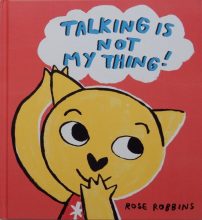
Talking Is Not My Thing

Talking Is Not My Thing
Rose Robbins
Scallywag Press

Having a neurodiverse member of the family can be challenging for everyone as Rose Robbins, the author/illustrator of this, her second book knows so well for she has a brother on the autism spectrum and she also teaches young people who have autism.

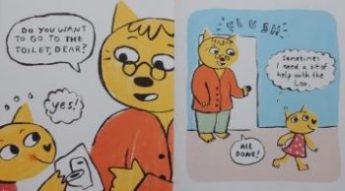
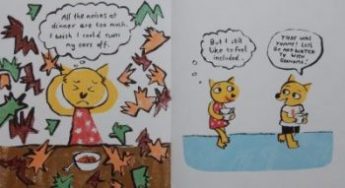
Much of this story is conveyed through the female narrator’s thought bubbles; the rest through her brother’s words in speech bubbles and Rose’s dramatic illustrations. The narrator’s opening thought is ‘I don’t speak. But my brother finds it easy.’

Having followed her brother’s call to come indoors as dinner is almost ready, we learn how she does sometimes attempt to speak using her voice but the words come out wrong. Furthermore as the narrator is sound sensitive the noises of dinnertime cause her some distress, but she likes to feel included.

She also on occasion needs to convey how she feels or what she needs by means of one of her flashcards ( PECS symbol cards perhaps),

It’s great that brother and sister are able to play games together and that sometimes little sister acts as teacher.

Clearly understanding is not a problem, for shared story sessions with her brother reading aloud from a book, give his sister much pleasure.

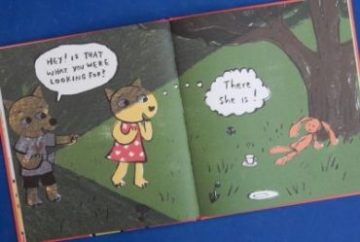
At other times, such as when things go missing, mutual assistance is enormously beneficial. First a beloved soft toy bunny is located

and then once his sister is safely in bed, she finds her brother’s lost car. A highly satisfactory ending to their shared day.

Once again, Rose has created an enormously empathetic story that she conveys with subtle humour and a sense of respect for the siblings she portrays in Talking Is Not My Thing.

That sense of respect and understanding is what I saw yet again very recently while walking in the grounds of Ruskin Mill College, a specialist education establishment near my home that caters for neurodiverse students of between 16 and 25. A fairly newly admitted boy whom I’ve never seen stand still before, stood transfixed watching a heron that had perched atop a tree in the grounds. At least three members of staff stood fairly close keeping a watch on his wellbeing, allowing the boy to take as long as he wanted to observe, what was for all of us an awe-inspiring sight.

Nipper and the Lunchbox / Gently Bentley!

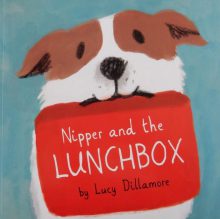
Nipper and the Lunchbox
Lucy Dillamore
Child’s Play

Nipper truly loves his owner, Richard who has to leave him at home all alone when he sets off to work every morning.

One day in his haste, Richard forgets his lunchbox; Nipper spies it on the kitchen worktop and sets forth to take it to him.

Handle in mouth, the dedicated dog journeys through the countryside

and after a somewhat perilous journey with all kinds of mishaps en route including getting completely lost in a market, manages to reach the town; albeit with some timely assistance and locate Richard’s Toyshop.

Once there he has to track down its owner and then finds himself the centre of attention as crowds of people stop to look at the wonderful new window display.

It’s a thoroughly satisfying finale as Richard makes him a partner at his shop and thus there are no more lonely days for Nipper. …

Lucy’s slightly muted, soft-focus illustrations are full of things to spot, particularly in the bustling market square scene where Nipper gets himself lost: there’s the plethora of pants that the creature then manages to get himself entangled with.

Nipper he might be named, but this small canine creature is determined, brave and resourceful. Based on a real life rescue dog, his story is a delight.

Gently Bentley!
Caragh Buxton
Child’s Play

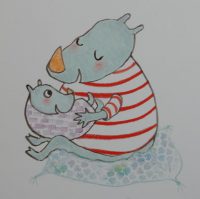
Like most five year olds, young Bentley rhino is bursting with energy, easily excitable and thus, apt to get into trouble. “Gently Bentley!’ comes the oft repeated cry from his mum or dad as the little guy creates havoc in the living room; manages to slop his breakfast in all the wrong places;

he even causes a crack to appear across the ceiling, so exuberantly does he dash down the stairs before school.
It’s much the same at school; he trips and scatters his belongings everywhere, whizzes madly around the playground alarming his classmates. Again it’s a case of “Gently Bentley” this time from his teacher and pals.
Then on the way home he manages to terrorise the ducks.

Once indoors however, he spies Baby fast asleep in the cot. Now we see a totally different side of big brother, Bentley.

Many families and all early years teachers will recognise Caragh Buxton’s Bentley; he’s thoroughly endearing and let’s say, super-spirited. Perhaps though, he could do with a little bit of regular yoga breathing or mindfulness.