The Language of Flowers

Juhi’s Appa, a florist, has taught her the language of flowers. She knows that stargazer lilies, irises and jasmine represent different kinds of love. On account of her flower knowledge she is aware of the various celebrations and special events that happen in her neighbourhood: frangipani is for those who pray on full moon days, dried henna petals are used to paint hands on a variety of occasions, daffodils announce the birth of a new baby and peonies often decorate a birthday cake. However of all the customers who visit the family’s florist shop, Mr Potter is her favourite. He is always cheerful, enjoys telling jokes and stories from long ago and every Wednesday chooses flowers of the brightest hues for his wife. Mr Potter lives life to the full, Appa tells his daughter.

Then one Wednesday it’s Mrs Potter who comes to buy flowers; she wants them for her husband who is in hospital and Juhi knows just the ones that will cheer him up. Several weeks pass and there’s no sign of either Mr or Mrs Potter and then on a Friday Juhi enters the shop and finds Appa making an enormous bouquet of white flowers. Sadly he tells her that Mr Potter has died and the bouquet is for his wife. Juhi though does not know the language of grief and remains silent.

Appa asks Judi if she’d like to accompany him to deliver the bouquet. However she doesn’t think that the white bouquet her Appa has made truly represents the way she wants to remember Mr Potter’s life of joy. Instead she makes a garland of all his favourite, brightly coloured blooms from his world travels.

This moving story of love, community, grief and self-expression is told in Shyala Smith’s elegant direct words and through Aaron Asis’s often vibrant, textured gouache and digital illustrations.
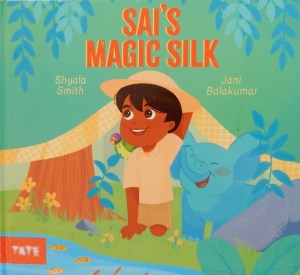
Sai’s Magic Silk

This image has an empty alt attribute; its file name is dscn9968-1.jpg


Sai finds special delight in his Amma’s beautiful silk saris using them to transport him into magical adventures; the problem is he can’t find anybody who wants to share in these adventures.


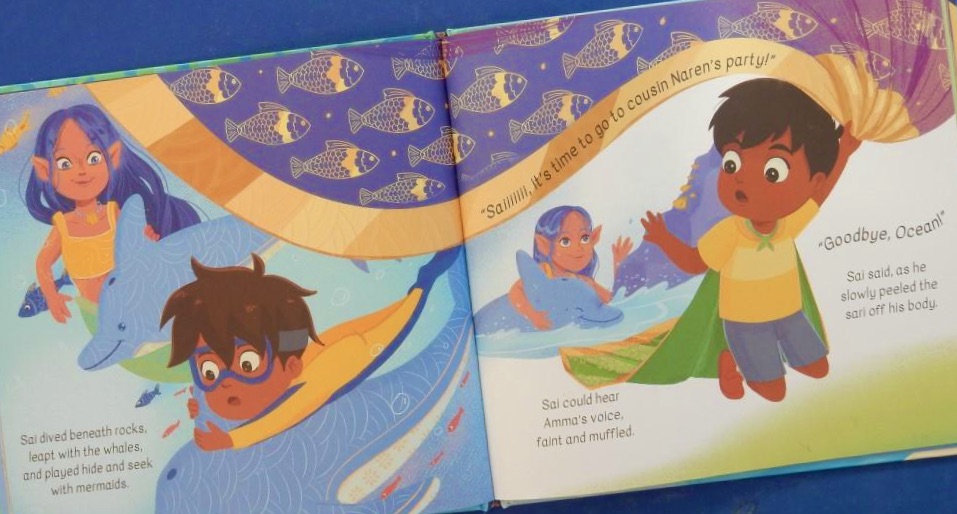
Instead, taking hold of the edge of one of Amma’s saris, he tosses it skywards. Immediately the boy finds himself plunging into the ocean, where he’s surrounded by all manner of underwater creatures through which he swims; he even plays with mermaids. All too soon though, a voice calls him back to reality.

This image has an empty alt attribute; its file name is dscn9969-1.jpg

Having bid the ocean farewell, Sai heads to his cousin Naren’s birthday party. There however, all the other children have their eyes glued to screens. Sai picks up the edges of Amma’s sari and instantly he’s in Sri Lanka’s Sinharaja forest surrounded by squawking birds and a wealth of wild animals.


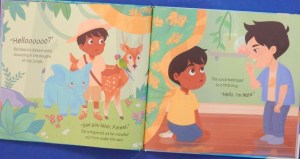
Then “Helloooooo?” comes a sound through the undergrowth and as Sai emerges from beneath the sari, there before him stands a little boy who introduces himself as Nate.

This image has an empty alt attribute; its file name is dscn9970-1.jpg

The two boys soon form a bond and Sai invites Nate to his home to play. In Sai’s bedroom, Nate too, is enchanted by the saris. Sai explains how they facilitate his imaginative play and having looked at their wonderful patterns and adornments, Nate finds Sai’s very favourite one.


Unlike the other children Sai knows, Nate is eager for an adventure. I wonder where they go, for, as the final words of the story say, ‘Anything’s possible with six yards of magic silk.’

With Jani Balakumar’s striking illustrations and Shyala Smith’s effective combination of lyrical description and dialogue, this richly woven vignette of Sai’s everyday life, treats readers/listeners to a journey of the imagination.

Having collected all manner of saris during my travels in India and made them available in my foundation stage classrooms, I know from experience, just how much young children love to use them to enhance their creative play.