Love is … / Sometimes I feel …

Love is …
Sarah Maycock and Lily Murray
Sometimes I feel …
Sarah Maycock
Big Picture Press

In the first book, using a variety of creatures great and small, furred, 

feathered or smooth and leathery, author Lily Murray and illustrator Sarah Maycock explore some of the myriad ways that we can experience love, both feeling it and giving it.

In each example, figurative language ‘Love is / BEAUTIFUL / like the sanctuary / a bowerbird builds for its mate -/ adorned with treasures.’ … – ‘love’s beauty comes / in many forms … / … a simple song, / a colourful dance, / a loving face’, and gorgeous painterly images extend across two double spreads whereon the artist makes use of vibrant hues and monochrome colour to great effect.

Having met a host of members of the animal kingdom the final spreads make the assertion ‘Love is a POWERFUL THING, / For with love … / We can do / ANYTHING.’

What better words to give a loved one: this large format book would send a powerful message to its recipient.
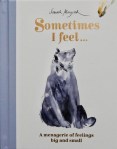
Presented in a small format, again using animal similes is Sometimes I feel … which looks at emotions. 

At the end of the book, in a note the artist explains that this had its origins as a project in her final year at university. She wanted to explore the ‘universal nature of animals and how we can relate them to our own (human) experiences and characteristics. She spent a considerable time studying animals both in zoos and in natural history documentaries on TV and as she painted it seemed that like us, wild animals display a gamut of complex emotional responses. Some of these she captures in this superbly executed series of watercolour and ink paintings.

A little book that offers children an unusual starting point for exploring their own feelings and emotions and those of others.

I Am Love / The Golden Rule

I Am Love
Susan Verde and Peter H. Reynolds
Abrams Books for Young Readers

Showing love and compassion towards others is one of the most powerful things we can do for our fellow human beings.

What’s more it doesn’t cost us anything; we just need open hearts and the willingness to give some of our time.

That is what the child narrator in Susan Verde and Peter Reynold’s latest ‘I Am … ‘ book demonstrates.

When we discover somebody is going through a tough time, perhaps something has happened to make them feel hurt, sad or angry, something unfair maybe; if a person is fearful and it seems as though darkness is all around, a listening ear may be all that is required … or a loving hug and some softly spoken, reassuring words like “Everything will be alright.”

Love is also gratitude: being thankful for what we have; it’s taking care of our minds and bodies.

Understanding is key and on occasion love is expressed creatively and takes effort.

Remembering is another way of showing love – remembering those who have died or are no longer with us for other reasons, perhaps a friend has moved away but they still need our love.

Small gestures can mean so much; they’re a way of demonstrating our connectedness to every living thing in the world, no matter what life brings.

The book concludes with an author’s note, a few heart-opening yoga poses and a final heart meditation.

Add this to your foundation stage PSHE class collection.

The Golden Rule
Ilene Cooper and Gabi Swiatkowska
Abrams Books for Young Readers

In a city street a boy and his grandfather stand together looking at a sign that says, “Do unto others as you would have them do unto you.’ The boy asks what it says. Grandpa reads and explains that the world over it’s called the Golden Rule.

As they walk further they talk about its meaning and for whom it’s applicable. Grandpa says it’s for “Everyone, everywhere”.

No matter the religion, the same basic tenet – essentially the cross cultural, universal reciprocity principle – is found in the holy book of the six examples he cites – Christianity, Judaism, Islam, Hinduism, Buddhism and the Shawnee tribe.

On a park bench the discussion turns both more realistic and philosophical, as the old man asks the boy to imagine himself in certain situations and asking how he would react. It then moves on to embrace countries as well as individuals – … “maybe there wouldn’t be wars,” comments the lad

before coming right back to the notion that, as Grandpa states in conclusion, you can’t make others practice the Golden Rule, … “It begins with you.”

Somewhat didactic yes, but the message also holds good for those of no religious faith such as this reviewer and Ilene Cooper’s text offers a good starting point for discussion with primary school children.

Incorporating both traditional religious symbolism and floral, avian and animal imagery Gabi Swiatkowska’s richly pattered, painterly illustrations, have an old fashioned look about them that feels just right for the book.