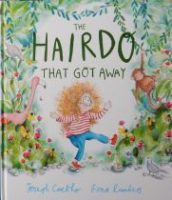
The Hairdo That Got Away / My Name is Bear

The Hairdo That Got Away
Joseph Coelho and Fiona Lumbers
Andersen Press

A small child narrator tells us how he’s used to a monthly visit to the barbershop with Dad, till one day Dad isn’t there. We don’t know the reason for this separation – perhaps his cool new haircut precipitated a parental row. The consequence though, is that the child’s hair starts growing and growing.

The days become weeks and then months; the hair grows ‘ginormous’ until his teacher, Miss Clarke is unable to recognise her pupil and Mum can’t hear her own child.

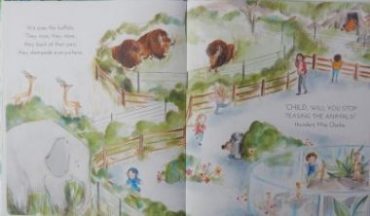
There follows a class visit to the zoo when the child, who is without any spending money, is accused of ‘teasing the animals’.
It seems that it’s down to the headteacher to recognise the recalcitrant child is actually struggling with his now unmanageable tangle of emotions and provide some bibliotherapy rather than a telling off.
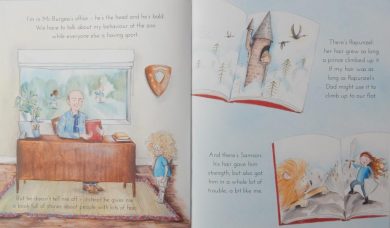
All ends happily with Dad’s return (now also with a huge mass of troublesome hair) and a new hairstyle for each member of the now re-united family.

Like this reviewer, others both children and adults may find performance poet and author, Joseph Coelho’s warm-hearted story slightly enigmatic. Assuredly youngsters will delight in the unruly head of hair the narrator grows during his emotional upheaval and the funky stars the barber cuts for him.
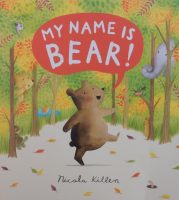
My Name is Bear
Nicola Killen
Egmont

The bear in this story has just moved home and is extraordinarily fond of his name, Bear. So much so that he soon starts introducing himself to his neighbours: “Hello! My name is Bear’ he says to Bird and Fish in turn but can’t stop himself from being rude about their respective names.

This doesn’t slip the notice of an observant earthworm that pops up every time Bear stops to talk.

The exchange with Elephant is downright insulting and Bear continues with his rudeness
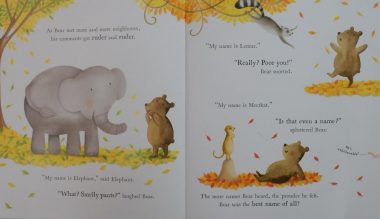
until he comes face to face with another ursine character. Now there’s a problem: both claim to be called Bear.
However although Bear 1 loses it completely throwing a tantrum on the spot,
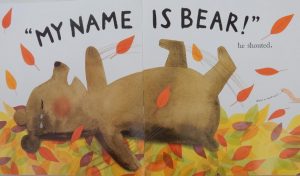
the other Bear is ready to compromise. Eventually, after giving it some consideration, Bear number one agrees that perhaps after all they can share the same name.

Thereafter it’s a case of apologies to all the neighbours who in turn start to think that perhaps the newcomer isn’t quite so bad after all.

That’s not the end of this tale though for not long after a third new neighbour, bear number three, arrives and introduces himself … To reveal the finale would make me a story-spoiler so I’ll merely say that the worm actually has the last word.

Nicola Killen’s amusing tale of acceptance and learning how to get along with others is just right for little humans learning to make their way in the wider world, perhaps having started at playgroup or nursery.

Separation

Here are two picture books that I would want to have in any setting where there are young children. Both deal with separation and each has come about as the result of direct experience. Most children will at some time have to face an extended temporary absence of one or other parent. Indeed I can well remember times when my own father (who worked for an airline) was sent on overseas assignments and how much he was missed.

DSCN1338

My Daddy’s Going Away
Christoper MacGregor and Emma Yarlett
Doubleday
The small child alien narrator of this story shares experiences of having an absent father. We hear about preparations and packing, saying goodbye, keeping in touch, staying strong, missing each other, anticipating the return and crossing off the days, getting ready for a welcome celebration and finally, home at last.
The overall tenor of the rhyming text is upbeat – a mix of humour and pathos – and grew out of a poem Lieutenant Colonel Chris MacGregor wrote and recorded before being separated from his own two children during a six-month tour of duty in Iraq in 2007. What comes across loud and clear is that it is love that keeps everything together.

DSCN1337

Emma Yarlett’s alien world is intriguing and seems to be set somewhere between outer space and under water with spaceships, fish and tentacle creatures abounding and the featured family sporting antennae and tails. This makes it somehow a safer place in which to explore the emotions of separation and assuredly, this book offers an excellent starting point for discussion.
The book is endorsed by HRH The Prince of Wales and the author gives ideas, support and things to do as well as further information about what inspired him on http://www.mydaddysgoingaway.com/
Buy from Amazon

DSCN1340

Two Nests
Laurence Anholt and Jim Coplestone
Frances Lincoln pbk.
A pair of birds sits in a tree as the autumn leaves fall. Betty requests a nest to snuggle in; Paul builds one and the two cosy up for the long winter. Spring brings cherry blossom and a rumbly feeling in Betty’s tum. A few weeks later there is a new baby; Betty sings it a song of love. However, the nest becomes an unhappy place – too small for three and the parents are squabbling. Paul decides to move out and a new nest is built. Now there are three sad birds but Betty sings her little one another song. The message is loud and clear: “WE BOTH LOVE YOU.” The cherries ripen and Baby sprouts wings. Now s/he is able to visit both homes and spend time with each parent.
Jaunty verses and amusing illustrations help make this topic accessible to very young children. Parental separation is not an easy issue and here we have a sensitive treatment presented through the medium of a story that nursery age children can relate to and enjoy. The important message is that no matter where they live, there are two parents who love them and it is those parents, and not their offspring, who are responsible for the separation.
Buy from Amazon

Find and buy from your local bookshop:

http://www.booksellers.org.uk/bookshopsearch