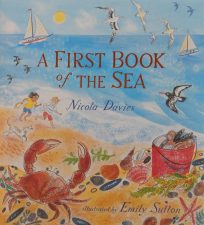
A First Book of the Sea

A First Book of the Sea
Nicola Davies and Emily Sutton
Walker Books

Award winning team Davies and Sutton present a fine, diverse collection of sea related poems that subtly blend information within.
Starting down by the shore readers can experience a paddle, sandcastle building, watch a flock of seagulls, have a spending spree on the pier, ride a wave, become creative with shells and pebbles, or stop still and watch a Shore Crab:

‘Delicate! / As a dancer, / The crab sidesteps / To a dead-fish dinner. / Wary! / Periscope eyes up, watching. / Its big claws pinch tiny scraps / And pass them to its busy mouth. / Dainty! / Like a giant eating fairy cakes.’

I love that observation.

Equally beautiful, from the Journeys section, is Star School wherein, ‘The old man draws the night sky out in pebbles / to teach his grandson the pattern of stars. / They will steer his path across the ocean / like stepping stones laid out in the sky, / They’ll steer him safe to tiny islands, / green stars lost in seas of blue.’

I’ve never been a particular lover of beaches and the sea other than in tropical climes, but Nicola Davies’ superb word pictures in tandem with Emily Sutton’s remarkable watercolours have made me want to head to the nearest coast and look anew at those seagulls, limpets, shells and ‘bits of beauty that are pebbles.’
I know I’ll have to travel a bit further in search of puffins though, and I can wait a few more months to watch fishermen on palm-clad shores, perhaps in Kerala or Goa, tossing their nets ‘spider web’ like, endeavouring to ‘catch just enough fish for dinner’.
This is an outstanding and wondrous evocation of the sea – beside, upon, above and beneath –
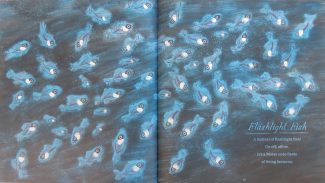
‘A festival of flashlight fish! Off-on, off-on. It’s a morse code fiesta of living lanterns.

for every book collection, be that at home or in school. A ‘First Book of the Sea‘ it might be, but this is one that will go on being appreciated over and over and …

Towering Tree Puzzle / Lift-the-Flap and Colour:Jungle & Ocean

The Towering Tree Puzzle
illustrated by Teagan White
Chronicle Books
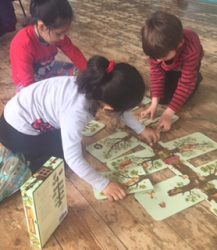
Essentially this is a sturdy box containing 17 large, easily manipulated, double-sided pieces depicting Spring/Summer scenes on one side and Autumn/Winter ones on the reverse. Each piece shows various woodland animals playing and working together; a whole tree community indeed and the puzzle when complete is over 130 centimetres long. Nothing special about that, you might be thinking but, the language potential is enormous, especially as there is no one right way of fitting the pieces together: this open-endedness also means that if more than one child plays with the pieces, there is a co-operative element too.

The artwork is splendid: each detailed piece, a delight.
Every branch of the tree generates a different story, or rather, many possibilities; ditto the completed tree. Some children like to story about the pieces as they put them into place, others prefer to complete the puzzle and then tell one or several stories which may or may not be connected. You could try a completely open-ended ‘take it in turns tell me about’ game with children sitting in a circle for starters, or perhaps choose a focus, say animals, plants or perhaps, events: the possibilities are many.
I’ve used this marvellous resource in several different settings and each time it’s been received with enormous enthusiasm and the users have shown great reluctance to part with it afterwards.

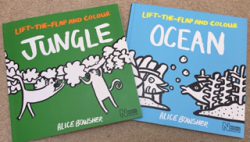
Lift-the-Flap and Colour Jungle
Lift-the-Flap and Colour Ocean

Alice Bowsher
Frances Lincoln Children’s Books/ Natural History Museum
In this collaborative publishing enterprise, children can choose from one of two locations to start their colouring in experience. The first is the South American Amazon jungle wherein jaguars hunt, slow sloths dangle, alligators lie in wait for a tasty meal, stick insects and parrots share the lush foliage, and swinging monkeys abound.
In the Ocean they can encounter diving dolphins, and shoals of fish, visit a coral reef with its abundance of sea creatures, notice the seaweed fronds that provide a safe hiding place for fish; and dive right down to the deepest dark depths.
A brief, rhyming text accompanies each adventure gently informing and guiding the young user as s/he explores the location, lifts the flaps and adds colour to the black and white pages – five spreads per book. And the final page of each book has an information paragraph that focuses on the importance of protecting the specific environment.
These will I’m sure be seized on by young enthusiasts, particularly those with an interest in wild life and will one hopes, leave them wanting to discover more about the inhabitants of each location.

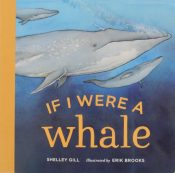
If I Were a Whale
Shelley Gill and Erik Brooks
Little Bigfoot
This contemplative, charmer of a board book successfully mixes rhyme and science facts. It imagines the possibilities of being a minke, a beluga playing with icebergs, a pilot whale and then these beauties …

If those don’t suit there’s a tusked narwhal, a blue whale, or a humpback perhaps? There are eleven possibilities in all, each one beautifully illustrated by Erik Brooks who manages to capture the essence of each one in those watery worlds of his.
Yes, it’s a small introduction to a huge topic but this is a pleasure to read aloud, is likely to be demanded over and over, and to inspire tinies to want to know more about these amazing mammals.

I’ve signed the charter