Uprising

Set in Poland during World War 2, this book is based on the real life story of Lidia Durr – a girl whose life changed irrevocably when the Nazis invaded Poland. Lidia, a talented pianist, is just twelve in September 1939. She and her family went into hiding in their basement when the Nazis began bombing Warsaw as part of their house was smashed by bombs. When the German takeover was complete, Lidia and her family went back to living upstairs but then were forced out as the Germans took the house for themselves. Papa meanwhile has donned his uniform from WWI and gone to fight for Poland.

The Durr family – Lidia, her mother and brother, Ryszard, together with a Jewish woman their former maid, Doda, and Doda’s mother relocate to a tiny apartment adjacent to Warsaw’s Jewish quarter from where, at the mercy of their occupiers, Lidia helplessly watches family, friends, and countless strangers suffer terrible cruelty, starvation and injustice.

With life becoming ever more difficult, Lidia, desperate to fight back, seeks opportunities to play her part. She sneaks food into the ghetto and enrols in an underground school but as she gets older, with Ryszard having joined the resistance, she finds this isn’t enough. Always hoping for liberation, she begins to fear that the world has forgotten Warsaw.

Frustratingly, her brother doesn’t talk about his resistance work so Lidia finds her own ways to increase her participation. She begins by running messages for the resistance but soon becomes a crucial element taking on ever more dangerous assignments. Admitted into the circle of people planning Operation Tempest, Lidia (code name Cello) rapidly rises up the ranks.

This is a powerful story with Polish people who are not Jewish as its main characters that demonstrates just how very dangerous it was to speak out of turn, let alone be a pro-active member of the resistance movement. Lidia survived and was eventually reunited with her mother in Chicago, dying in 2011: her father and brother perished during the war.

Child readers and adults cannot fail to feel in awe of what she and others like her contributed to her country. (Some black and white photographs of Lidia and her family follow the main narrative.)
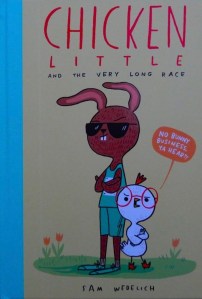
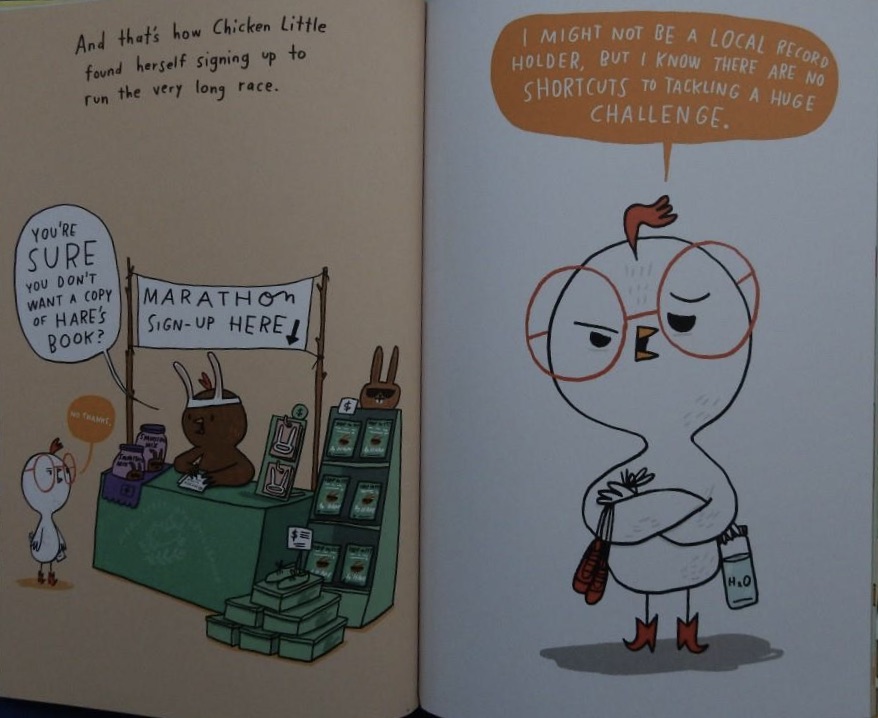
Chicken Little and the Very Long Race

Chicken Little returns in a third episode and at the outset she’s feeling bemused. Why the great ado about an announcement that the local record holder, Hare, is to compete in an upcoming marathon, she wonders. The hens have turned the barnyard into a training zone and it seems there’s no getting away from the event. Even though Chicken Little is not by nature a competitive creature, she begins to wonder whether she too should take part. Until that is a certain book penned by Hare appears and her gullible feathered friends start following it to the letter: smoothies aplenty, special ‘Hare-Brand’ sneakers, headbands, self belief in bucket loads, but nothing that might enhance one’s stamina.

Surely not, thinks Chicken Little who tries getting her pals up and doing some preparatory running but they dismiss her concerns, suggesting she prove her running prowess by participating herself, and so she signs up

and starts training, slowly and steadily.

Come race day, Hare is immediately the focus of attention for every chicken, save one. When the race begins it’s soon evident to Chicken Little that the other hens are having serious problems and before long there are only two contenders left in the running. Which one will be first past the post: fame obsessed Hare or our determined little avian competitor?

The combination of Sam Wedelich’s hand-lettered text, speech bubbles and chuckle-inducing digital illustrations make for another fractured fable with an important lesson for humans, as well as for the characters herein.

Huge fun to read aloud to a KS1 class or for solo reading.

Signs of Survival: A Memoir of the Holocaust

This is a true story of two sisters, Renee (age ten) and Herta (age eight). It’s based on video testimonies of the Jewish siblings born and living in Bratislava, the capital of what was then Czechoslovakia, during World War II. Both the girls’ parents and Herta are deaf, so they all communicate by means of sign language with Renee acting as the family’s ears. The book opens in 1943 with Renee’s voice and then alternates between hers and Herta’s.

By then, so adept has Renee become at recognising the sound of soldiers’ boots beneath the windows of their apartment that she’s able to warn other family members of danger, ie Nazi soldiers rounding up fellow Jews in the town.

Having been sent to a farm for safekeeping by their parents, the sisters eventually find themselves the last Jews in Bratislava and they give themselves up to the Slovak police. The police put the girls on a train bound for Bergen-Belsen, to join their parents so they were told. However what the girls didn’t know was that their parents had been sent to Auschwitz.

We read vivid accounts of the horrors the siblings witnessed, but what stands out is the power of the relationship between the sisters and Renee’s protectiveness that sustained them through horrendous ordeals.

When the war ends, the sisters are sent to Sweden where they learn their parents are dead; there they spend three years. The final part tells of the girls’ post war lives in the USA, where with the help of the Red Cross, they arrived to live with American relatives residing in New York in 1948.

Then follows a poem written by Renee, an epilogue written by Joshua M.Greene giving historical background relating to the Holocaust, and some photographs.

Simply told, this compelling, enormously moving story will linger with you long after you close the book.
It’s a must read for primary children especially those learning about World War Two in their history lessons.

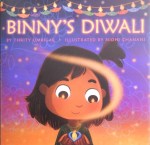
Binny’s Diwali

Binny’s Diwali
Thrity Umrigar and Nidhi Chanani
Scholastic
‘All over the world, Diwali marked the victory of goodness and light.’ So young Binny’s mother tells her, and surely more than ever right now we could all do with goodness and light to help us through the coming months that promise little of cheer.

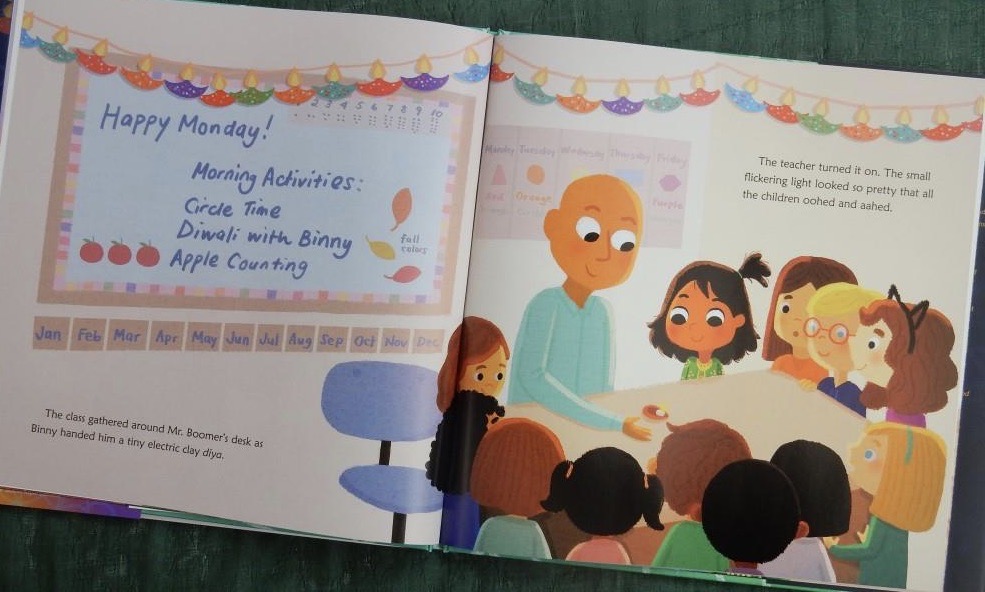
Binny is due to talk to her class about the celebration of this important Hindu festival; she’s wearing her new clothes, has eaten a sweet breakfast and can’t wait to tell her friends about Diwali at circle time. But when it’s her turn to speak, she gets an attack of nerves and can’t get her words out. Her fear is almost palpable but then so too, is her delight and enthusiasm when she finds her voice after some reassurance from her teacher. She tells of her favourite holiday, of how people light diva lamps and put them outside their front doors to chase away the dark and guide the light and good fortune to their homes.

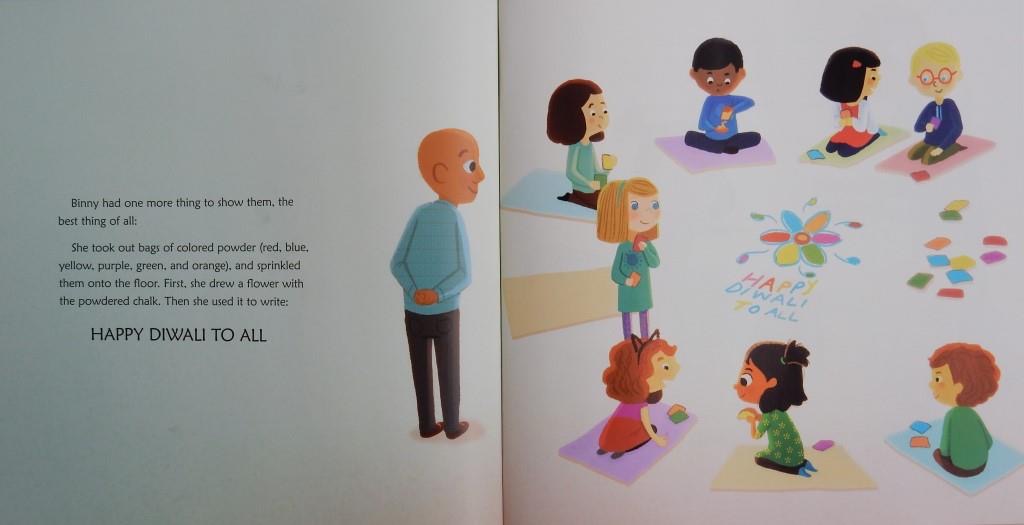
She explains how the festival lasts for five days and how fireworks colour the air (not often now though at least in some countries on account of the pollution), and best of all she creates her own rangoli pattern on the classroom floor using the bags of coloured powder she’s brought specially.

Then after sharing a box of sweets with everyone she feels that after all she’s done Diwali proud in her classroom. Then walking back home she’s able to feel that in her class she’s celebrated her very ‘own victory of goodness and light’.

I especially love Nidhi Chanani’s beautiful diva endpapers reminding me how much I will miss celebrating the festival in India this year. I’ll be interested to hear how my friends there do so during the pandemic; no doubt many be they Hindus or from another of the faiths followed there, they’ll find a way. Yes, Diwali is a Hindu festival but many Indian friends who do not share a Hindu worldview, also celebrate (and that’s despite the current political climate).

Thrity Umrigar (herself from a Zoroastrian family) provides a brief account of the Diwali story – the triumph of good over evil – at the back of the book along with an explanation of the five days of the festival.

This is a lovely, uplifting, colourful book to share with youngsters in KS1 classrooms as well as in a family.