Fart Zoo / Not Another Unicorn Book

Have an air freshener close at hand when you share this malodorous book with youngsters for you’ll be paying a visit to an exceedingly pongy place.

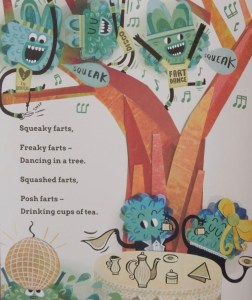
At this unique zoo (make sure you read all the signs at the entrance) you will encounter more than twenty fart varieties so wearing a nose peg or a face mask might be a good idea. Read too the signs relating to the beastie(s) in each enclosure. Thanks to Leigh Hodgkinson’s narrative and madcap visual portrayals you will quickly discover they come in all shapes and sizes including those sneaky, cheeky …

shlumpy and grumpy, squeaky and freaky, even posh farts (though how that’s possible I truly wonder) and several others.
Finally, however comes an empty enclosure: seemingly a fart has done a runner but where could it possibly be? Chaos rapidly ensues. With the zoo gate wide open the escapee might be anywhere, but it’s not actually left the venue. A couple of eagle-eyed security staff eventually apprehend the whiffer (Evade Fartum), put it back on its recliner and lock the gate but how long will it remain there is anyone’s guess – check out the final scene.

Replete with silly speech bubbles, this is fetid fun for little ones and any adult with a sufficiently strong constitution to read aloud Leigh’s rhyming rendition. (Wearing my science studies hat, the final User’s Guide to Farts is not strictly correct as a classification. For instance ‘Escaping farts should be Fartum evado and ghostly farts should be Fartum umbrabilis and so on … ie only the genus name is capitalised, not the species.)

Another subject with great appeal for young children is:

The unicorn narrator of this book is anything but pleased at the possibility of being in a unicorn book, vowing she would ‘never, ever ‘ do so but fate takes its course …


There’s nothing for it but to escape its covers as soon as possible. Try as she might with her chomping, poo-dodging and running, her search for adventure doesn’t match up to her expectations. Maybe being in a unicorn book is not actually so bad after all. Assuredly it has its compensations.

Undoubtedly countless little human unicorn lovers will fall for the protagonist in this rainbow coloured setting with its sparkly starry sprinkles that even hover over the poo piles and delicious-looking confections shown in Chris Jevon’s dramatic scenes

G.O.A.T.

Goat considers himself the Greatest Of All Time: none of the other creatures comes anywhere near him when it comes to greatness. Take Duck for instance; Duck is the Deadliest Underwater Crumb King and Donkey is Devourer Of Nice Kind Easter Yams.

Donkey needs correcting on G.O.A.T. for thinking it stands for Grunts Often At Termites, something Goat denies doing, though the Termites disagree on that. And so the discussion goes on until it appears that all the animals have ways of being GOAT, well maybe make that all but one.

Totally bonkers though if you’ve met books written by Kate and Jol Temple this probably won’t surprise you. Deliciously daft too are Rebel Challenger’s colourful portrayals of the animal characters – an ideal complement for the text.

Now should you want to introduce acronyms to children, this book offers a great starting point; however first and foremost it should be shared for its hugely playful content. I imagine it going down really well in a KS1 classroom: the most important thing children will get from it is that language is fun.

The Bunny Who Came to Breakfast

This unlikely tale is narrated by a small boy who, while relaxing with a book, suddenly hears a thump, thumping at the door. Young listeners will likely guess the thumper from the clues in Mike Byrne’s first illustration without needing to turn the page on which further clues in vignette form are offered. The visitor is of course the titular Bunny looking totally cute with a twinkle in her eye, a basket in her paws and one suspects, a rumbly tum. The boy and his grandad invite Bunny to sit at their table, and to say that she has a rather large appetite is a huge understatement. Having consumed slices of bread spread – thickly no doubt – with sweet confectionary items, followed by a whole bunch of carrots as well as goodness knows how many eggs served up in various ways, said Bunny then spies through the window, a trampoline. Claiming to be an expert, out she dashes and proceeds to demonstrate her skills. How she doesn’t throw up is anyone’s guess but having smelled something irresistible, she heads for the chicken coop.

Did I mention a basket? It’s soon full to the brim and rather than saying thanks and cheerio, the visitor proceeds to go back indoors and there Grandad mixes up and presents an enormous stack of further treats. She shares these with her young host but despite declaring herself ‘stuffed’, Bunny hasn’t quite sated her appetite. Only after consuming another of Grandad’s culinary delights, does she announce it’s time to leave, followed can you believe, by another request.
It’s the hosts though who have the final word as they bid their chaos creating visitor farewell.

With a nod to Judith Kerr’s The Tiger Who Came To Tea, this delightfully silly saga delivered through Rachael Davis’ bouncy rhyming text and Mike Byrne’s mouth-watering scenes will have young listeners, in Bunny fashion, calling for more.

Rita & Ralph’s Rotten Day

Rita & Ralph’s Rotten Day
Carmen Agra Deedy and Pete Oswald
Scholastic

Separated by several hills, best friends Rita and Ralph live quite some distance apart but they have established a daily routine, a ritual really. They both go ‘down the hill, and up the hill, and down the hill, and up the hill’ to meet under the apple tree between their houses. There they ‘high-five, pinkie-shake, do a cha-cha-cha, play zombie tag, and make daisy chains.’
One day though, they decide to play a new game, Sticks and Stones. Ralph accidentally knocks Rita who ends up with a very sore bump on her head and they both run off back home, Rita angry, Ralph sorry for hurting his best pal.


He wants to apologise so he makes the entire journey to Rita’s house. What a walk! ‘down the hill and up the hill … ‘He arrives feeling a tad grumpy and his apology doesn’t come across as very genuine so Rita’s door remains closed. Off storms Ralph back home leaving Rita feeling the need to say sorry. Off she runs – you know how it goes –

but her thoughts en route anger her and she also leaves without apologising. Now the two children are both mad and sad. What a rotten day and it’s followed by a sleepless night.
A new day begins and Rita and Ralph head out to their usual meeting place. Can peace resume? Of course it can for ‘best friends always find a way… ‘

Thoroughly engaging and what fun this will be in a story time session with all that upping and downing of hills, high fiving, pinkie shaking, cha-cha-cha’ing. The author provides a note showing how to play the ‘Mr Wiggle and Mr Waggle’ hand game after the story, a story which shows how anger can sometimes cause ridiculous behaviour and saying sorry to a treasured friend is a vital, often up and down, process. Pete Oswald’s digitally worked gouache illustrations skilfully uses the format, showing the hilly landscape, the contrasting homes of Rita and Ralph, not to mention occasional guest appearances of Ralph’s cat and Rita’s dog, and humorously depicting the feelings of both children in their constantly changing expressions and body language.

That’s My Flower!

That’s My Flower!
Alice Hemming and Nicola Slater
Scholastic

The rather possessive rodent and his feathered friend from The Leaf Thief return in a new story.

When Squirrel wakes one morning he’s excited to discover that the leaves are back on the trees: hurrah! it’s spring.

Suddenly Squirrel is surprised by unusual buzzing and cuckoo-ing sounds. Then a strange bird flies at his head. Fortunately Bird is close by to explain about spring’s arrival being heralded by a bumblebee, a cuckoo and a swallow.
Then Squirrel notices a small, yellow flower that reminds him of the sun: another sign of spring explains Bird. By now Squirrel has decided that he likes spring but goes on to claim ownership of the flower and starts trying to protect it.

It mustn’t get wet, nor be attacked by bees, he decides until Bird tells his pal that the flower needs rain and that visiting bees help flowers. Moreover, “Your flower is a wild flower … It’s there for everyone to enjoy,”

Still Squirrel continues his safekeeping activities by covering the flower with a bucket, with disastrous results, he later discovers.

Happily though, Bird persuades Squirrel just to leave the flower alone. The following morning, a wonderful surprise awaits when the two wake up.

Bird’s gentle lesson has been a success. Such a fun lesson it was too, for young readers and listeners certainly. They will be sure to laugh at Squirrel’s lack of understanding regarding the natural world, made all the funnier by Nicola Slater’s portrayal of Squirrel’s custodial antics and his friend’s reactions.

Let’s hope Alice Hemming’s story will encourage respect for the natural world in children.

When Jelly Had a Wobble / Ceri & Deri: Get Your Skates On

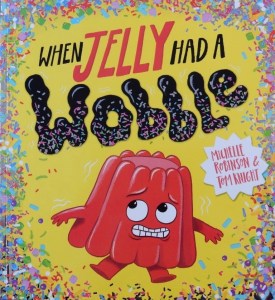
When Jelly Had a Wobble
Michelle Robinson and Tom Knight
Scholastic

Should you or should you not let others know how you are feeling? That dilemma lies at the heart of this story.

Jelly, the main protagonist definitely has some feelings of self-doubt he’s not eager to share when he’s expected to tag along with all the other dinners heading to the Kitchen Hall of Fame keen to discover which of their number will receive the golden crown for “Best in Show’. He’s the only one showing any reluctance to participate in this culinary extravaganza.

In fact he’s all of a wobble, unable to ‘take the tension’ despite the enthusiasm and determination of fellow foodies that he be there for the big announcement.

So determined are they that some are even ready to offer some calming techniques to help with his wibble-wobble nerves …

Imagine Jelly’s surprise then, when the announcement is made.

With its repeat ‘jelly on a plate’ refrain to join in with, and plenty of speech bubbles along the way, Michelle Robinson’s jolly rhyming narrative reads aloud well. Tom Knight’s foodie characters are a whacky lot with their googly eyes that clearly express how they’re feeling in his bright, funny scenes. The combination of words and pictures provides a taste bud tickling tale about being yourself to share with foundation stage children and little ones at home.

Ceri & Deri: Get Your Skates On
Max Low
Graffeg

In the latest of Max Low’s gently educational series featuring striped moggy Ceri and her spotty pooch pal, Deri, the two help Dai Duck learn some important life lessons.

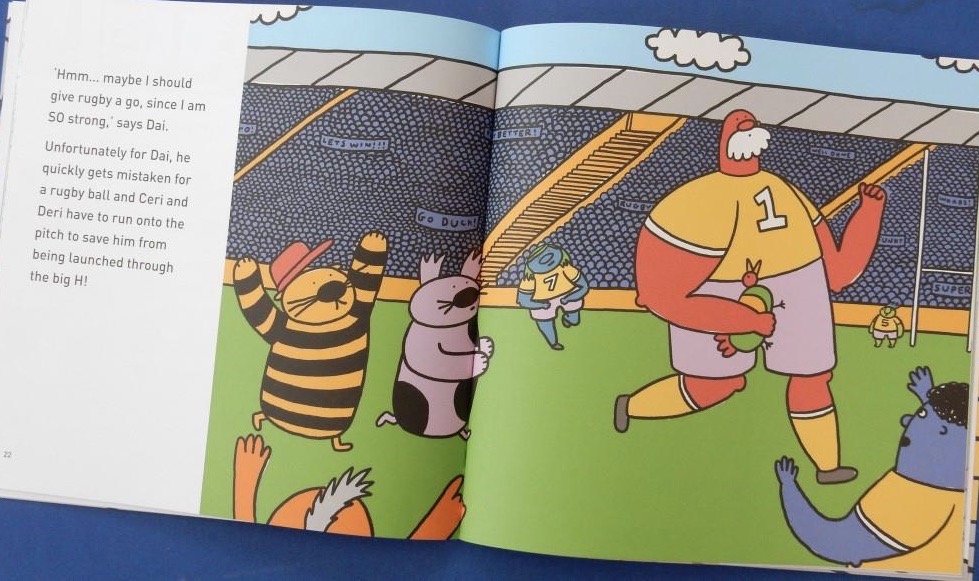
Dai is absolutely determined to be the best at anything and everything he tries and wants it to happen straightaway. So when he tries his hand (s), feet and brain at skateboarding, spelling, music making, DIY and rugby

and a host of other activities, the result is disaster. The trouble is Dai just isn’t prepared to put in all the hard work, perseverance and positive thinking that’s required when you want to be successful at something.

Until that is, Ceri and Deri step in and introduce him to Barbara Bear, ace skateboarder. She explains how her success is down to all the tumbles she’d taken as a learner acting not as a deterrent, but a motivation and an opportunity to spend time having fun with her friends. Can a similar attitude work for Dai? You bet …

The inherent humour and Max Low’s distinctive, bold illustrative style make for another enjoyable Ceri and Deri experience.

Animal Allsorts

dscn9536

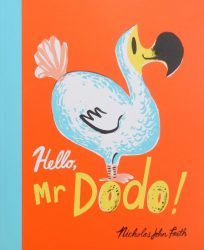
Hello, Mr Dodo
Nicholas John Firth
Alison Green Books
I absolutely loved Nicholas John Firth’s debut Hector and the Hummingbird, so was thrilled to get my hands on a copy of this, his second offering. It also has an avian theme and once again, is a delight through and through.
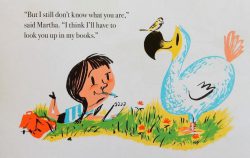
Martha is an avid bird lover and twitcher spending much of her time in the woods with her binoculars; there isn’t a bird she can’t identify until that is, the day she comes upon an extremely large specimen she doesn’t recognise

%0a

and it bears a very close resemblance to a supposedly extinct creature.
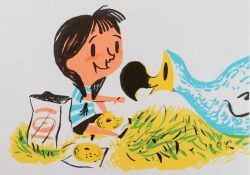
Before long a secret friendship has developed between Martha and her discovery, who shares with her, a particular penchant for doughnuts …

%0a

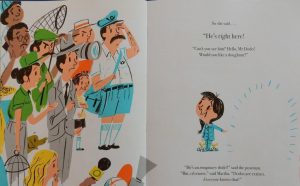
Then one afternoon Martha accidentally lets slip her secret and the following day she’s besieged by a crowd at her front door. Time for some quick thinking: the dodo has to disappear.

dscn9541

Is that to be the end of a beautiful friendship?
The wonderfully retro look of the book (there’s a slight touch of Roger Duvoisin about it) comes from the artist’s choice of colour palette, yet this is a thoroughly modern and enchanting tale.

%0a

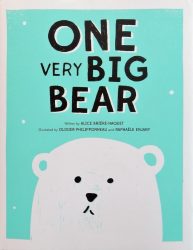
One Very Big Bear
Alice Brière-Haquet, Olivier Philipponneau & Raphaële Enjary
Abrams Appleseed
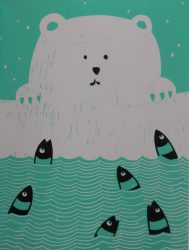
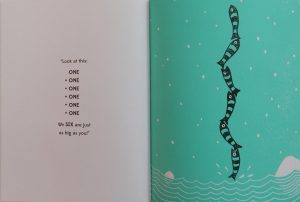
Mightily impressed by his own stature, a bear make an announcement: “I’m very big! … I’m almost a giant!” This claim is quickly countered by a whole host of other polar creatures that turn up in turn: two walrus, three foxes, four sea lions, five penguins and six sardines, the latter have the cheek to call him ‘foolish

%0a dscn9553

But who gets the last word …
Minimalist artwork, an easy to read text, mathematical opportunities aplenty and a giggle-inducing finale make for a fun book to share and discuss.

dscn9542

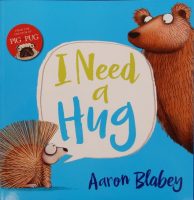
I Need a Hug
Aaron Blabey
Scholastic Childrens’s Books
We all need a hug from time to time but when you’re covered in spikes it makes things just a little tricky and so it is with the prickly creature in this tale.
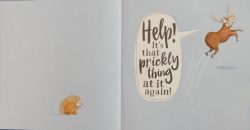
When a porcupine declares he needs a hug, unsurprisingly he doesn’t get any offers.

dscn9543

Then something happens to change his luck but it’s not quite what he was expecting …

dscn9544

With themes of looking for friendship and embracing difference, this brief rhyming tale offers food for thought and discussion with early years groups or individuals.

dscn9548

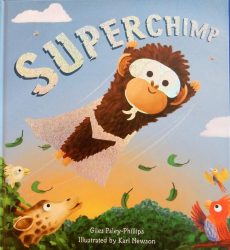
Superchimp
Giles Paley-Phillips and Karl Newson
QED
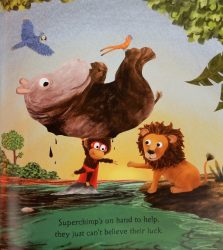
Sporting his red underwear and feasting on fleas, a young chimp spends his days whizzing around in the jungle coming to the aid of troubled animals,

dscn9549

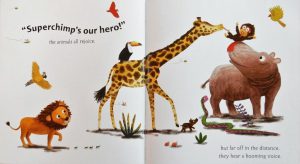
zooming through the trees in his super-cool chimpmobile or occasionally, relaxing in his secret cave. Known as Superchimp, he’s loved by all the rainforest inhabitants; in fact he’s nothing short of their hero …

dscn9550

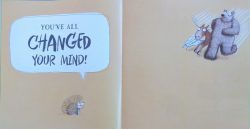
Come nightfall though, from afar there comes another booming voice; but it’s not a voice asking for assistance this time. Now Superchimp doesn’t look quite such a hero and it’s not just his underpants that are a dazzling shade of red.
Rhyming text from Paley-Phillips and vibrant rainforest scenes from Newson combine to make a fun read for young would-be superheroes.