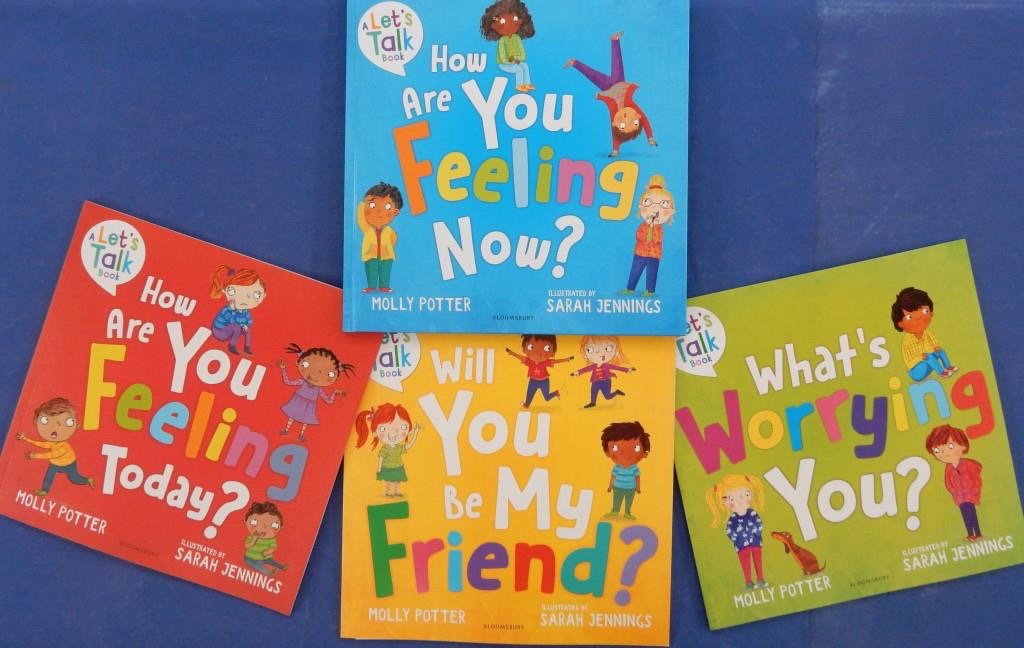
How Are You Feeling Now? / How Are You Feeling Today? / The Same But Different / Will You Be My Friend?

How Are You Feeling Now?
How Are You Feeling Today?
What’s Worrying You?
The Same But Different
Will You Be My Friend?

Molly Potter and Sarah Jennings
Bloomsbury Education

How Are You Feeling Now? is a hardback addition to the interactive Let’s Talk series; the other titles are, in the publisher’s words ‘refreshed paperback editions’ of existing titles.

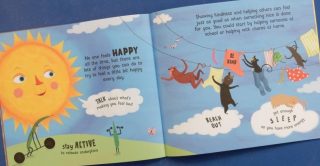
Developing emotional intelligence is a key part of children’s education in the early years and in her newest title Molly Potter adds another twelve ways of feeling to happy, angry, bored, worried, sad, excited, grumpy, scared, quiet, jealous, embarrassed and shy, which were discussed in How Are You Feeling Today? again devoting a double spread to each one. The new ones are giggly, anxious, confused, disappointed, proud, brave, frustrated, guilty, lonely, grateful, surprised and playful. For each, she explains what the feeling means and offers several suggestions – some sensible, others slightly offbeat, to help manage it. ‘Tell an adult that you need clarification because you are confused. It’s fun to use fancy words!’ or ‘ ‘Say I am SO confused. See how long you can say “so” for!’

Those of us who work or live with young children know they experience a whole range of emotions every day. A lot of them do not know how to deal effectively with these emotions. Since the start of the COVID pandemic many more youngsters began finding it difficult to cope with the gamut of feelings that beset them and this is still true now. So, books like this new one, written in straightforward, child friendly language giving fun, imaginative, positive ways to deal with these feelings, illustrated with Sarah Jennings’ appropriately expressive vignettes is a welcome resource for both parents and those in education. Also included is a guide for parents with information about emotional intelligence and advice about how we as adults can be important role models.

Worrying is normal, adults worry and so increasingly do children, often due to the pressures of the education system. In What’s Worrying You? Molly identifies other possible reasons why a child might feel worried: falling out with a friend, being picked on, arguing parents, fears and phobias, jealousy, being ignored, not having friends to play with and being ill. The verso acknowledges the child’s feelings and provides several words for their feelings: a great way to open a conversation and to help the child concerned verbalise how they feel. The recto comprises ‘things to remember’ in the form of gentle guidance and suggestions to improve the particular situation. As always the tone is spot on for young children. Back matter offers a Feelings glossary and guidance for adults about helping a child to talk about their worries.

Both The Same But Different and Will You Be My Friend? have been reviewed previously on this blog. All the titles deserve a place in Foundation Stage settings and families with young children.
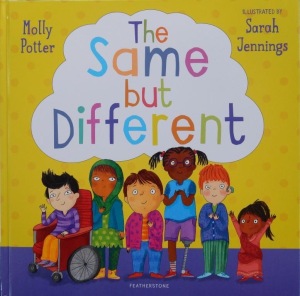
The Same but Different

The Same but Different
Molly Potter and Sarah Jennings
Featherstone

This is the latest in the excellent series written by Molly Potter and illustrated by Sarah Jennings that are used by so many teachers to stimulate thought and discussion.

Herein youngsters are invited to recognise, explore and celebrate both the things we have in common with other people and those that make us different. After all, every single one of us is a unique human being and our differences need to be acknowledged, respected and celebrated. Imagine a world wherein we are all identical in every way: how dull and boring life would be.

Sarah Jennings’ splendid illustrations portray a diverse mix of children (and some adults) and Molly’s narrative focuses largely on differences including how people look – skin colour, hair styles and colours, eye colour, whether or not we wear glasses, height and clothing styles.
There’s a page on talents and skills, another explores preferences such as foods, favoured times of day and another on personality.

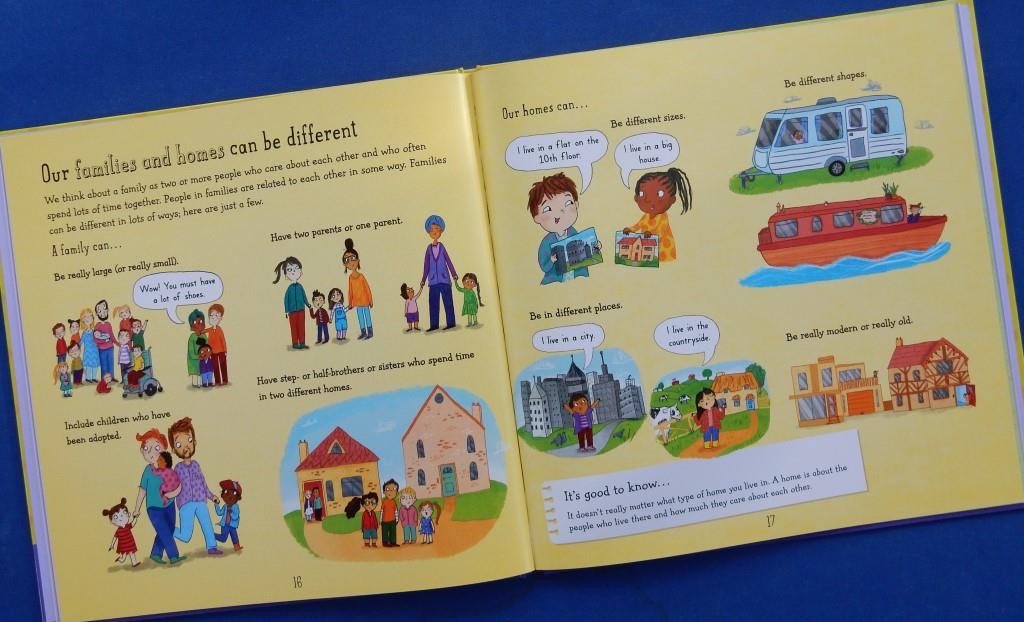
That everyone is entitled to have his or her own opinions and beliefs is acknowledged and these should be respected (provided that nobody is harmed, that is.) The concept of family and that of a home are both presented and some of the ways families and homes can be different, mentioned.


However, in addition to the differences, there are spreads that look at some things that are likely to be same or nearly the same as other people –

things that are part of our shared humanity such as the need to eat, a desire to be loved, a felt discomfort at excessive cold or heat, a brain that enables decision making and an imagination.

The book concludes with some helpful tips for adults sharing it with children to help in their understanding of various forms of diversity and the celebration of difference. There’s also a final glossary. All in all a very useful starting point for discussions on inclusion both at home and in the classroom.

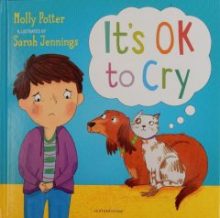
It’s OK to Cry / The Happy Book

It’s OK to Cry
Molly Potter, illustrated by Sarah Jennings
Featherstone (Bloomsbury Education)

Molly Potter’s latest book that offers both parents and teachers a starting point for developing emotional intelligence/ emotional literacy with youngsters is written particularly with boys in mind.

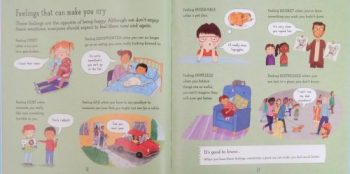
How many times in my teaching career have I heard a parent say to his/her young boy words such as “Stop all the fuss, boys don’t cry like that.”? Way too many; and if children are subjected to such comments from a very young age they soon internalise what they’ve been told and become afraid to show their feelings. Instead, from the outset we all need to encourage children to feel safe to talk about and show how they feel.

The author starts by presenting some commonplace scenarios to explore why it is that boys have a tendency to keep their emotions under wraps.

She then goes on to look at where some of the messages about ‘acting tough’ might come from, and to explore the importance of being able to articulate how you really feel.

This is followed by a look at a variety of different feelings, some positive, others negative. In each case the text is straightforward and easy to grasp, and offers starting points for opening up discussion, and is accompanied by Sarah Jennings bright, friendly illustrations.

There’s also a ‘park full of feelings’ that is a great discussion jumping off point, as well as some suggestions to help cope with ‘uncomfortable feelings’.

The final pages are directly aimed at parents and carers again with the emphasis on boys.  Included is the stark reminder that ‘poor male emotional literacy is reflected in the fact that in the UK suicide is the single biggest cause of death for men under the age of 45.’

With a down to earth approach such as the one Molly Potter offers herein, let’s hope all children will develop coping strategies to deal with feelings and emotions.

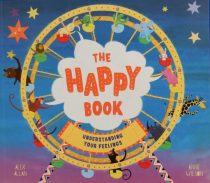
The Happy Book
Alex Allan and Anne Wilson
Welbeck Publishing

Developed in collaboration with child, psychotherapist Sarah Davis, this accessible book explores with a young audience in mind, five emotions – happiness, sadness, anger, fear and worry.

The author’s tone is warm as she encourages readers to consider carefully so they can identify their feelings and possible causes, as well as the reactions they might cause.

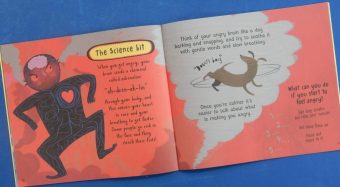
Occasional questions add to the interactive nature of the text and for each emotion, there is a paragraph (or several) explaining the science of what happens in both the brain and the body: ‘When you are happy, your brain releases a chemical called dopamine that helps you to learn, remember and helps you sleep well.’

There are also ‘top tips’ as well as a host of other suggestions to encourage positive feelings.

Anne Wilson varies her colour palette according to each emotion so for example red reflects an angry mood

and blue-black, sadness in her amusing illustrations. I particularly like the green vegetable characters and I’m sure they will appeal to youngsters.

This book provides an ideal starting point for parents and educators wanting to develop emotional intelligence in young children.

What’s Going On Inside My Head? / Step Into Your Power

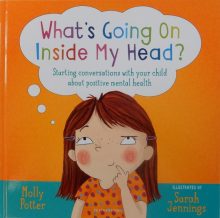
What’s Going On Inside My Head?
Molly Potter and Sarah Jennings
Bloomsbury Featherstone

Developing and supporting emotional literacy is, or should be, a crucial part of young children’s education in school and most teachers consider it so.

However, parents/carers can at times feel inadequate when it comes to talking to and supporting their children’s mental health, and at an increasingly younger age children come under enormous pressure be that through the education system (I could rant at length about that) or out of school in clubs and activities in which they participate, as well as through social media and advertising. What parents need to do is to love and support children not for what they can achieve but for who and what they are.

To this end Molly Potter, a teacher who specialises in PSHE has written a very helpful book to share with young children.
By means of twelve questions she explores a range of topics: how to think about oneself; the relationship between a healthy body and a healthy mind (how the former feeds into the latter);

the notion of happiness; dealing with emotions; coping with feelings of anger, sadness and fear; coping with negative thoughts that seem overwhelming (suggestions to prevent ‘ruminating’ and instead focusing on being in the moment); dealing with upsets triggered by another person (forgiving is important here).

There’s also a spread on meditation and its potential benefits;

another on who to ask for help when it’s needed; the role of family and friends as a supportive network; being a better friend and finally, improving one’s own thinking habits – being proactive when something is upsetting you.

Many of the topics includes a ‘top tip’ or ‘It’s good (or important) to know that …’ paragraph and I particularly like the coping plan

and the invitation to hold up a mirror to oneself and think about which behaviours ‘you like’, ‘don’t mind’ and ‘really do not like’.
The book concludes with three pages of guidance for parents and carers.

Throughout Sarah Jennings’ inclusive illustrations both support and extend Molly’s straightforward, sensible, practical words.

For an older age group is:

Step Into Your Power
Jamia Wilson and Andrea Pippins
Wide Eyed Editions

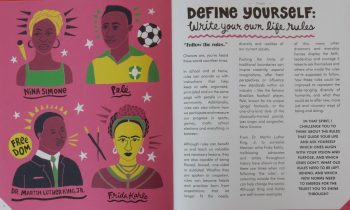
Here’s a book I wish I’d had when I was growing up. Both author Jamia Wilson (executive director of the Feminist Press) and illustrator/designer Andrea Pippins act as mentors in this, their guide to helping girls to grow into confident young women, cognisant of their strengths (and the areas they need to work at), and sufficiently empowered to step out and follow their dreams.

Subtitled ‘23 lessons on how to live your best life’, the book offers exactly that and made me want to go immediately and seek out some young females to share it with.

After an inspiring introduction, said lessons are organised into five sections entitled: Power, Community, Choices, Act! and Self-Care and all sections comprise several key elements each of which is allocated a double spread (or two) illustrated in vibrant colour by Andrea.

Thinking outside the box, abandoning old habits that are no longer appropriate in today’s richly diverse society, and not always following the rules, are explored and the author mentions as examples some visionary rule-challenging individuals.

Each topic has an encouraging and uplifting ‘Step into your power’ section.

Thoroughly recommended for upper primary readers and beyond.

I Am Human: A Book of Empathy / Let’s Talk About When Someone Dies

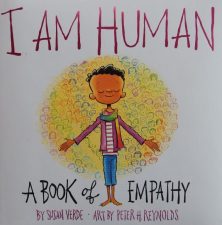
I Am Human: A Book of Empathy
Susan Verde and Peter H.Reynolds
Abrams Books

The team who gave us I am Yoga and I am Peace now explore what it means to be human.

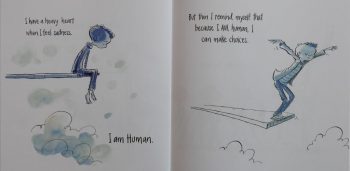
Humans have a playful side and find joy in relationships, we hear; but on the negative side sadness brings a heavy heart. This though, is countered by a reminder that part of being human is the ability to make choices.
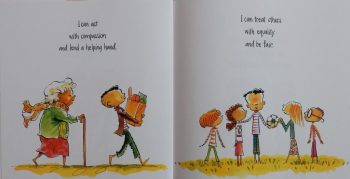
Positive actions – such as compassion and helping others, being fair and treating all people equally, bring a feeling of connectedness with fellow humans.

In keeping with the child narrator’s mood, Reynolds changes his colour palette from bright to a dull bluish grey as the actions switch from positive to negative.

Yes, we’re all flawed human beings who make mistakes but Susan Verde and Peter Reynold’s little book of empathy is perfect for starting a discussion with young children about making good choices. To this end, there’s also a loving-kindness meditation to share.

Let’s Talk About When Someone Dies
Molly Potter and Sarah Jennings
Featherstone (Bloomsbury)

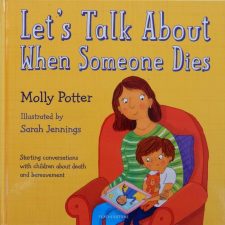
Most young children will bring up the subject of death either at home or in school, or both, and many adults are unsure of how to engage in a discussion about it. This book, written in child-friendly language by a teacher, will for those adults especially, prove extremely helpful.

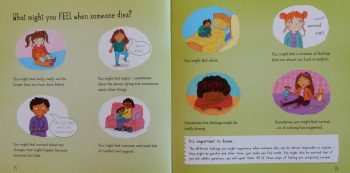
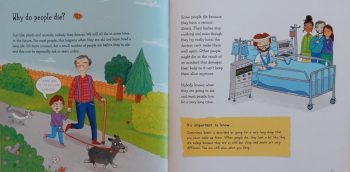
Each double spread – there are a thirteen in all – takes a different aspect and almost all start with a question such as ‘Are there different words for death?’; ‘What might you feel when someone dies?’ …

‘What do people believe happens after death?’ and, the only one that isn’t prefaced by a question, “To remember a person who has died, you could …’.
There’s a brief ‘It’s important to know’ paragraph at the end of most sections and Sarah Jennings has provided bright, appealing illustrations (often including speech bubbles).

The tone of the entire book – both verbal and visual – is spot on for the primary audience and is suitable for those of all faiths or none.

The Birthday Invitation / Wishker

The Birthday Invitation
Lucy Rowland and Laura Hughes.
Bloomsbury Children’s Books
That the author of this book is a speech therapist is evident in the abundance of verbs in her enormously engaging story.
We meet Ellen on the eve of her birthday excitedly writing and posting off invitations to her party. On her way though, she drops one: it’s picked up by a wizard while out collecting herbs, and into a bottle he pops it.

Some while later though, it finds its way into the hands of a pirate captain out at sea where it is then seized by his parrot which flies off and drops it into the hands of a princess and thereafter, it passes to several other unsuspecting characters before ending up in the pocket of its originator.
The day of the party dawns and there’s considerable hustle and bustle as Emma makes the final preparations for her birthday party and then comes a loud knock on her door …
Has there been a mistake or could it be that the wizard had worked some rather extraordinary magic? Certainly not the former, and maybe a sprinkling of sorcery went into the making of that wonderful celebratory cake …

There certainly is a kind of magic fizzle to Laura Hughes’ captivating illustrations: every scene sparkles with vivacity and her attention to detail further adds to the enjoyment of her spreads.
Just right for pre-birthday sharing with those around the age of the birthday girl herein, or for a foundation stage story session at any time.

Wishker
Heather Pindar and Sarah Jennings
Maverick Arts Publishing
Be careful what you wish for is the moral of Heather Pindar’s deliciously crazy cautionary tale.
Meet Mirabel who it seems never gets what she asks for be it a sleepover with her friends or a pet monkey; “It’s not fair! Everyone always says NO” she complains as she sits outside in her garden. Her comments are heard by a cat that introduces itself as Wishker, claims to posses magical powers and offers her three wishing whiskers.
Mirabel uses her first wish on ice-cream for every meal and her second for having her friends to stay – forever. The third wish involves a phone call to the circus and results in the arrival of clowns, fire-eaters, acrobats and a whole host of animals. The result? Total pandemonium in one small house: things are well nigh impossible.

Another wish is uttered and ‘Whoosh’. Normality reigns once more. But that’s not quite the end of the tale – or the whiskery wishing: Mirabel has a brother and there just happens to be a whisker going begging …
Sarah Jennings bright, action-packed scenes are full of amusing details and endearing characters human and animal.

I’ve signed the charter  

Let’s Go to Nursery! / Will You Be My Friend?

Let’s Go to Nursery!
Caryl Hart and Lauren Tobia
Walker Books
We join Bee and Billy (and their mums) at the door of a nursery. The session is already in full swing with all kinds of exciting activities taking place. The children give their mums a farewell hug and Bee eagerly begins to join in. Billy however, is more reluctant and a tad clingy. He soon gets drawn in though, thanks to a ‘message’ full of kindness …

Happy noisy play ensues until there’s a dispute over ownership of a large toy; but Billy, surely a fast learner, comes to the rescue and all is well once more.
There’s so much fun to be had, so many things to share and so much playful learning – just how it should be.

All too soon though, it’s time to help tidy up; the mums are back and it’s farewell until tomorrow: a happy, exhausting day spent and the prospect of many more to come.
Caryl Hart and Lauren Tobia paint a lively portrait of nursery life without the intrusion of the nursery staff: they, one hopes, are observing and sometimes, gently encouraging and perhaps guiding, unobtrusively from the side-lines.
The first of the First Experiences series for ‘a new generation of little readers’ the publishers say. Perhaps ‘little listeners’ would be more accurate, but no matter which, its intended young audience will find plenty to enjoy; it’s as well that the book is sturdily made with wipe-clean pages as I foresee a lot of enthusiastic handling.

Will You Be My Friend?
Molly Potter and Sarah Jennings
Bloomsbury Children’s Books
This is a title from Bloomsbury’s Featherstone imprint and has something of an educational slant: There’s plenty to think about and discuss; and the whole thing is invitingly illustrated with a sequence of vignettes. These are captioned and each spread opens with a question on an aspect of friendship: ‘What do you do when a friend upsets you?’ and ‘What do your friends think of you?’ for instance. Notes from a friendly puggish pup offer further food for thought at the bottom of each right hand page.

A final spread is aimed at parents, although I see this book being used in preschool and KS1 sessions on ‘What makes a good friend?’ too. It’s all very nicely and inclusively done though personally, I prefer emotional and social learning to be part and parcel of picture books’ stories rather than books specially created for the purpose.

I’ve signed the charter