Dasher Can’t Wait for Christmas / ’Tis The Season

Dasher (the reindeer we met previously in the book named after her) is so impatient she just cannot wait for the big night when she’ll help pull Santa’s sleigh. With just one sleep remaining before Christmas Eve, she’s wide awake with excitement and taking a run, she leaps skyward to investigate the music she’s heard.

Enjoying herself thoroughly, as the music dies away she spies bright lights on the horizon. In her joy, she fails to pay heed to the falling snow and is unable to find the North Star to guide her, so again she takes to the sky, hoping to find something familiar. At last she sees something bright way ahead.

Flying towards the light, she discovers a wonderful Christmas tree in a garden and decides to land to take a rest. There she encounters a small girl. Having admitted to being lost and hungry, she receives, thanks to the child Charlie’s kindness, both food and a means of finding the way back home. This Dasher does, just in time to reach the North Pole where a worried Mama and Santa await.

Then off they go, the reindeer team pulling Santa along on his delivery round, during which Dasher ensures that they stop to leave a special thank you to Charlie.

A gentle story with some tense moments and a happy ending, dramatically illustrated by the author.

Constructed of thick card, this fold out book will work well with children from around four, right through KS1. Of the twenty four shortish poems included some have a distinct Christmas feel, others are wintry and the whole thing opens into a gorgeous advent calendar zigzag frieze that can be brought out yearly on the first of December.

There are flaps to open on each of Richard Jones’ beautifully illustrated snowy spreads, the first five of which have four poems each, the next has three and the final page has Philip Waddell’s clever What Christmas Is For, the last two lines of which are the hugely pertinent, ‘Christmas is a time for peace – / Forgiving and forgetting.’

What You Need To Be Warm

In 2019 Neil Gaiman author and UNHCR Goodwill Ambassador, asked his Twitter followers, ‘What reminds you of warmth?’ He received thousands of replies and from these he composed a freeform poem in aid of UNHCR’s 2019 winter appeal.

The images Gaiman gathered signifying warmth range from clutching a baked potato

to ‘The tink tink tink of / iron radiators /waking in an old house. / To surface from dreams in a bed , / burrowed beneath blankets / and comforters,’ …to ‘the wood burning / in the stove’ .
There is hope though for the poem concludes thus, ‘You have the right / to be here.’
Thirteen artists: Yuliya Gwilym, Nadine Kaadan, Pam Smy, Daniel Egnéus, Beth Suzanna, Marie-Alice Harel, Petr Horáček, Chris Riddell, Bagram Ibatoulline, Benji Davies, Majid Adin,

and Richard Jones each provided an original illustration. Twelve illustrators offered comments printed at the back of the book. Oliver Jeffers created the stirring cover art and this important, compelling book is the result.

A wonderfully warm glow emanates from his cover images: would that such warmth be offered to all refugees and other people displaced of necessity around the world. With both the on-going conflict in Ukraine and now that in Israel and Gaza, its humanitarian message is even more urgent today than it was four years back when the tweet went out.

A donation of £1.55 from each sale of the book in the UK and at least 40p from sales in other territories will be donated to the UN Refugee Agency.

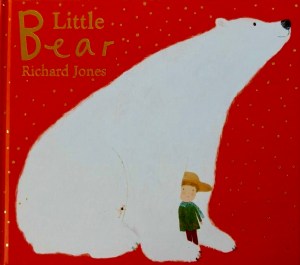
Little Bear

Little Bear
Richard Jones
Simon & Schuster

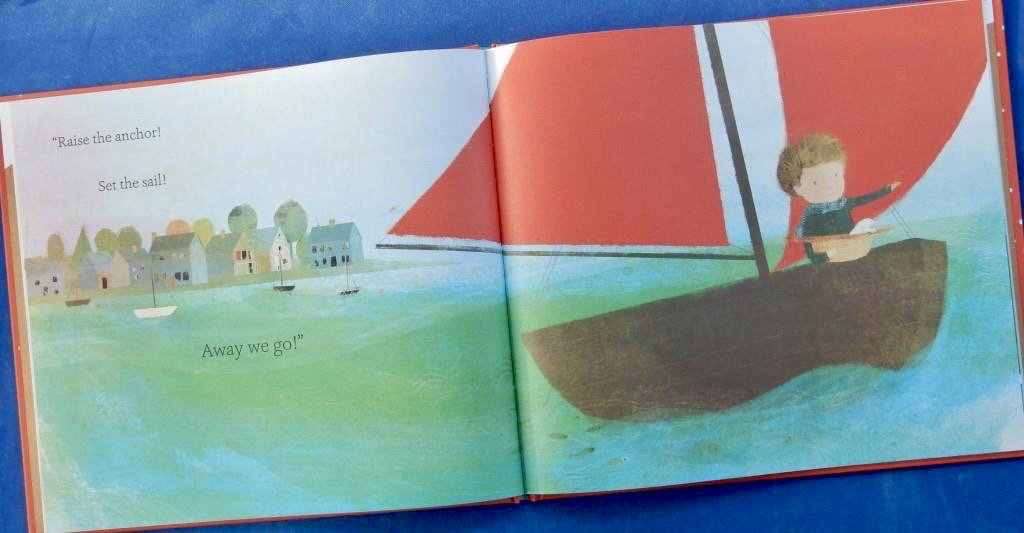
One day, a Monday to be precise, a little boy discovers a polar bear in his garden – a very tiny one. So small is the bear that he can sit in the boy’s hands. The boy speaks to the bear and realising he must be lost wants to help him. Over the next few days two things grow – the polar bear and the friendship between bear and boy and by Wednesday, it’s time for the two to set sail.

They embark on a journey that takes until Sunday when the bear is reunited with his family. After a day playing with the polar bears, the boy knows he must say goodbye to his special friend and sail back home. This he does, safe in the knowledge that the bear’s love will stay with him.

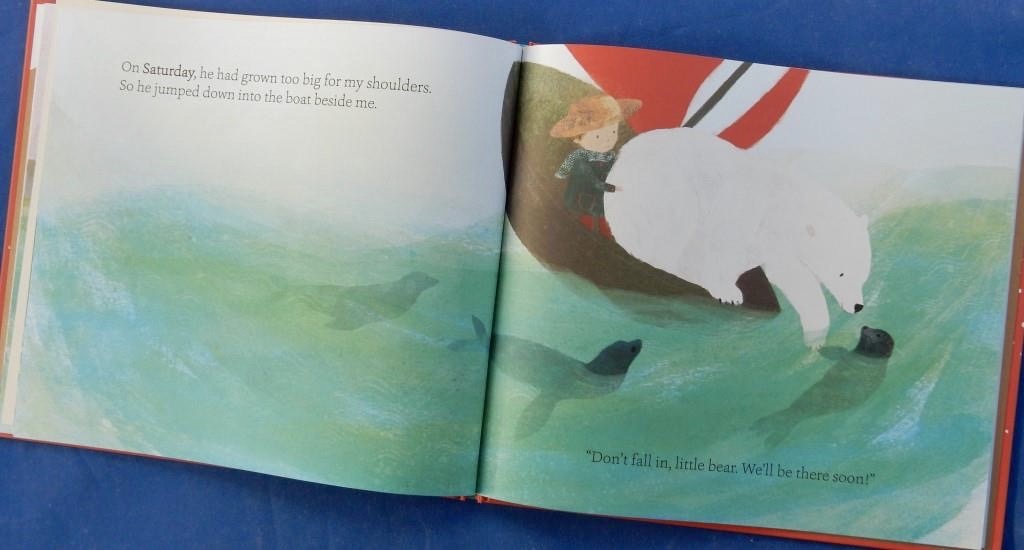
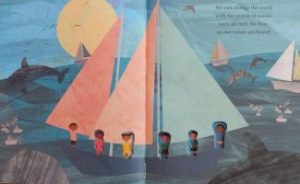
With the caring boy narrating the story, and Richard’s wonderfully gentle portrayal of the events and the growing loving bond between bear and boy, we truly feel as though we’re with them throughout. It’s this care and concern that lies at the heart of the story: “Are you lost, little bear. Can I help you?” comes the boy’s first question; then on Thursday we read ‘he had grown too big for my hat … So he curled up tightly, safe and warm in my bag.’ while on Saturday we see this:

Comforting and reassuring, this is heart-winner of a book that lingers in the mind and is open to several interpretations depending on what readers/listeners bring to the story.

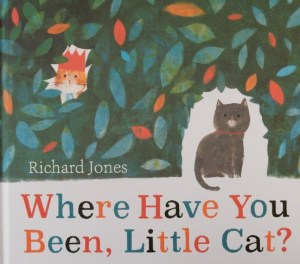
Where Have You Been, Little Cat?

Where Have You Been, Little Cat?
Richard Jones
Simon & Schuster

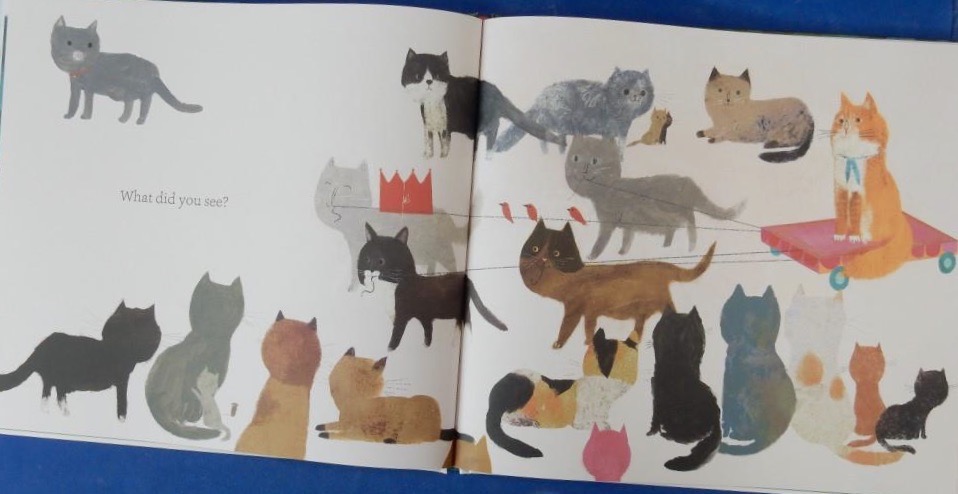
On returning after a day outside, a little cat’s owner is eager to learn what the moggy has been doing. ‘Where did you go?’ she asks, going on to pose a series of further questions. These comprise almost all of the simple straightforward text. What we’re shown in Richard Jones’ storytelling sequence of illustrations offers one possible way of filling in the gaps left by his words. It involves a coming together of cats,

a crown, a special event suddenly interrupted by the arrival of a canine intruder, a confrontation,

a resolution and finally, a return home with a very warm welcome.

Young readers and listeners pouring over the playful pictures still have room to imagine their own interpretation of the events or indeed, invent their own stories. They will surely notice the bit part players – three small red birds and a tiny mouse.

Rich in possibilities, this is a story that children will enjoy returning to over and over again.

Smile Out Loud / Marshmallow Clouds

Smile Out Loud
Joseph Coelho and Daniel Gray-Barnett
Wide Eyed Editions

I’m sure that like me, many others have in the past couple of years of mandatory mask wearing in so many places, wondered how to show somebody that we are giving them a smile. Perhaps if I’d had a copy of Smile Out Loud then I could have performed one of Joseph’s 25 ‘happy poems’ poems in a shop or elsewhere. I wonder what the reaction would have been to The Dinosaur way of walking funny, which is to Pull your trousers up / as far as they will go, / stick your bottom out / and walk like a chicken / … But instead of clucking – / … let yourself roar! / Like a dinosaur, / … a roar dinosaur! Then there’s The Ballerina way that involves a turn, a spin, a leap followed by Plié! Plié! Petit / Jeté / flutter and glide / the day away.

I’m always plugging the power of the imagination so I really like Imagination Running Free where the instructions are to tell the audience for a read aloud of this poem to close their eyes and imagine the scenarios presented by Imagine your legs / are two conker trees! Imagination running free. // Imagine your knees / are stripy like bees! / Imagination running free. // Imagine you’re running with / toes wet / legs wooden / knees stripy! I love too how Daniel Gray-Barnett has clearly let his imagination run free for this accompanying illustration. 

There are poems to read and act out in a group, one or two to inspire readers to create poems of their own, a funny one that uses spoonerisms and lots more besides. Certainly you should find something to help cheer up not only yourself but those who hear the tongue-twisters, riddles and giggle inducers. So, get a copy for home or school and spread a little sunshine thanks to Joseph’s words and Daniel’s lively, inclusive illustrations.

Marshmallow Clouds
Ted Kooser and Connie Wanek, illustrated by Richard Jones
Walker Books

Subtitled ‘Poems Inspired by Nature’, this is a dreamlike, often pensive collection of thirty poems, each a beautiful word picture placed under one of four elemental section headings: Fire, Water, Air, Earth and all intended, as Kooser says in his afterword, to “encourage you to run with your own imagination, to enjoy what you come up with.”

Being a tree person I was immediately drawn to Trees, the final four lines of which are:
They don’t ask for much, a good rain now and then,
and what they like most are the sweet smells
of the others, and the warm touch of the light,
and to join the soft singing that goes on and on
.
Beautiful words and equally beautiful art by Richard Jones, whose illustration here reminded me so much of one of the places where I pause to sit on my walk and look up at the surrounding understory.

Tadpole too is a poem I found great delight in reading, having recently watched a pool full /of swimming tadpoles, / the liveliest of all punctuation.

No matter where you open the book though, you will find something that’s a joy to read aloud again, and again; something thoughtful and thought-provoking, something likely to make you look at things around you differently. What more can one ask?

The Seed of Doubt

The Seed of Doubt
Irena Brignull and Richard Jones
Walker Books

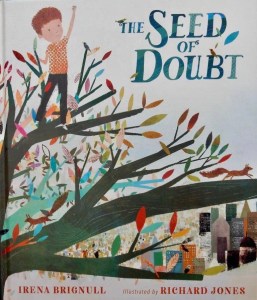
The boy in this story has big dreams far beyond his immediate horizons. “You know you can do anything, … as long as you believe it,” his father would say in encouragement.

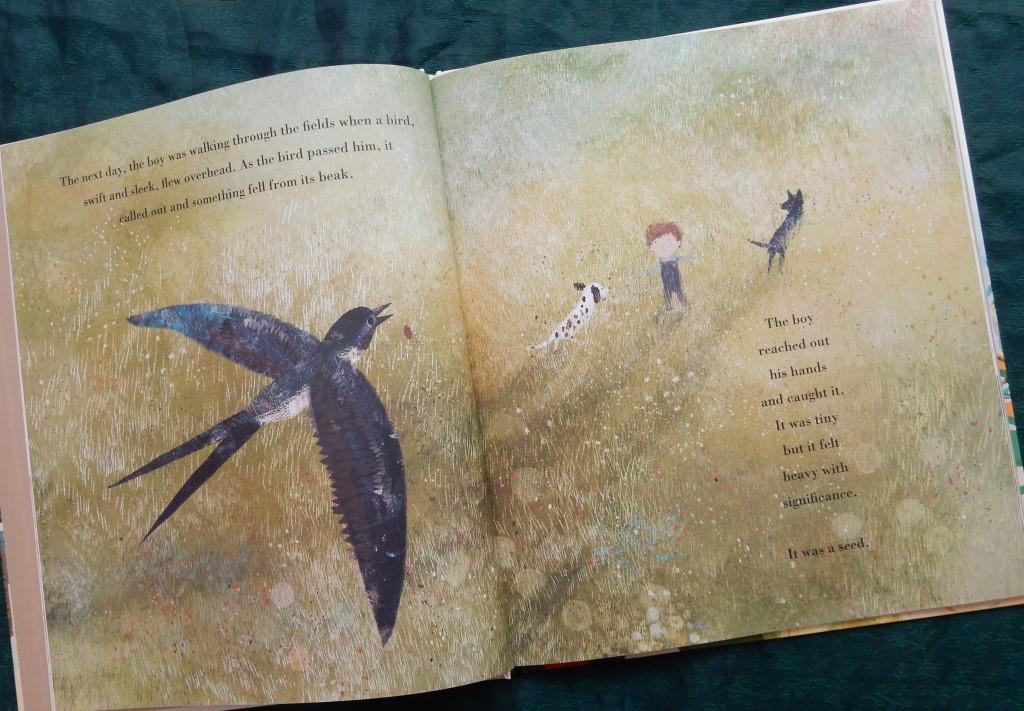
One day while the boy is walking in the fields a bird calls to him and in so doing drops something from its beak.

Catching it, the boy feels the seed is significant. He plants it and after a few weeks it sprouts, becoming a sapling and eventually a tree.

The tree grows, the boy grows too, but his dreams get smaller and self doubt begins to take root. Now the tree seems to signify fear rather than its original joy and the boy no longer feels capable of climbing it.

His evening chats with his father are no longer of dreams but every day farm-related matters. However the change doesn’t go unnoticed by his father who reminds his son of those words from long back, “You can do anything … “
That triggers a change and slowly, slowly the lad begins his ascent of the tree, until eventually, with lots of encouraging words …

he reaches the very top.

Once more his dreams are visible: “I can see everything,” he tells his proud parent.

Movingly told is this beautiful story of a boy’s journey back to self-belief, equally movingly illustrated by Richard Jones. His variety of page layouts and perspectives make the narrative even more powerful, and I love the patterning.

It’s all too easy to let those small seeds of self-doubt take root and this book is a lovely starting point for talking about faith in oneself, determination and positiveness either at home or in the classroom.

The Child of Dreams

The Child of Dreams
Irena Brignull and Richard Jones
Walker Studio

A little girl lives happily with her mother until she realises that unlike the other creatures she observes, she doesn’t have a father.

The answer her mother supplies doesn’t satisfy her and so the girl resolves to find out for herself about her origins.

Her quest takes her into the woods where she encounters first a stork and then squirrels, a salmon

and a fox.

Each one provides a part of her story, which eventually leads her to the source – the place where fox had found her.

There she comes upon a boy sitting alone staring at the road behind which is a tall building. He tells her that he’s waiting for someone to come for him.

As they talk together, the girl realises that what is truly important to her is what she already has.

Unlike the boy who is still waiting to discover where he’s going, that is something which, thanks to her mother’s love; a love ‘stronger than the rocks on the mountain peak, softer than the petals of the meadow flowers, fuller than the harvest moon’, she already knows.

There’s a fairy tale feel to this magical story that is essentially one celebrating the love between a parent and child – that sense of belonging that everyone yearns for.

Richard Jones’s awesome mixed media illustrations add to the power of this story of growing up and finding how you fit into the world.

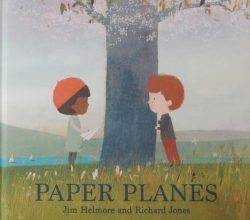
Paper Planes

Paper Planes
Jim Helmore and Richard Jones
Simon & Schuster

Following his The Snow Lion, Jim Helmore has written another  beautifully observed, enormously moving story.
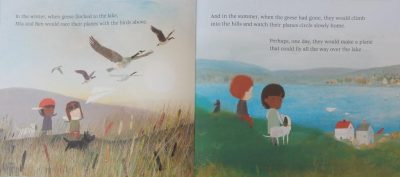
Mia and Ben are best friends; they do everything together, their favourite activity being making paper planes. In winter, they race them against the geese and hope one day to make a plane that will fly right across the lake.

Then comes some devastating news: Ben and his family are moving to a new home in the city. How will they sustain their friendship when they’re so far apart?

The two exchange planes and vow never to forget one another.

Winter comes; the days are hard for both of them and in her frustration and anger, Mia smashes the plane Ben’s given her.

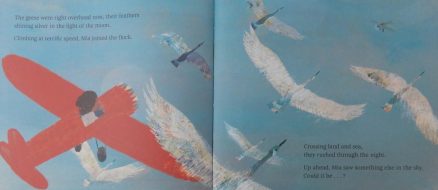
That night something stirs Mia during her slumbers. The plane in the garden, appears whole once more; and then she’s flying with the geese, high in the sky. Suddenly she spies another plane: could it possibly be?

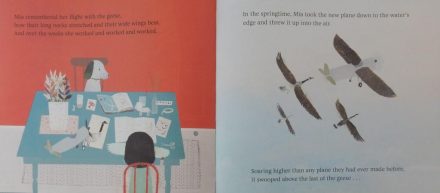
The next morning she receives a parcel from Ben. Inside is a model plane but it isn’t complete: Ben knows of only one person who can add the wings …

The friendship isn’t broken after all; the connection is still there, and the hope.

Richard Jones’ captures the changing emotions to perfection in his richly textured illustrations. They contain plenty of details, and like the words, a powerful poignancy that is impossible to forget. I love the subtlety of the STEM element especially the way Mia uses both her knowledge from her observations and her creativity to complete her task.

Readers and listeners too will need to use their observational skills to read Richard’s pictures carefully to get the most from this quietly powerful picture book.

Happy / As We Grow / We Are Together

Here’s a trio of books from Caterpillar Books one of the Little Tiger Group imprints that I was excited by on my return  home after three weeks away in India.

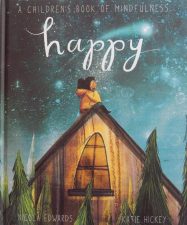
Happy
Nicola Edwards and Katie Hickey
Caterpillar Books

Mindfulness is a popular theme at present and we’ve had several books on the subject for children in recent months, possibly as a response to the growing concern about the pressures even very young children are under in their everyday lives both in school and at home.

I know from experience that offering youngsters a brief period of quiet, calm time each day when they can be in the here and now away from the stresses and strains of life leads to a happier, more relaxed classroom or home atmosphere.

This beautiful book encourages children to become mindful, offering them some ways to be in the moment, to explore their emotions by tuning in to their senses in a meditative manner. They can listen to the natural sounds around them; or tune in to and focus on their feelings. Tension can be released not only from our minds but also our bodies in a manner similar to that at the end of a yoga session when participants are encouraged to tense and relax the muscles in their bodies one by one until the whole body is completely relaxed.

How many of us really pay attention to what we eat, to savour every mouthful noticing the texture and flavour as we chew: it’s a really great way of being mindful and perhaps more appreciative of our food.

Touch too is a way of connecting and calming, particularly when outdoors in natural surroundings; looking with awareness too works to calm and connect as do smelling and deep slow breathing.

The gorgeous illustrations and gentle, rhyming text herein will surely encourage children to slow down and become mindful, to discover that place of peace that’s deep within us all.

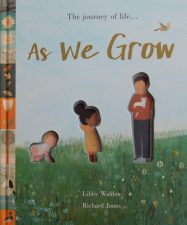
As We Grow
Libby Walden and Richard Jones
Caterpillar Books

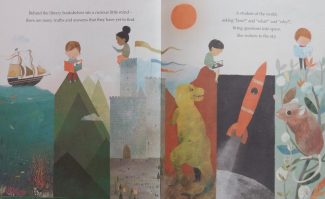
This Walden/Jones collaboration is a great way to look at life as a journey full of changes, challenges and joy, that begins as a very tiny babe totally unaware of what is to come as we grow and travel through the years. What we can be sure of though, is that each stage will be different, full of excitement and new adventures. There’s that toddling stage that opens up a myriad of new experiences and quickly gives way to the more assured young child full of imaginative ideas, when language develops rapidly and words are a toy and a tool. Fuelled (one hopes) by mind-opening books a plenty that help with those ‘hows’, whys’ and whats’.

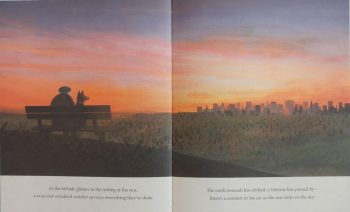
The transformation into a teen is a dramatic one when times are unsettled, restless and confusing, a time of self-discovery prior to adulthood; in the early stages of which independence and challenge go hand in hand before perhaps settling down and maybe even becoming the parent of a new little one.

Like life, this entire book is full of beautiful, memorable stopping points

richly portrayed in Richard Jones gorgeous scenes and Libby Walden’s lyrical text.

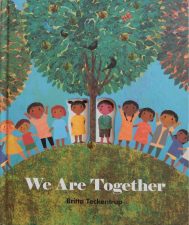
We Are Together
Britta Teckentrup
Caterpillar Books

Britta Teckentrup celebrates human diversity through a rhyming text and her inimitable vibrant style illustrations with their peep through cut out pages.

What better way to encourage young children to value togetherness than these opening lines: ‘On our own we’re special, / and we can chase our dream, / But when we join up, hand in hand, / together, we’re a team.’

Readers are then presented with a sequence of gorgeous scenes of children out together in the natural world that will surely encourage positive feelings in youngsters both about themselves and others.

Perfect for sharing in foundation stage settings and a great starting point for a circle time discussion.

Secrets of the Mountain / Rock Explorer: Minerals & Rock Explorer: Fossils

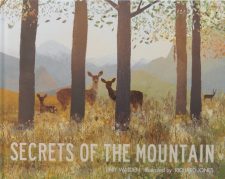
Secrets of the Mountain
Libby Walden and Richard Jones
Caterpillar Books

The mountain referred to in the title of this breathtakingly beautiful book is I think, part of the Rocky Mountain Range.

Libby Walden’s narrative takes readers to spend a day on the mountain observing the plethora of animals that make it their home be that on the plains, the slopes or the mountaintop.

It begins as the sun rises and starting at the summit, day dawns. A breeze moves down the mountainside waking the furry pikas to look for their morning food.

At midday, the forest erupts with birdsong and sunlight glows among the trees.

Animals large and small are on the move.
Then come sundown, the air is cool: night is drawing in and the bears can sense it …

Then is the time to seek a place to sleep and let the nocturnal hunters take over in the shadows of the night-time forest while, watched by the patrolling wolf, the moon illuminates the rolling plains and the mountain lion stands waiting for yet another dawn to awaken the chorus of birdsong.

Everything has changed, yet everything is the same: evolving and ever constant, both.

From gorgeous front endpaper to back endpaper (the final one comprises 48 small named pictures of the mountain fauna), every one of Richard Jones’ spreads is simply stunning in its beauty.

Rock Explorer: Minerals
Rock Explorer: Fossils

Claudia Martin
QED

These are two titles of the four in a series of very visual books that introduce aspects of geology to younger readers. This is an under represented topic and yet once children are introduced to it, they are often fascinated.
Minerals looks at their formation, location and use. Did you know for instance, that fluorite is used in toothpaste and feldspar is used in making glass and pottery?

Fossils explains what a fossil is, outlines how they form, where to hunt for fossils and what we can learn from them. I was intrigued to discover that the Victorians first discovered fossilised Dinosaur poo – hmm.
Clearly and invitingly presented with good quality photographs, both are worthwhile additions to a primary classroom or school library.

Bird Builds a Nest

Bird Builds a Nest
Martin Jenkins and Richard Jones
Walker Books

Back in the day when I was studying physics at O-level I recall learning things about forces with no real understanding of the concepts as they were never demonstrated practically and I’m sure terms as straightforward as ‘push’ and ‘pull’ were ever used; how I passed the exam is anybody’s guess. It was only when I began teaching young children and everything was done through playful activities that I realised ‘oh so that’s what that statement I recall really means’.

Now here’s a cracking little book that introduces forces through a story about a bird building her nest.

Oh joy, it’s a sunny day and the little creature needs to find a juicy worm to feast on and here she is about to apply a pulling force …

No luck with that particular worm but eventually she finds a suitable smaller, less strong one and out it comes. Yum! Yum!
Breakfast over, she heads off in search of twigs to build her nest. Some inevitably are too heavy but Bird perseveres, pulling and lifting, to-ing and fro-ing, pulling and pushing the twigs into place, over and over until the outer construction is ready.
Then she collects softer, light things to make a cosy lining cup…

And finally the eggs are laid …

Already a big fan of this Science Storybook series of narrative science books for young children, I’m now an even bigger one. It’s so simple and yet so effectively explained both through the main narrative and in the smaller printed factual statements.
There’s an additional investigation on the forces topic using ping pong balls to try at the end.

Once again, Richard Jones has created a series of beautiful mixed media, textured illustrations in earthy tones to complement Jenkins’ text to perfection.


The Squirrels’ Busy Year

The Squirrels’ Busy Year
Martin Jenkins and Richard Jones
Walker Books

From the creators of Fox in the Night is a new addition to the Science Storybook series, this time about the seasons and changes in the weather.

We start in winter and just like today when I’m writing this, it’s very cold, the pond is frozen and snow covers the ground. The animals are tucked away in warm places until they have to go out and search for food.

Spring brings warmer weather with bird song, croaking frogs, scampering squirrels hoping to find juicy maple buds on the trees or bulbs they can unearth; but they’ll have to be quick for there’s an owl on the prowl.
With the summer come hotter days, the need for shade, and longer hours of daylight with a chance of thundery weather.

Come autumn and the frogs have gone to the bottom of the pond to sleep in the mud;

many birds have flown to warmer climes and the squirrels start collecting for their winter store in preparation for hibernating.
All this is presented through an engaging, at times poetic, text, together with some basic scientific facts, and in Richard Jones’ textured illustrations.
His beautifully crafted scenes work in perfect harmony with Jenkins’ descriptions, his colour palette mirroring the seasonal hues superbly.
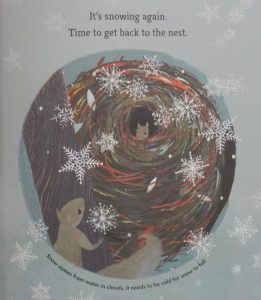
Look how perfectly this embodies the hushed arrival of winter’s snow …

A fine example of non-fiction for the very young.

The Snow Lion / Toby and Tabitha

The Snow Lion
Jim Helmore and Richard Jones
Simon & Schuster
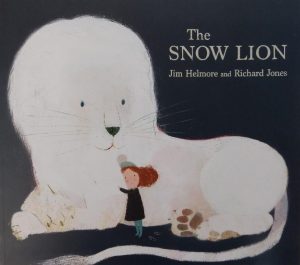
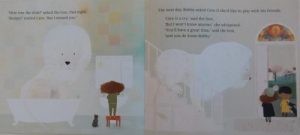
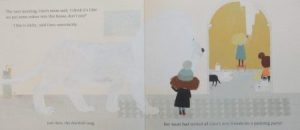
Caro and her mum move to a new house in a new neighbourhood. Then, into the whiteness of everything comes a snowy lion inviting Caro to play hide-and-seek. Their play fills her day bringing cheer instead of loneliness; but can this new animal friend encourage her to venture outside and have fun with the local children?
That proves something of a challenge but little by little, with the lion’s help, Caro starts to find her inner courage and joins in with the other children.

When mum suggests adding colour to their new abode, and invites her new friends round for a ‘painting party’, Caro is concerned that the lack of white will mean no more visits from her wildcat pal.

He no longer appears anywhere inside her brightly painted house, but surely he can’t have deserted her altogether, can he?
A lovely, gentle, reassuring tale about moving and finding new friends.
Richard Jones’s mixed media, warm-hearted scenes of friends real and imaginary are enchanting.

Toby and Tabitha
Alexander Bar and Emma Proctor
Walker Books
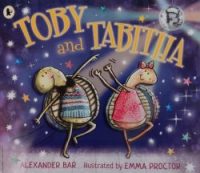
Have you ever heard of dancing tortoises? No? Me neither. I suspect nobody has other than young Lucy, whose grandfather owns, the pet shop, Animal Palace. This establishment is full of all manner of desirable pets and one of Lucy’s favourite places. She loves to help with the animals whenever she can, her favourites being two tortoises, Tabitha and Toby.
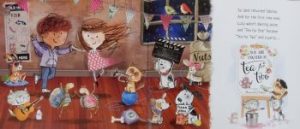
Lucy has a secret though: when the shop is closed and darkness falls, the two creatures respond to her singing by leaving their beds and dancing together in the moonlight, with Lucy joining them in a ‘Tea for One’ rendition of her own.
Then one day, disaster strikes: Lucy arrives at the shop to find Toby alone: Tabitha has a new home with a little boy, so her Grandpa tells her.

When the boy returns with a question, “what do tortoises like to do?” Lucy has a dilemma. Should she share her secret with Tabitha’s new owner, or keep it to herself?
Who would have thought that a couple of dancing tortoises could be the catalyst for a burgeoning friendship between two children?

This debut picture book written by Mike the Knight creator, Alexander Bar and illustrated by Emma Proctor is a delight.
Bar uses a child-friendly, chatty narrative style with playful language and opportunities to join in and Emma Proctor brings out the humour of the story. Her exuberant, mixed media visuals are such that you want to stop and explore the plethora of whimsical details in every spread.

Town Mouse, Country Mouse

Town Mouse, Country Mouse
Richard Jones and Libby Walden
Caterpillar Books
There are numerous versions of the Aesop classic tale to be had; I have a fair few myself, but this has now become my favourite. Libby Walden renders the story in a measured, beautifully readaloudable rhyming text telling of the house swap between the mouse cousins: the ideal solution to Town Mouse’s hectic bustling life fatigue and Country Mouse’s yen to become ‘a mouse about the town!
Invitations are sent, received – love the postie frog –

and responded to, bags packed (don’t you love Town Mouse’s roller-wheels and little black bag); with high expectations the two sally forth …

and the swap begins.
Less than twenty-four hours later though, all is not well: Town Mouse is disturbed by the dawn chorus, and the never-ending ‘beeps and creaks and clinks’ result in a sleepless night for Country Mouse. Food is problematic too: Town Mouse almost breakfasts on poisonous berries;

and the tasty chunk of cheese Country Mouse has set his sights on for his morning meal, is in a trap.

Their walks are equally stressful: Town Mouse is totally unenthusiastic about country rambles in the rain: Country Mouse finds the whizzing wheels and lurking cats downright alarming. It’s time to return: farewells are said and with heads whirling with unforgettable memories, the cousins head for home. Assuredly it’s a case of ‘thank you’ but ‘no thank-you’ to one another’s ways of life.
This particularly resonated with me and my present struggles with having moved out of London to the country a few years ago, and now feeling the call of London life pulling strongly at my heartstrings. Richard Jones’ truly beautiful artwork makes both town and country look wonderful places to live. I love the cleverly conceived, strategically placed die cuts and the cutaway page, making the reading experience all the more pleasurable. A totally gorgeous fable reimagining to share and discuss, over and over.

Feelings

Red Reading Hub is Happy that Caterpillar Books invited me to be part of the FEELINGS blog tour and thanks too, to the book’s creators, Richard and Libby for …

%0A

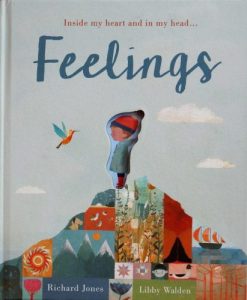
Feelings
Richard Jones and Libby Walden
Caterpillar Books
Emotional literacy and well-being are at the heart of the Early Years Foundation Stage and Every Child Matters, and yet still, as we’re told in the PR for this book, ‘One in ten children aged between 5 and 16 (have) a mental health problem.’
So what happens once children move into primary school at age five? Here is not the place to discuss this issue although I have strong views on what I see to be some of the contributory factors: rather, I welcome anything that can help children to explore their own feelings and emotions openly and within a safe context. Many picture book stories offer this possibility; now here we have a lovely, specially written and illustrated book to this end.
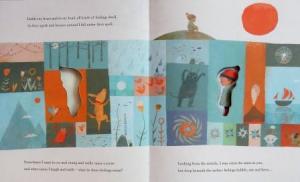
Richard Jones, the illustrator, places the child right where he or she should be: at the heart of this book …

DSCN8777

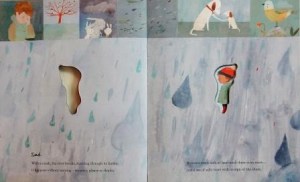
and then, after the introduction, assigns a double spread to the exploration of ten different feelings/emotions: Brave, Sad, Angry, Happy, Jealous, Alone, Embarrassed, Excited, Afraid and Calm. Each one is beautifully atmospheric.
Vitally important as personal feelings are, it is also essential, in order to function well in society, to be able to see things from other people’s viewpoints. So after acknowledging that we’re all different and that this is mirrored in our own personal feelings, Libby Walden (or rather her child narrator) makes this final suggestion: ‘Try to walk in someone’s shoes to see how they might feel, /For though you cannot see them, their feelings are still strong and real.’ How many times a day or week do those of us who teach in the foundation stage or spend time in Early Years settings say to individuals after an incident, something like “Now how do you think so and so feels about that?”
The rhyming text makes use of metaphor to look at what happens when one is overwhelmed by a particular emotion: Sad is a ‘river … bursting through its banks’ covering the land and creating a ‘sea of salty tears with no sign of the shore.”

%0A

Angry is ‘a fire-pit in the ground ‘blazing, spitting, bubbling and swirling and finally, erupting …

%0A

Jealousy, in contrast, is a rolling ‘emerald mist’, churning, seething and eating away at you from inside, blurring your vision and fixing your mind on something you don’t have.
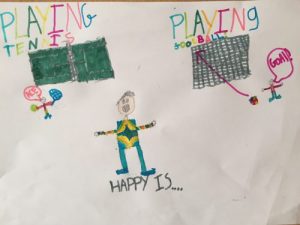
For many children, particularly younger ones, pictorial representation is the easiest (and for them, safest) way to explore their feelings. With this in mind, I shared the book and asked some children to talk, reflect and respond in their own way: here are a few of their pictures.
Angry seemed to be the one feeling that was all-engulfing: Gracie has become an enormous bear with jagged teeth and claws …

IMG_2261

Interestingly Richard himself mentions jagged shapes and fiery colours in his discussion of illustrating Angry for the book. Saba too has jagged lightning in her Angry scene …

saba- angry

Happy for Daniel is doing sport …

image1

for Shahan lots of sweets to eat, especially his favourite gulab jamun …

shahan-Happy

For Lexi, it’s celebrating a birthday …

DSCN8775

Sad, for Shifan is broken toys …

shifan - sad

for Frankie it’s bullying …

DSCN8774

Excited for James is activities that allow him to release his boundless energy …

2016-08-29-PHOTO-00000030

If these responses are anything to go by, Feelings should certainly prove to be a very valuable resource for teachers and other working with children.