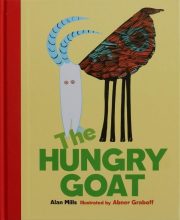
The Hungry Goat
Alan Mills and Abner Graboff
Bodleian Children’s Books
So insatiable is Hungry Goat’s appetite that he consumes pretty much everything he sets eyes on – grass, twigs, leaves, pigs’ swill, bugs of all kinds, bees included –AAGGHH!, the bark from trees, paper bags, string, filthy rags, chicken feathers; even these seemingly indigestible items – OUCH!

as well as old car tyres and broken glass. Goodness knows the condition of his innards, which, so we’re told, have contained barbed wire and more.

Surprisingly instead of dropping down dead, the animal grows and grows and … which pleases his master on account of the prizes they bag.
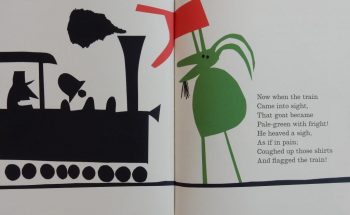
One day he angers this master by consuming from the washing line, three of his red shirts. These however come in useful when tied to a railway line in punishment, the goat regurgitates said shirts and succeeds in stopping the approaching train.
That action though, lands him in gaol, temporarily nonetheless – more chewing gets him out. But once free, the creature – will he never learn – consumes something that not only inflates him but also sends him off on his greatest ever adventure.
With Alan Mills’ superbly paced rhyming text and Abner Graboff’s distinctive, wonderfully quirky illustrations, this re-issue of a 1964 classic comic cautionary will delight a new generation of children as well as reminding adults of its seemingly simple brilliance.



 Red Reading Hub - Jillrbennett's Reviews of Children's Books