Unity Street School Saves the Planet

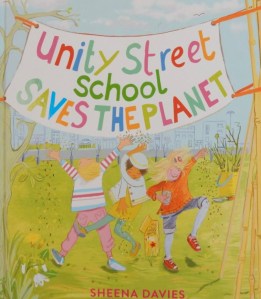
The Green Team – Fern, Verdun, Jade and Silas, not forgetting Selva their toucan puppet assistant visit Unity Street School. They talk about climate change, explaining how our planet is getting too hot and how bad that is for wild life and for humans. The children come up with a great idea: they will create their own wild, green space to look after at school. It’s to be situated in the old playground behind care-taker, Mr Moss’s tidy grass.

A fortnight later the Green Team return with litter-picking equipment, Mr Moss clears the playground, the children collect all manner of rubbish, most of which can be recycled and then comes the planting. Beans and hedge saplings are supplied by the Green Team, the children plant the beans in jars and Mr Moss plants a cherry tree. They also make a pebble pond.

Then it’s the holiday, after which the work, (including a fund-raising yard sale), continues through to spring when wildflower seeds are scattered and the beans and hedge saplings planted in the earth.
Weeks pass and eventually —- hurrah! Later that summer Unity School community’s hard work has paid off: something really exciting has happened.

An inspiring story of conservation and rewilding. that one hopes, will inspire others to think of ways to help our precious planet, having been shown the way by Unity Street School.

UltraWild

This image has an empty alt attribute; its file name is dscn9806-1.jpg


Subtitled An Audacious Plan to Rewild Every City on Earth, this large format book is truly mind-blowing. One can only feel wonder at the brain of its creator, Steve Mushin.


Perusing the endpapers of this book brought to mind the work of Leonardo da Vinci and W. Heath Robinson. Both let their imaginations run wild, the former designing machines like the helicopter, submarine and bicycle centuries before their time; and the latter, any number of odd and outlandish contraptions to perform simple tasks. Steve Mushin, an industrial designer, inventor , illustrator and teacher from Down Under invites his readers to think outside the box and employ their talents to the task of rewilding our cities.

This comic-style book is crammed with his own ideas. There’s a prologue, ‘Ludicrous ideas are bootcamp for brains’, fourteen chapters presenting more than one hundred inventions/projects ranging from mechanical megafauna,

This image has an empty alt attribute; its file name is dscn9807-1.jpg

3D printer replacement birds, converting every lamp post into armoured luxury hotels for native animals,

This image has an empty alt attribute; its file name is dscn9808-1.jpg

the sewer sub, to extreme flying mountain bikes and compost cannons.


Truly thought provoking; there is huge potential for STEAM learning at every level and countless hours of entertainment. Packed with accurate scientific and technical information, most importantly it is concerned with saving our planet. Why not take up the challenge presented in the epilogue, “Over to you for the greatest design project in history.’


Back matter includes acknowledgements, a select bibliography, glossary, index and an afterword from the author. Brilliant!


The Fairy Garden

The Fairy Garden
Georgia Buckthorn and Isabella Mazzanti
Ivy Kids

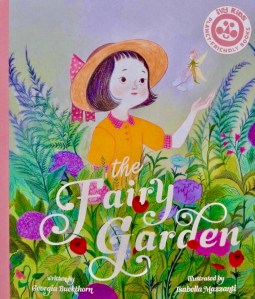
Mimi loves her garden. Every morning she tends it with great care, removing all the weeds and spraying the plants to keep bugs away, making it as near perfect as possible in the hope that a fairy will pay a visit.
Despite all her efforts, there is no sign of any fairies, so around her perfect garden she places little fairy houses: perhaps these homes might attract the visitors she so longs for. However, again Mimi is disappointed, even when she adds a welcome sign.

Is she doing something wrong?

Astute listeners to this cautionary tale will likely, by now have realised that she is. For that night as a tearful Mimi looks out at her garden she sees that she has visitors. Some fairies have finally come, but what they have to tell her surprises the little girl.

Her well intentioned perfection has led to the destruction not only of the garden’s wildlife, but the kind of environment that fairies would inhabit: a fairy-friendly garden is wild.

This environmental fable is gorgeously illustrated by Isabella Mazzanti whose fairytale landscapes and the richly detailed, verdant flora and latterly the insect life, are a delight.

Look closely too at the expressions on the faces of the three fairies as they gently chastise Mimi. How well the artist captures the ethereal nature of those visitors and the total absorption of the little girl at work in her garden. (The final two spreads detail how to grow a fairy-friendly garden and how to make a fairy house.)

An engaging way of alerting youngsters to the importance of rewilding, done with a gentle touch by author Georgia Buckthorn and artist Isabella Mazzanti, and it’s printed on 100%recycled paper.

The Wall and the Wild

The Wall and the Wild
Christina Dendy and Katie Rewse
Lantana Publishing

At the edge of Stone Hollow town, young Ana grows a garden – a perfect garden, tidy and full of life; it’s in stark contrast to the wild, the place where she tosses her unwanted, left over seeds and against which she creates a boundary to delineate and shelter her orderly garden from the disorder beyond.

Soon Ana’s garden is full of scented flowers, delicious fruit and vegetables, leafy trees and birds and insects in abundance. It’s a place where people like to stop and admire what they see, but while they might be full of admiration, Ana is not.

Certainly not when she notices unfamiliar plants that have started to grow; these she pulls up, tossing them and other seeds that she now rejects into the wild. She also builds her boundary a bit higher and now her garden isn’t quite so thriving: less tasty crops grow and the numbers of visitors both natural and human, diminish. Despite this Ana continues to reject many seeds and shoots, hurling them into the ever-increasing wild against which she keeps on building up her boundary until eventually it’s an enormous wall.

Now at last Ana stops and takes stock of her creation – first on her side of the wall and then finally, she decides to look beyond …

What she discovers is truly astonishing and unexpectedly beautiful in its own way. Time to start removing some of that wall …

Both a fable, and a cautionary tale of sorts, Christina Dendy’s story, in tandem with Katie Rewse’s vibrant illustrations, shows the importance of biodiversity and of embracing and appreciating wildness. It’s great to see the subtle inclusion of Ana’s hearing aid in this beautiful book, which offers a great way to introduce the idea of rewilding and its potential benefits especially to those readers with gardens of their own.

When We Went Wild

When We Went Wild
Isabella Tree and Allira Tee
Ivy Kids

This is prize-winning author, conservationist and rewilder, Isabella Tree’s first book for children. Herein she describes what happens when farmers Nancy and Jake decide to convert their failing farm (the animals and even the trees look sad), and whereon they use chemicals for crop growing and machines for milking and harvesting, for something totally different – a haven for wildlife.

Nancy’s idea so to do means they can sell off all the machinery and pay off their debts. Then it’s a waiting game: soon the bare earth is covered in wild flowers, brambles and bushes,

and their animals now roaming free seem much happier.

Their neighbours though, are far from pleased and write to the local paper complaining about the messy vegetation spoiling their view.

Will Nancy and Jake have to abandon their plans and return to conventional technology-led, intensive farming? Happily not. When a storm and torrential rain hits the village everyone prepares for the worst as flash-flooding strikes across the country but that messy vegetation helps to slow and absorb the rainfall and the village is spared. A lesson learned thanks to a near disaster,

and soon everyone is going wild.

Allira Tee’s digital illustrations for this thought-provoking, important book are beautiful and from the alluring cover, every page full of engaging detail.

On the final spread, the author explains what rewilding actually is and talks a little about its importance and her own experience. (The book itself is sustainably produced).