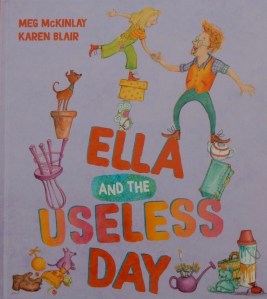
Ella and the Useless Day

Ella and the Useless Day
Meg McKinlay and Karen Blair
Walker Books

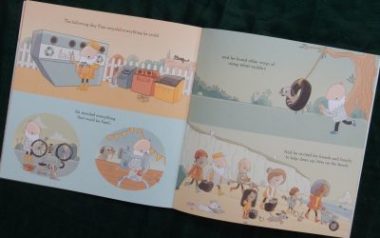
Having had a good look around their house, Dad and Ella decide it’s time for a serious clear out and so they get to work right away. Together, they search, scramble, sort, poke, pick and pile all the useless stuff they find into the trailer to take to the rubbish tip, where useless things go. However, before they’ve even set off, their neighbour delightedly relieves them of the tricycle, calling it “Absolutely perfect!” and so it goes on until by the time they reach the dump, their trailer is almost empty,

even the holey blanket has been given a new lease of life. Then Ella realises that the final item is one they can make use of back in her own bedroom.

Meg McKinlay tells a subtle, gently humorous tale of recycling and reusing, creativity and community, that is highly pertinent in our throwaway society, where we all ought to be giving serious thought to living more sustainably. One wonders what on earth can be done with the “fashion disaster” of a suit,

the leaky goldfish bowl, the broken crockery and other things but young listeners/readers could have fun thinking of possibilities before turning to the final wordless spread where in a series of vignettes, Karen Blair shows just what their new owners did with them. Throughout the story, her watercolour and pencil illustrations provide lots of delightful details and underscore the wry humour of the words.
Make Tracks: Building Site / Go Go Tin

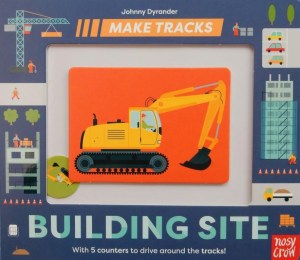
Make Tracks: Building Site
Johnny Dryander
Nosy Crow

In one of a new interactive series, Johnny Dryander illustrates five vehicles often found on a building site – those that small children are fascinated by when they see them for real.

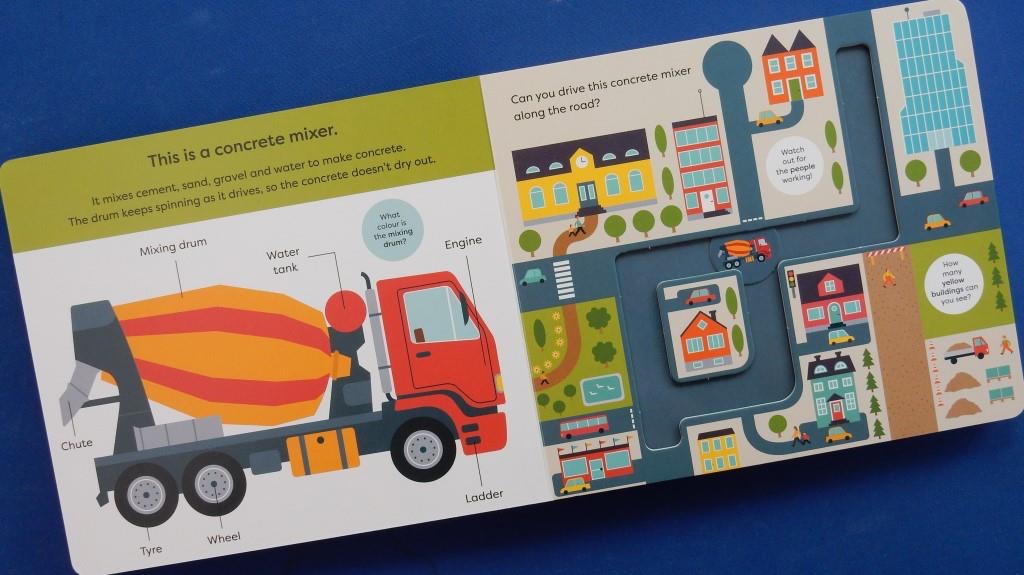
Each one – concrete mixer,

dump truck, excavator, bulldozer and front loader – is presented on the verso in a clearly labelled picture along with a brief introductory paragraph giving some information about its key features and what it is used for. There’s also a question for little ones to consider.

On the opposite page, with additional prompts for opening up discussion, is a scene showing people and machines at work on the site. This contains a track around which little fingers can manipulate a counter depicting the vehicle illustrated on the facing page in response to the ‘Can you drive this … “ challenge. (This feature is also part of the front cover.)

With lots of potential for fun learning be that of related language or fine motor skill development, this will be particularly popular with young enthusiasts of large building site machines.

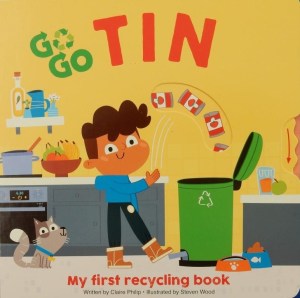
Go Go Tin
Claire Philip and Steven Wood
Sunbird Books

This sturdy board book explains in simple words and bright cheery pictures what happens to a tin can from the time it’s tossed into a kitchen recycling bin until it becomes part of one of the shiny new tins produced at a factory.

With its onomatopoeic sounds aplenty to join in with, little ones will enjoy following the sequence of events from lorry to recycling plant, through a crushing machine, into a furnace to melt and be formed into new blocks, ready for stamping, stretching and further shaping.

Eco Craft Book / The Extraordinary Book That Eats Itself

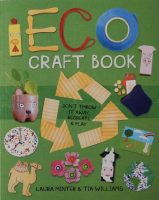
Eco Craft Book
Laura Minter and Tia Williams
GMC Publications

In their latest book, Laura and Tia offer some cool ideas for using bits and pieces that might otherwise end up being thrown away.

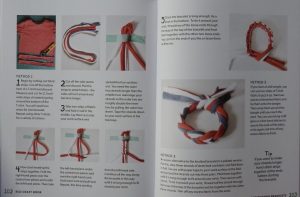
Instead of consigning that old T-shirt or other no longer worn garments to the rubbish or recycling bin, why not suggest your children try a project like the T-shirt friendship bracelets here.

Alternatively, if the T-shirt is white, it can be dyed using a natural plant dye and refashioned into a ‘no-sew tie-dye bag’. Those are just two of the fabric projects.

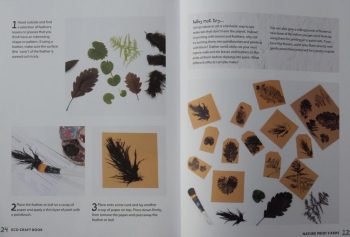
Getting even closer to nature, youngsters can make a collection of interesting shaped leaves, grasses or perhaps feathers and use them to make some printed cards (or perhaps wrapping paper)

and if you want to attract more wildlife into your garden, there are instructions for creating a bug hotel using for example, old tin cans.

Each mini project is succinctly explained with step-by-step guidance and clearly illustrated with colour photos. In addition there are spreads that talk about climate change, what youngsters can do to help protect the environment and why it is important to immerse children in nature.

This book would be a boon to parents who are coping with home schooling, but all of us who work with children have a duty to nurture their creativity and to encourage them to think about the impact on the environment of all they do.

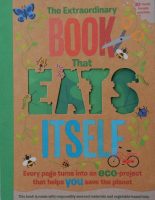
The Extraordinary Book That Eats Itself
Susan Hayes & Penny Arlon, illustrated by Pintachan
Red Shed ((Egmont)

If you’re looking to engage a child or children in some environmental projects here’s a book to try. It’s packed with eco-projects – thirty in all – and each page (as well as the cover) is cleverly designed to be used in an activity – hence the title.

It’s amazing just how much difference simple everyday actions such as turning off the lights when you leave a room, and at night can make, not only for the safety of animals but to reduce electricity consumption. Ditto, saving water by turning off the tap while brushing your teeth or using your bath water to ‘feed’ your plants (of course that takes a bit of effort but every drip and drop counts). There’s a Make a Difference in your home’ page with additional suggestions .

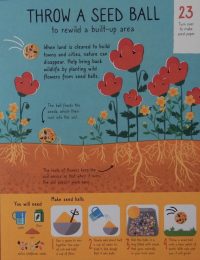
One of my favourite projects is Throw a seed ball to rewild a built-up area, something I’ve never tried, although I have scattered plenty of packets of wild flower seeds. This is really clever though and all that’s needed in addition to wild flower seeds are water, flour and soil to make your mixture. Can’t wait to have a go at this.

(The reverse side suggests making seed paper for writing a message on – another clever idea.)

Whether or not home schooling continues, this is certainly worth getting hold of.

Action and Reaction: Fish / Yawn

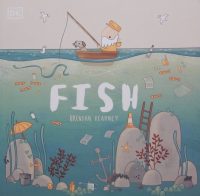
Fish
Brendan Kearney
Dorling Kindersley Penguin Random House

Softly spoken yes, but, inspired by personal experience, Brendan Kearney’s picture book about the perils of polluting the ocean with plastic, and how we can all help to improve the situation for the endangered fish and other marine flora and fauna is clear and to the point.

Finn and his dog Skip set out one morning in their little boat, hoping to catch a tasty fish or two for their supper.

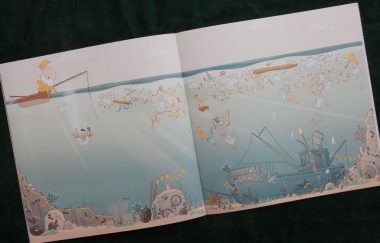
After a while when not a single fish has given so much as a tug at Finn’s line, Skip spies something in the waves. Down to the depths he swims and the sight that meets his eyes is horrifying.

Rubbish, rubbish and more rubbish. Back to show Finn with some evidence he goes.

Equally concerned, the man goes on fishing for a while but before long all he has on board is a collection of weird objects.

Fortunately, once back on dry land the two encounter a group of young beach cleaners who are equally alarmed at the load of rubbish brought out of the sea.

Finn explains how he came by it and about the complete lack of fish. What follows are a number of pertinent comments from the young eco-warriors and the following day Finn heeds their words – re-use and recycle – and goes on to join the beach cleaners.

With his engaging narrative, visual and verbal – Brendan Kearney focuses on the crucial environmental issues in the hope – his, mine and countless others – that young children will become part of the movement to clean up our polluted oceans and beaches and of course, it’s never to soon to teach them about the importance of recycling.

Yawn
Patricia Hegarty and Teresa Bellón
Little Tiger

A yawn can be highly infectious as this fun story shows.
Starting with a single feeling from deep inside the little boy narrator, a single yawn quickly becomes unstoppable, passing from the boy to all – every neighbourhood inhabitant, human and animal, until the entire street have gaping mouths.

From here it moves to the countryside and eventually all over the world, not content until every single person and every single creature has the yawns. It even heads off out into space

– it’s ‘gone viral ‘we read. Does that remind you of anything?

Fortunately though, on this occasion the outcome is that when bedtime comes, so does a great big YAAAAAAWN! to send us off into the land of slumbers.
Happy dreams.

It’s is definitely a book to share at bedtime unless that is you want to induce sleepiness at some other time in your home or classroom. Patricia’s rhyming narrative has that soporific feel to it, and if you happen to pause just a little too long on any of Teresa Bellon’s spreads (love those cutaway pages) to enjoy all the funky details, you might just find yourself the next recipient of that repeat refrain ‘YAAAAAAWN! Pass it on!’ Snore …

Pandora

%0a

Pandora
Victoria Turnbull
Frances Lincoln Children’s Books
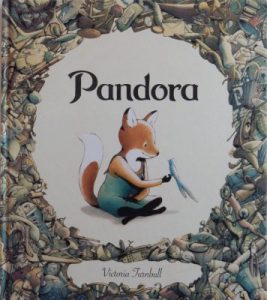
I have to admit to doing a little dance when I saw this. I’ve loved all Victoria Turnbull’s books so far, but this one, with its tactile, satin, gold-sheened cover, is sublime. It takes picture book perfection to another level as it draws readers into Pandora’s lone world of broken things …

%0a

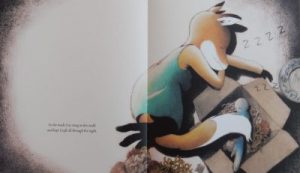
where she spends her time collecting, mending and recycling whatever she can.
Into that world one day crashes a small creature. That too needs fixing, but Pandora’s mending skills are, she feels, inadequate. Clearly not her caring though, for she nurses it with tenderness …

%0a

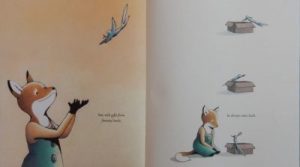
as it gradually gains strength and is able to fly once more. Pandora’s kindness is rewarded with small treasures …

%0a

But then one day she is faced with an empty box.
The emotional turmoil this creates is as devastatingly heart-wrenching for the reader as for Pandora. Alone once more she nurses her broken heart and, as it slowly grows back together,

%0a

other things start to grow in that box until one morning, the sun shines into her room drawing her outdoors to the best of all possible surprises …


%0a

The spare text means that every turn of the page is part of an exquisite contemplative experience that has you in its thrall throughout Pandora’s highs and lows, as you linger to explore every delicate detail of this ultimately, uplifting, fable of transformation; for as Alexander Pope said, ‘Hope springs eternal …’

Ossiri and the Bala Mengro

DSCN8182

Ossiri and the Bala Mengro
Richard O’Neill, Katharine Quarmby and Hannah Tolson
Child’s Play
Travellers have a rich folklore, that I know having taught many traveller children, as a primary teacher in an outer London borough school close to which was a traveller site. They are also fiercely proud and eager to learn and to prove themselves. These characteristics are demonstrated in this story told by a Romani storyteller and a picture book author. Its heroine is traveller girl, Ossiri who lived with her family who earned their living as ‘Tattin Folki’ (rag-and-bone people) and were wonderful recyclers. Ossiri loved to help her father and grandfather loading, looking after the horses and making things to be used in the recycling of items the grown ups collected.
The entire family were music lovers and Ossiri longs to play an instrument herself. Despite her father’s explanation as to why this can’t happen, the young girl holds fast to her dream and decides to make an instrument for herself. Thus the Tattin Django comes into being.

DSCN8184

The sounds Ossiri makes on it however, are anything but music according to her family and even the birds take flight. Undaunted, Ossiri resolves to keep practising and improve her skill before her next performance.
Then comes the time for the whole family to take to the road again, destination Lancashire. “ … leave your Tattin Django here, ” her father advises but grandfather suggests otherwise and so the instrument goes with them. And that’s when Ossiri first hears mention (from a farmer’s daughter) of a huge hairy ogre said to reside in a cave near to where they’ve set up camp: An ogre who loves to sleep and woe betide anyone who should wake him.
Ossiri does wake the dreaded Bala Mengro though, with her playing; but his reaction is not what she expects.

DSCN8185

Rather he demands she play again and what’s more, he sings and dances to the sounds she creates, handsomely rewarding her for so doing.
The tale doesn’t end there though, for the instrument is stolen: is that to be the end of Ossiri’s fame and fortune? Happily, not, for we’re told on the final spread that ‘she played from the heart …’ And so she does, until this day,

DSCN8186

in very shiny leather boots!’

WNDB_Button localbookshops_NameImage-2