Little Chimpanzee / Little Whale / Little Monkey / Tiny Tadpole

Little Chimpanzee
Anna Brett, illustrated by Rebeca Pintos
Little Whale
Anna Brett, illustrated by Carmen Saldaña
Words & Pictures

These are the latest additions to the Really Wild Families series of fun, informative interactive books for children and adults to share.
Having introduced itself, Little Chimpanzee invites readers to spend a day exploring its African rainforest home and meeting the sociable family community comprising father, mother, older brother, aunts, uncles and cousins. The creature narrator explains how chimpanzees care for and groom each other and talks about the social structures and relationships in the group , including how they communicate with one another.There’s a spread about chimp conservation and another about the vital work of Jane Goodall and the chimps in Gombe Stream National Park.
The narrative is followed by a quiz and a craft activity. A charming, effective way for young children to find out about our nearest relative, while gently reminding them of the importance of caring for creatures in the wild; vibrantly illustrated with gentle humour.

The Little Whale of the title introduces itself and the rest of its pod of humpback whales and readers join their annual journey from warm waters to search for the cold waters of the Antarctic Ocean where there’s plenty of food. On the way we learn about how the creatures move, their external features, breathing, breeding, diet and feeding,

possible predators and whale song.
Following the story are the usual factual spread, a look at conservation, a craft activity, a quiz and we meet Migaloo, a albino humpback that lives off the Queensland coast of Australia. Carmen Saldana’s underwater illustrations are beautiful and really add to the book’s appeal.

Narrative works really well as a means of transmitting information to young children and these are additions to the Amazing Animal Tales series that also successfully use this approach along with straightforward facts found beneath the flaps.
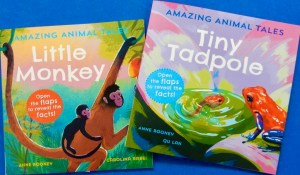
Little Monkey
illustrated by Caroline Rabei
Tiny Tadpole
illustrated by Qu Lan
both written by Anne Rooney
Oxford Children’s Books

Little Monkey is a spider monkey and we first encounter him high in the rainforest treetops clinging round his mother’s tummy as she moves from branch to branch. Lifting the full-page flap reveals two pages of information and a simple question to further engage listeners.
As the story continues there is information about feeding, what this entails.and how it changes as he becomes more independent, an independence that makes him want to go off exploring by himself.

Anne Rooney’s way of presenting the information is appealing and perfectly pitched for an Early Years audience, the special skill being the combination of the two styles, with Caroline Rabei’s delightful illustrations containing just the right amount of detail.

The Tiny Tadpole also lives in the rainforest but further south than the monkey family. Herein we follow the transformation from tadpoles hatching out of the protective jelly eggs and the growth and changes that ensue in their habits and in the care provided by the mother frog,

until the tiny black dot has become a froglet. This one is illustrated using a rich colour palette by Qu Lan and every picture is bursting with life.
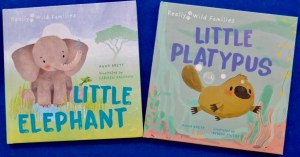
Little Elephant / Little Platypus

Little Elephant
Anna Brett and Carmen Saldaña
Little Platypus
Anna Brett and Rebeca Pintos
QED

In the first of these additions to the Really Wild Families series, Anna Brett takes readers to the African Savannah, home to Little Elephant (our narrator) and family to spend a day with the elephant herd comprising fifteen elephants, almost all of which are female, the oldest and most knowledgeable being Grandma. The youngest member of the herd is a two day old cousin of the narrator.

We see how the elephants search for and eat their food, meet some of the other animal inhabitants of the savannah and then head for the watering hole to drink and have some fun too, all under the watchful eye of Grandma.

It’s she that sounds the trumpet alarm call warning of a lion in the vicinity: time for the adult elephants to form a protective circle around the calves until the danger is over. There’s information about the role of tusks, ways of communicating and more, until at sundown, members of the herd stop to rest for the night.

Following the simple narrative are some additional elephant facts, information about elephant conservation, a case study and some activities. Carmen Saldaña illustrates this one, supporting the information well.

Belonging to a much smaller family (a mother and her two young ones) and living tucked away in a burrow on a riverbank in eastern Australia is Little Platypus, a nocturnal animal. It’s Little Platypus’s voice that tells readers about platypuses’ physical features, habits and habitat, reproduction and how they are born,

what they eat and how they survive. Males such as Little Platypus have a spur on each back leg that is able to release venom in dangerous situations.
Again Anna Brett’s manner of presenting the information is well pitched for young children and Rebeca Pintos’s illustrations are beautifully executed, playful and alluring. The backmatter is similar to the previous book though platypus related.
Like the elephant title, the few photos are especially useful as both illustrators have made their animals look rather more endearing than realistic.

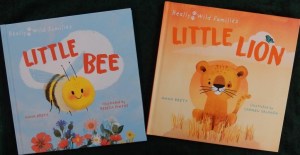
Little Bee / Little Lion

Little Bee
Anna Brett, illustrated by Rebeca Pintos
Little Lion
Anna Brett, illustrated by Carmen Saldaña
QED

These are the first titles in the new Really Wild Families series, each book being narrated by the titular Little animal.

Little Bee is a bumblebee, just a few days old that’sfreshly emerged from its cell in the nest ready to introduce its entire family. We meet first a few little brother bees and more than a hundred sisters (the workers) and the Queen, their mother. The babies’ first task of the day is to clean the wax cells in their nest: their very first lesson. They also help look after their mother so she has sufficient energy to lay more eggs. However their role changes as they age, the elder ones caring for the queen and her eggs; in addition they go out collecting pollen and nectar for food. What stories they have to tell about the wonderful aromas of some of the flowers they visit. In contrast, the young drones leave the home fairly soon and go off in search of young queens to mate with.

All the female bees need to be on the alert for intruders such as birds or small mammals that like nectar and if necessary they’ll defend themselves with venom-covered stingers.
The queen prepares the young females for the time they too will lay eggs and set up their own nests, giving them step-by-step instructions.

Our narrator tells readers about the nurse bees and the larvae that they feed with royal jelly and once they’ve grown sufficiently, seal them in separate cells by means of a wax cover and there each will pupate, eventually transforming into new queens. After that she talks more about nectar and pollen collecting.
A considerable amount of information is included in this chatty narrative but further spreads contain more ‘fun facts’ about pollination, a quiz and some other fun activities.

Little Lion works in a similar way with a cub reporting on life in the grasslands of the African savannah. We meet the pride that comprises mother, father, siblings and many relations, learning of the roles of the adults and how the cubs spend their time in a playful manner that helps prepare them for hunting in the future. She also says that lions are territorial creatures, explaining what that means and how lions keep safe; she tells readers about surviving through the dry season

and introduces some very young cubs belonging to another adult female. On this particular day, night brings a storm which serves to make hunting easier but after so much talking, our cub narrator is ready to curl up with other family members for some sleep.
Again there’s a ‘fun facts’ spread, information about white lions as well as the need to conserve lions, now classed as a vulnerable animal species, and other activities for little humans.

Both illustrators make the creatures they portray more endearing than realistic, but there are some photographs of bees and lions after the main narratives. Attractively presented, basic scientific information embedded in a story form easily absorbed by young children make this series written by Anna Brett, one to share in foundation stage settings or at home.