The Shade Tree / Rapunzel

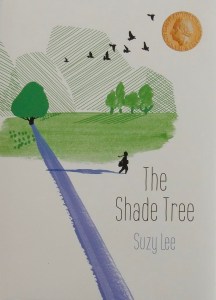
This is a re-telling of an old Korean folk tale wherein we see how a young traveller tricks a rich but heartless man into selling him the shade from the tree that grows on the latter’s land. The rich man considers he’s made some very easy cash but hasn’t considered the effects of the lengthening shadow of his house as the day progresses.Whatever the shade touches is thus owned by the traveller, and he can share it with whomever he wishes. Furthermore when the shade covers the rich man’s house, the traveller can enter that house, which he does,

eventually causing the wealthy one to move out. Once the house is vacant the traveller settles down and enjoys life as the new resident.

Much of the power of this thought-provoking telling lies in its simplicity, simple too is Suzy Lee’s art; it’s almost abstract in style and uses a limited colour palette to effect. With its dramatic gatefold, this is altogether an unusual book that feels at once both old-fashioned and contemporary. It would probably appeal most to older readers especially those with an interest in folk stories.

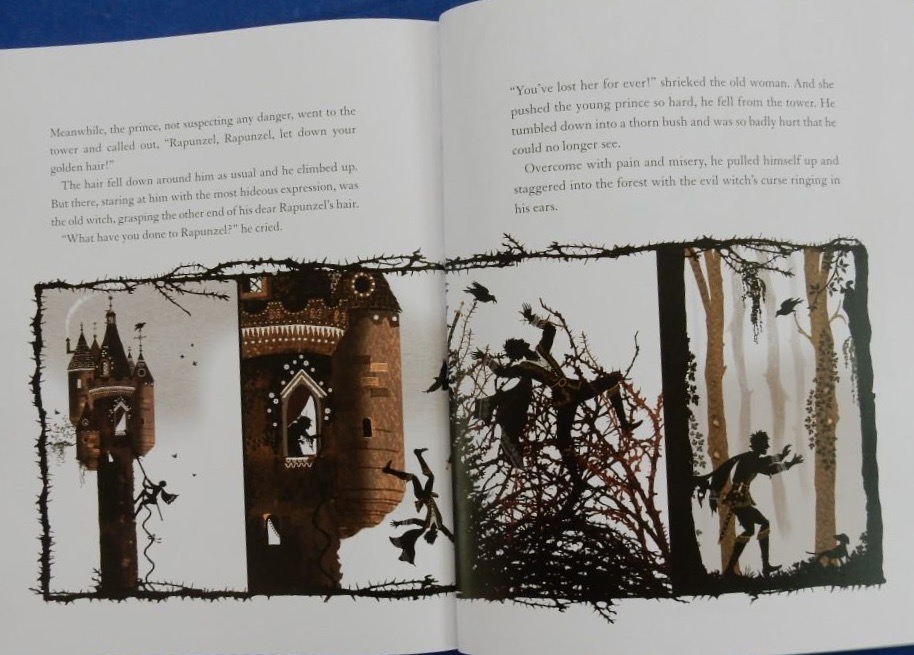
Sarah Gibb has taken the original classic fairytale and turned it into a visual feast.with a mix of gorgeous silhouettes and delicate, detailed colour illustrations, without losing any of the essential elements of the plot in her simplified telling. We still have the drama: the witch discovering the young husband helping himself to the salad leaves from her garden to cure his ailing wife and his promising to give her the baby when born in return. And romance: the baby Rapunzel becoming a beautiful girl incarcerated in a tower, who is visited by a prince and the two eventually marrying.

Rapunzel’s tower is illustrated in true fairytale style, with turrets and weathervanes, vines and roses
and the contrasting silhouette style prince staggering through the forest having been seriously hurt as a result of his fall from the tower.
Recently reissued with a new cover, I suggest that if you are looking for a highly pictorial version of the fairytale, look no further than Sarah Gibb’s offering.

David Roberts’ Delightfully Different Fairy Tales / Pippi Longstocking Goes Aboard

These are two special gift editions with Christmas in mind

David Roberts’ Delightfully Different Fairy Tales
written by Lynn Roberts-Maloney
Pavilion Books

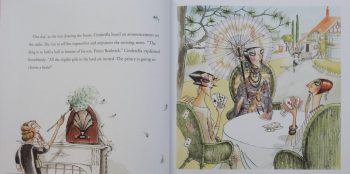
This sumptuous edition brings together three of the brother and sister team’s fairy tales previously published as separate books, Cinderella, Rapunzel and Sleeping Beauty. Lynn’s texts written with enormous verve and David’s magnificent illustrations that set each of the stories in a different era combine to re-energise tales from way back making readers experience them with fresh eyes, ears and hearts.

For Cinderella we’re transported to the art deco 1920s, age of flapper girls and glamour, where Greta’s (aka Cinderella) stepsisters, are Elvira (the wicked one) and Ermintrude (she’s exceedingly dim).

Her fairy godmother is a fashionista and her stepmother is a stone cold-hearted bullying female who immediately evicts Greta from her room giving it to her own offspring instead.

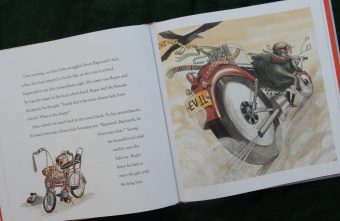
Rapunzel is set in the 1970s when platform shoes were all the rage. The beautiful miss in this version has a red-haired stunner as its star and she resides in a tower block flat, (or rather is imprisoned by her Aunt Edna who owns a ghastly pet crow).

Edna insists that safety is the reason for her niece’s current incarceration, and she uses occasional gifts of second-hand records and magazines to placate the girl, promising to show her the city sights once she’s older. Said aunt is employed as a school dinner lady, one who almost force feeds her charges with such ghastly fare as lumpy custard. Enter stage left, young Roger, lead singer of the school band. Could he be the one to rescue the red-haired damsel?

Sleeping Beauty has an entirely female cast, a 1950s vibe and a science fiction loving young lady Annabel who on her first birthday, falls under the evil spell of spiteful witch Morwenna, and wakes many more years later than the sixteen she’d first thought.

If you know somebody (or several people) who love fairy tales, then buy them this totally brilliant book: I’m going to have to invest in several copies this season. And, KS2 teachers just think of the potential this offers in the classroom.

Pippi Longstocking Goes Aboard
Astrid Lindgren, illustrated by Lauren Child
Oxford University Press

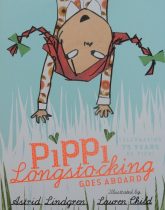
This bumper book with superbly spirited, full-colour illustrations by Lauren Child (who better to illustrate this Pippi 75th anniversary edition?) is an ideal present for a lively child with an inquiring mind, and a cracking way to bring Pippi, fellow residents of Villa Villekulla, monkey, Mr Nilsson and her horse – the one she can lift with her super strength – (strictly speaking he lives on the veranda), and her next-door friends, Annika and Tommy, alive to a new generation of readers and listeners.

The episodes herein include that where Pippi gets a trifle carried away when she goes on a shopping spree with a pocketful of golden coins. The consequences are pretty unlikely (unless you’re Pippi) with a bit of bother over a false arm and whether or not the particular shop is self-service. She also gets carried away in the sweet shop buying rather an excessive amount of sugary confectionery, and uses her common sense in the pharmacy.

Another time there’s an addition to the school role, though only briefly; Pippi also livens up the school outing;

has an encounter with a rather large ’kitty’, she gets shipwrecked and almost leaves her ‘more organised’ Villa Villekulla life and sails away with her father to live a thoroughly disorganised one.

Hours of pleasure visual and verbal, lie between the two covers of this gift edition.

Rapunzel

Rapunzel
Bethan Woollvin
Two Hoots
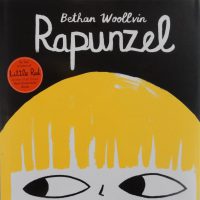
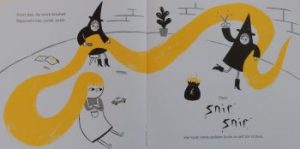
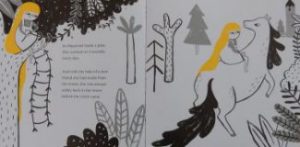
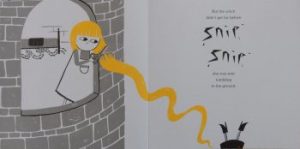
The witch in Bethan Woollvin’s alternative version of Rapunzel has a good little business going: she snips off lengths of the girl’s golden tresses and sells them.

Keeping Rapunzel locked up in the high tower she threatens her with a curse should she dare to attempt an escape.
With Rapunzel however, the evil woman has more than met her match. Far from being fazed by such threats she’s positively emboldened.
If the witch can ascend using her captive’s hair, then the girl can descend by the same means; and so she does.
Once free Rapunzel explores the forest, forms a friendship and hatches a plan.

No it isn’t with a handsome prince: this wily young miss is more than capable of managing her own fate. She’s determined to get the better of the old hag. Thus it’s Rapunzel, not the witch who wields the tonsorial scissors and sacrifices her flowing locks ridding herself of her jailor once and for all.

Then with the aid of her forest friend, she embarks upon her very own witch hunt.
Again Bethan Woollvin uses a limited colour palette – black, grey and yellow on an expansive white background to dramatic effect for her fairy tale rendition. Her assured lines and minimalist shapes are rendered in gouache and she injects subtle humour into every scene: the flies bothering the frog, the abandoned sock on the floor, and more darkly, her subversive heroine continuing to show no fear in the face of her captor’s threats, standing meekly before her with her intended weapon of witch destruction hidden behind her back.
Make sure you check out the endpapers too: the hunted of the front ones becomes the hunter at the back.

I’ve signed the charter