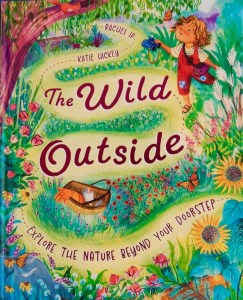
The Wild Outside

There’s nothing little Tulip likes better than to be outside exploring. She observes carefully the flora and fauna using all her senses and never stops asking questions to increase her knowledge. Then she comes upon a trail of muddy footprints on the path and a sign saying Nature Trail. Written in chalk in various places are labels naming lots of the plants, some she’s already familiar with, but lots that are new to her.
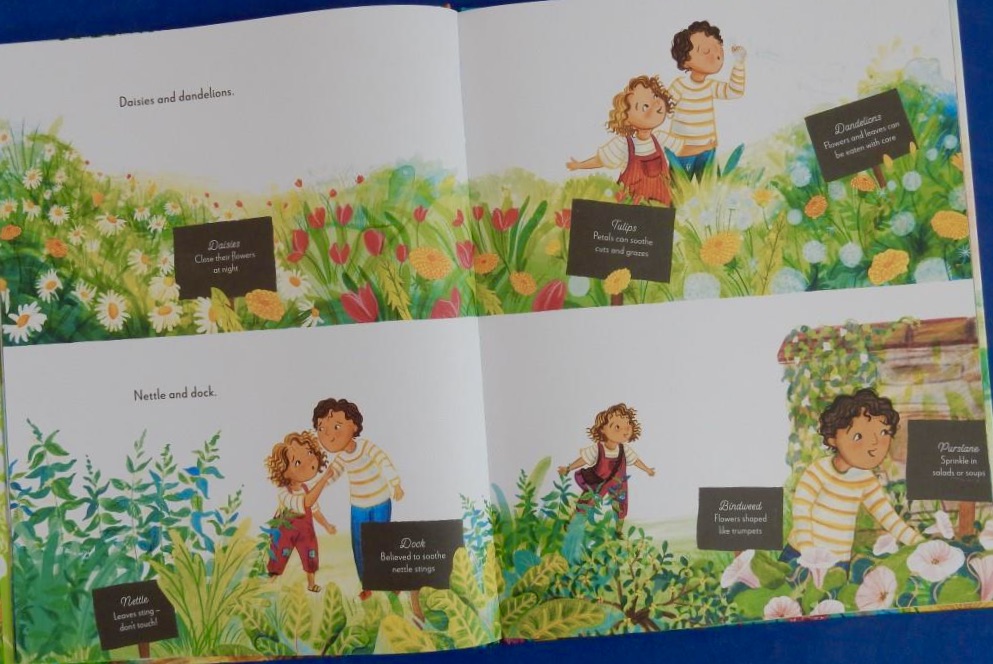
Who can possibly have made this trail, she wonders as she catches sight of somebody’s back retreating. Having filled her pockets with flowers and catkins, Tulip and her elder sibling return home and on the doorstep is a parcel with Tulip’s name on and inside is an illustrated botanical guide and a note encouraging her to keep on exploring.

On opening the book, Tulip is excited to find lots of plants and trees she recognises and is inspired to do some labelled drawings. This keeps her engaged until bedtime when she falls asleep wondering where the following day’s explorations will take her. However, come the morning it’s raining hard and so she further explores her book instead, visiting Asian mangroves and forests, the deserts and plains of Australia, African rainforests and grasslands, mountainous regions of Europe,
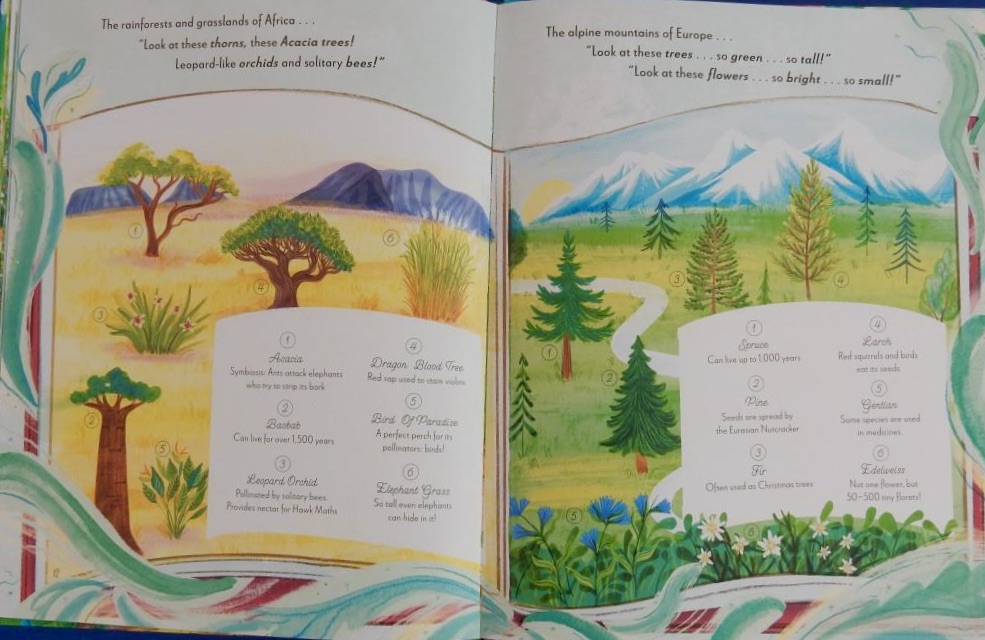
the North American tundra region, various South American habitats and the cold Antarctic deserts. A clever device this for introducing to readers habitats the world over.

The following day the sun returns but rain has washed away the chalk markings of the trail. However someone has created a new one: who could that be? Tulip chalks a list of plants from the trail, leaving question marks for some she can’t name. On her return walk she discovers somebody else has written the names of those plants and left a trail of footprints. Who could it be? Tulip is delighted to discover the identity of her fellow nature lover and she makes a very special floral thank you using the contents of her pockets and bag.

A smashing way of encouraging young children to emulate Tulip and become natural history enthusiasts. The vibrant illustrations show the abundance of flora Tulip encounters as she explores and the labels are accompanied by brief captions with additional information about each plant. A wonderful combination of story and non-fiction.

One Day at a Time / Roots of Love

Robin and Poppy couldn’t be happier with their family life; their days are full of fun and adventuring together. And every springtime the children and their parents plant sunflower seeds together and watch them grow and bloom in the summertime. Then one summer Daddy tells the children that their parents are separating and will be living in different homes.. “We’ll always be a family, and we’ll always love you,” Dad reassures them. Poppy and Robin don’t want this to happen but despite the tears and talking, and the hugs, happen it does.

As you would expect both brother and sister are emotionally mixed up;

they also show this in different ways. Robin shares his worries with his friends at school whereas Poppy keeps everything to herself.

Both of them though ask their parents lots of questions and they all choose sunflower blooms to take to their parents’ new homes. Homes that are very different too.

Come the following spring Robin finds the dried out sunflower heads in the garden shed; they are absolutely full of seeds and give them an idea. Before long they have more than enough to sow in both mum’s and dad’s gardens. Little by little both Poppy and Robin have accepted their new way of life and realise that they will be okay; They are able to laugh more, hug more and of course, there is more than enough love for everyone; after all they are still a family no matter what.
A sensitively written and illustrated story that is full of hope and love, a story that offers an optimistic view of separation. However Poppy and Robin are fortunate in the way their parents separate; not all families are so amicable; indeed some children’s parents are downright hostile toward each other and this takes its toll on their offspring.

Also about changes in family circumstances is:

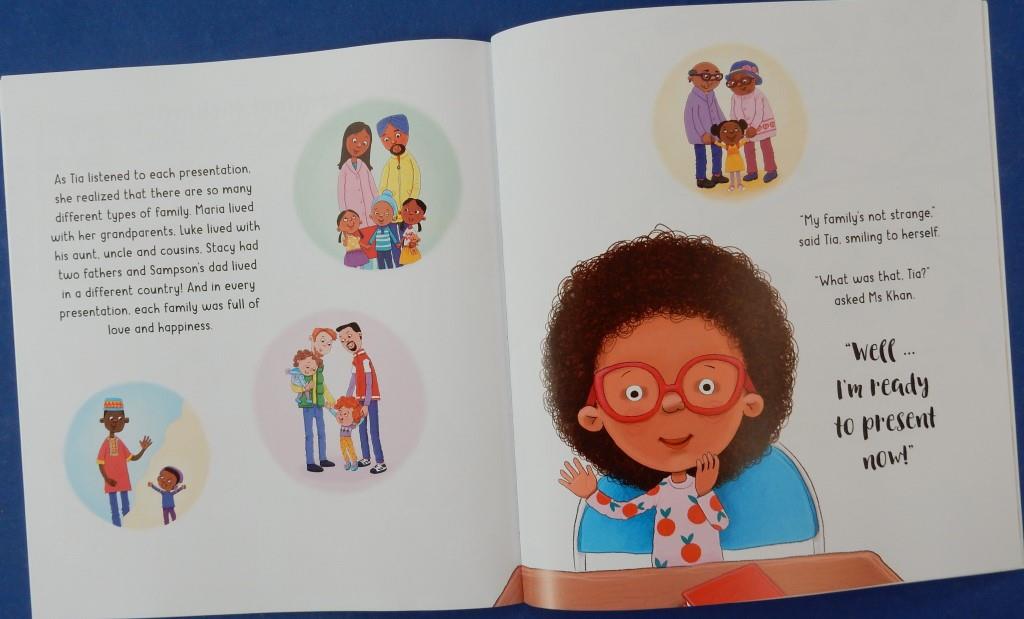
Subtitled Families Change, Love Remains, this story starts with a happy little girl, Tia who has just enjoyed the best day at school ever. But that evening after dinner her mother tells her to leave her project about her family and come and join a talk with her mum and dad. She knows they have been keeping something a secret recently and realises quickly that this isn’t going to be cheerful chat. Instead she learns that her parents are going to separate and that her dad will move out. “We’re still a family, we’re just changing to something new,” her mum tells her. Devastated little Tia rushes upstairs and cries herself to sleep.

Next day at school her class are to present their projects about families; inevitably Tia is worried about how her classmates will react to what she says. However what she hears from some of her friends about the variety of families they have, surprises, reassures and empowers her, enabling her to share her project too.

Using the apt metaphor of a tree Tia explains how her family has changed.

Ultimately reassuring, Sarah Asuquo’s story with its inclusive illustrations by Ruthie Burton is one for KS1 class collections as well as for sharing with individuals.

The Forgettery

The Forgettery
Rachel Ip and Laura Hughes
Egmont Books

Memory loss and dementia are ever increasing and although adults are well aware of this challenging topic, it’s not easy to open up a discussion with young children about why a much loved grandparent for instance, is unable to remember things. Sharing this beautiful book is a wonderful place to start: it never once mentions the word dementia during the story of Amelia and her Granny and their adventure together.

From the outset we’re told that Granny is forgetful, sometimes being unable to recall where she’s put the marmalade or where she keeps her socks but sometimes forgetting important things like special moments. Amelia is a daydreamer and explorer and this means that she too is apt to be a bit forgetful.
One day while exploring in the forest together they stumble upon a strange place called The Forgettery and decide to investigate.

They receive a warm welcome and Amelia explains that they’ve forgotten their way home. The kindly Memory Keeper invites them aboard a hot air balloon and off they go

eventually arriving at a door labelled with Granny’s name. Inside it’s enormous on account of all the memories it’s storing: ‘Moments of delight, lost and forgotten, fluttering in the room like butterflies.’ Sensory experiences including the smell of fresh bread, the crunch of autumn leaves underfoot and the giddy joy of cartwheeling. Granny chooses her very favourites from among them all

and then they move on to Amelia’s Forgettery. This is a small room and while Amelia is delighting in its contents, they receive a message reminding them it time to head home to dinner.

Back indoors Amelia decides to make an illustrated book of all the memories Granny had collected at her Forgettery and henceforward Amelia would take a photo of each fun thing they did together, to add to the book as a special reminder; a book they could always share.

Granny then adds a final item to their list of special things but it’s one neither of them will need to be reminded of …

Both new memories and all the lost, old ones are stored in The Forgettery so the book can equally be shared as an unusual fantasy adventure showing the special relationship between Granny and Amelia. This is highlighted both in Rachel Ip’s warm-hearted telling and Laura Hughes’ gently humorous, equally warm illustrations reflected in her choice of colour palette and the wonderful details in each of the scenes.