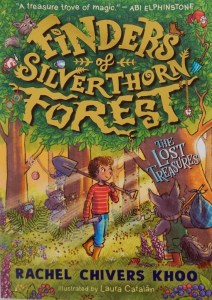
Finders of Silverthorn Forest: The Lost Treasures

As the story opens we meet almost simultaneously the two protagonists: a small boy, Max, and the more diminutive Tuft, who wears odd shoes. It’s partly on account of this footwear that the two meet. Tuft (a Finder) is looking for treasure and Max is a passenger in his mum’s car that almost crashes into what Max mistakes for a tea towel.

Back at Grandma’s, Max continues his mission- to help her find the time capsule she buried almost seventy years ago, before she has to move out of her home. The problem is Grandma can’t remember where she buried it; maybe it was in her garden, or perhaps in the surrounding woods, or even in a treehouse in an ancient oak tree. Off goes Max in an old faux-fur coat of Grandma’s to search the treehouse but is surprised to discover it’s occupied.

Occupied by Finder, Tuftorius Snook, the very creature that Max mistook for a tea towel. Finders are woodland creatures that ‘scavenge lost objects’ that their whiskers help them find and treat them as treasure, even keeping an inventory. “Finders keepers’ is their rule. The two start chatting over tea and a friendship begins. Suddenly a lot more Finders turn up including Tuft’s grandfather, Old Grey.

Tuft persuades his grandfather that Max means no harm and on the way back through the woods, he tells Max that the next day is Domesday. When they arrive at Grandmas’s cottage Max asks Tuft for his help and a plan is formed.

The following morning Mr Pellington, the new owner of Grandma’s cottage arrives telling her that diggers are a coming and she must be out by noon. When they discover his real reason for buying the cottage, Max becomes desperate to see Tuft despite their having said their goodbyes to each other. Can they still do something to stop the entire wood being demolished and most importantly save the oak tree with that treehouse?

Another entrancing story from Rachel (I’ve loved both her previous books) with detailed illustrations by Laura Catalán adding to the pleasure at almost every turn of the page. Woven into the tale is a vital theme about tree preservation.
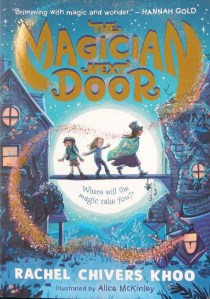
The Magician Next Door

Callie and her father have moved out of London to a mountainous area of Northern Ireland; she feels far away from her friends and her memories too. One night sleepless and struggling to settle into her new life, as she stares out of her window there comes a loud BOOM! An upside-down house has appeared in her back garden. Next morning no house is there, so despite the large crater on the lawn as well as a piece of tile, she decides it must have been a dream. Then the boy from across the fields appears and he knows her name as she does his; Sam believes what she says about the previous night’s strange occurrence but Carrie remains unconvinced until that is, some weeks later she finds a mysterious paper aeroplane on her duvet on which is a message from Winnifred Potts, a magician from the strange house who is urgently asking for her help.

Carrie meets her at midnight and learns that Winnifred’s Wanderlust, the adventure magic that protects her house from attack by magical beings is lost and she begs Carrie to go and bring it back.
Can Callie and her new friend, Sam, who has hidden himself away and overheard the conversation, provide the help Winnifred and her house need?

Not only that but will she be able to transcend the overwhelming sense of loss she feels after her mother’s untimely death and her homesickness for her London community? With the help of new friends and different experiences, can she find hope for her life in the future?

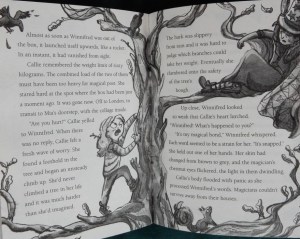
With a sprinkling of Irish folklore, some great characters, and lots of sensitivity, Rachel Chivers Khoo has written a wonderful tale of magic and mayhem, with a vital message about the true meaning of home. To add to its spellbinding nature are liberal scatterings of Alice McKinley’s delightfully quirky black- and-white illustrations. A great read for children from Y2 and beyond.

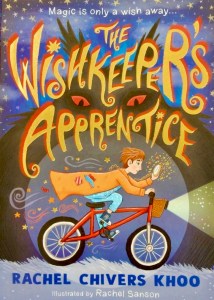
The Wishkeeper’s Apprentice

The Wishkeeper’s Apprentice
Rachel Chivers Khoo, illustrated by Rachel Sanson
Walker Books

This debut novel is a tale of belonging, wishes, family and self-belief. set in a magical world of wishkeeping.

One day when his sister hasn’t turned up to collect him, feeling lonelier than ever, ten year old Felix Jones tosses a penny into Whittelstone’s wish fountain and makes a wish. To his surprise almost immediately he notices a very unusual man fishing for his coin in the fountain. It turns out that this is none other than the town’s wishkeeper, Rupus Beewinkle, who shows surprise that Felix can see him and then invites the boy to partake of some hot chocolate with him. It’s then that the elderly man reveals his identity and announces that Felix is to become his apprentice saying, “The future of Whittlestone depends on you helping me. And I do believe fate has brought us together.”

Thus begins a new education for Felix who takes home the book Rupus gives him entitled A Complete Guide to Wishkeeping and that evening begins reading it.

Well, Felix had been wishing that things were different and now perhaps he’s got his wish. There are new things to learn about such as wish grades from one (‘highly suitable’) to four (‘ungrantable’); but he also learns of the malevolent presence of the Wishsnatcher. This menacing being is intent on reversing existing wishes and preventing any future ones being made.

A wishless world is a very bleak place with inconceivable threats to Rupus, Felix and indeed Whittlestone town. Felix has a quest: to fight for good: what a roller-coaster of a ride he’s embarked on.

The imagery in the story is superb: Rupus’s home, Snugwarm, is chaotic but has lots of unlikely magical objects including a wishofax machine, the vanquisher (fire extinguisher to defeat the villain), and the messaging wishfulness gauge.

Emerging above all from the book are the comments Rupus makes to Felix, “I remembered there is more to life than darkness and despair’ and “A creature capable of great wonders could turn into the greatest monster of all when deprived of hope.” Pertinent in our world assuredly and vital for today’s young readers.

Add to Rachel Chivers Khoo’s superb storytelling, Rachel Sanson’s black and white visuals, which add even more sparkle to this book: it’s a cracker either shared with a class or as a solo read.