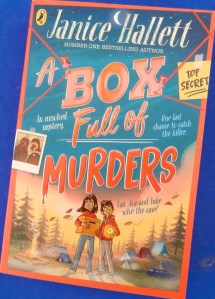
A Box Full of Murders

Janice Hallett adopts a similar style for this, her first children’s story, as she does for her adult crime/mystery books, making clever use of letters, diary entries, press cuttings, police reports and emails.

Siblings Ava and Luke live in different homes with parents who have separated; Ava lives with Mum and Luke with Dad. Both children keep in touch via their mobiles and when Luke discovers a box marked ‘Top Secret’ in Dad’s loft, he shares its contents by means of text messages, quickly realising that it tells the story of a crime that took place at a Scout and Guides’ summer camp in 1983 – the last to be held at that location as the campsite land has been bought for questionable reasons. Because of this the leaders of each tent group have been asked to write diaries about their experiences. These groups have names like The Fun Girl Three, Hunky Dory, Ventures, Duran Spandau – apt for the times.

As the siblings read through these diaries they are introduced to the campers, the Scout and Guide leaders, some mysterious strangers lurking in the forest and rumours of a shrieking ghost. Along with Ava and Luke, we readers see events at the camp playing out and every so often there’s a Progress Report summarising the information so far to help in solving the case. Things become very dangerous for the campers when two bodies are discovered, one of a botanist, the other his assistant, and even more alarming when one of the guides goes missing.

Luke and Ava work diligently through the clues and it becomes clear that this whole mystery is not something left in the past; the murderer is still at large and perhaps nearer than they think.

A pacy, gripping read with a multi-layered plot, some humour, two terrific characters in Ava and Luke and an ending that hints of more to come. I can hardly wait.

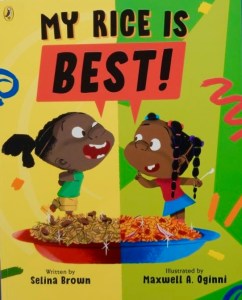
My Rice Is Best!

There’s absolutely nothing in the entire world that Shane prefers to eat than his Mum’s home cooked rice and peas. She uses a recipe passed down to her through many generations. When Mum suggests he take some for his school lunch the following day, he jumps at the chance.

Next day Shane sits beside Yinka and is surprised to learn that she considers the best rice in the whole world is Jollof rice. The two children have a loud dispute which is interrupted by Chong who insists his fried rice is undoubtedly the best. Then several others join in, each claiming their version of rice is BEST. The vocal dispute degenerates into a physical one

that ends up with the contents of Shane’s lunch box scattered all over the floor.. He’s devastated, but quickly Yinka offers her tub to him and as Shane tastes her Jollof rice, he’s surprised how tasty it is. There follows a lot of sharing between the rice eaters but one child, Tim, is confused for he has rice pudding not for lunch but for breakfast, which all the other children think must be pretty scrumptious.

I must admit I have to disagree with that however: the only time I ever got a detention at school was when lukewarm, stodgy rice pudding was served for afters. I discreetly – so I thought – opened the canteen window and threw the contents of my bowl out onto the path and the teacher on duty caught me in the act.

Selina Brown’s deliciously funny story is vibrantly illustrated by Maxwell A. Oginni whose scenes of the rice face-off are wonderfully dramatic and expressive. A super story to encourage children to try new foods, especially those from cultures other than their own.

Beetles, Butterflies and other British Minibeasts / Look and Say: What You See at the Seaside / Queen Victoria

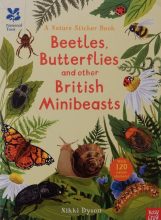
Beetles, Butterflies and other British Minibeasts
Nikki Dyson
Nosy Crow & the National Trust

In all my time teaching under 7s, I’ve probably never come across a child, however lively or challenging who, when outside (or sometimes in) failed to become engrossed in watching such minibeasts as woodlice, ants, ladybird larva or caterpillars.

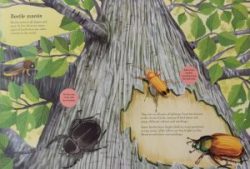
This beautifully illustrated Nature Sticker book takes users to several locations where minibeasts are likely to abound: the vegetable patch – several, but not all of the minibeasts therein are likely to be pests.

Anything but pests are bees, hugely important garden visitors that have a vital role in pollination, as do some butterflies like the beauties shown herein.

The shed is a likely place to find spiders and their webs in abundance as well as daddy-long-legs and perhaps other less desirable kinds of flies.
You’ll probably hear grasshoppers and crickets before you see them as they’re often camouflaged in the long grass they like to frequent.
Tree trunks like this one are good spots for discovering and observing beetles.

What better time that now to get outside, look for small creatures and then come back and enjoy hours of learning and fun with this beautifully illustrated book?

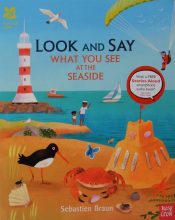
Look and Say: What You See at the Seaside
Sebastien Braun
Nosy Crow & the National Trust

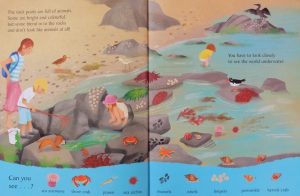
Whether you’re building sandcastles at the water’s edge, swimming in the sea, looking at the boats in the harbour, walking on the cliffs, rock-pooling, fishing, exploring the estuary, strolling on the sand-dunes, or perhaps diving down beneath the waves, there’s always plenty of interesting things to see. when you visit the seaside.

This is what Sebastien Braun shows in his engaging scenes of the various locations, each of which has an introductory sentence and another pointing out a particular feature of note. At the bottom of each spread is a row of named objects to find in the large illustration and say together, if sharing the book as intended with an adult (or older child).

A fun way to develop vocabulary and observational skills with little ones.

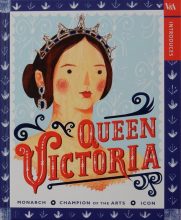
Queen Victoria
Illustrated by Nina Cosford
Puffin / V&A

Readers with an interest in the past will enjoy this mini-hardback book that looks at the life of Victoria and her legacy.
It tells how, when the young Victoria became queen she was determined to break free from the controlling influences of her mother and her courtiers and rule Britain on her own, even if she didn’t always get things right. It was against royal protocol for her cousin Albert, with whom she fell in love, to propose marriage to her; instead she did the honours and was accepted.

As well as information about the Queen, there are spreads about the industrial revolution; the Great Exhibition at the Crystal Palace, the royal couple’s work in support of the arts and science,

their interest in the latest technological developments as well as Albert’s popularising of the Christmas tree and Victoria’s golden and diamond jubilees.

Illustrated with a mix of photographs and finely detailed illustrations by Nina Cosford this is one to add to primary school classroom shelves, or for young readers wanting an introduction to a fascinating period of great change.