The Season of the Giraffes / Wild Animals of the World

The Season of Giraffes
Nicola Davies and Emily Sutton
Walker Books

This the first of the publishers new Protecting the Planet series looks at the effects of climate change on the much loved giraffes of Niger; its inspiration was the work of climate activist and film maker, Kisilu Musya.

Once some time back giraffes were very much a part of everyday life in Niger: and considered a blessing in the same way as the birds, the trees and the rain. The children saw them browsing the trees on their morning walk to school or when they brought home the cattle at night; the giraffes had a strange fighting regime and communicated in a language of grunts and snorts.

However the number of these graceful animals sadly started to decline as more and more buildings, roads and farms filled the land and then on account of climate change the rains began to fail too. The result was terrible droughts that parched the land causing much suffering to both animals and humans.

Soon very few giraffes were left in Africa but in the country of Niger, there was still time to save the few that remained. The humans stopped hunting, protected the trees giraffes fed on as well as the creatures’ favoured places and gradually, then more rapidly, the giraffe population increased. So much so that some have been transported by truck to other parts where they live under the watchful eye and care of wildlife rangers and scientists. The hope is that one day these beautiful animals might be able to return to the places they once roamed.

Nicola’s story of optimism shows how with resolve, we humans can change things for the better; it’s gorgeously illustrated by Emily Sutton who captures both the grace of the animals and their homeland, and the lifestyle of some of the people of Niger.
(There’s additional information about giraffes, climate change and what we can all do to help both causes.)

Wild Animals of the World
Dieter Braun
Flying Eye Books

This sumptuous volume brings together Braun’s Wild Animals of the North and Wild Animals of the South taking us on a world tour that begins in North America, moving in turn to South America, Europe, Africa, Asia, Australia and finally, Antarctica.

Magnificent art takes the forefront in an awe-inspiring introduction to an array of creatures great

and small of the land, sea and air. Sadly some – the Asian elephant, the Emperor penguin for instance – are on the endangered list, others are threatened, though this isn’t stated in the book.

Dieter Braun manages to encapsulate the very essence and spirit of every one of the hundred and thirty plus animals portrayed. Some have an accompanying factual paragraph, others leave the labelled illustration to speak for itself. (Both scientific and common names are given.) A great gift for young wildlife lovers.

What a Wonderful World

What a Wonderful World
Leisa Stewart-Sharpe and Lydia Hill
Templar Books

In this compilation, author Leisa Stewart-Sharpe takes readers to various parts of the world – the top of mountains, through rainforests, across deserts, over grasslands, along rivers, to both icy poles and deep down into the ocean – presenting the amazing flora and fauna of a large variety of habitats. In so doing, she shares stories of over thirty “‘Earth Shakers’ – activists young and not so young who have worked tirelessly for the cause of nature. The youngest mentioned is Romario Valentine (aka Romario Moodley) fundraiser and talented artist who on his 9th birthday asked for donations to an endangered bird sanctuary nearby rather than presents or a party.

Let’s go now to the foot of Mount Everest to meet Priti Sakha and learn about her fight for clean air in and around her home city of Bhaktapur. As a volunteer for the group Nepalese Youth for Climate Action, this nineteen year old participated in street clean-ups, protests and visited schools to help students understand the terrible dangers of air pollution and talking about ways in which everybody can work towards cleaner air in the Himalayan region. “The mountains are our pride. I’m taking a stand” she said. The spread devoted to this young woman and each of the other people featured includes a relevant ‘green tip’.

Trees are crucial to our world and several people included in this collection have espoused their cause. There’s German schoolboy Felix Finkbeiner who’s started a tree planting project in his school. It quickly spread to other schools and within a year, some 50,000 tree seedlings had been planted across the country. He set up the ‘Plant-for-the-Planet’ organisation to involve children the world over and to date there are over 91,000 child participants representing 75 countries.

Trees were also Julia Butterfly Hill’s cause. This young woman visited the redwood forests of California intending to stay for just a week, However on discovering that the forest was to be cleared by a lumber company, she lived peacefully in the branches of a tree named Luna for two years until finally the company agreed to leave a 60 metre protective zone around that tree and others in the vicinity.

Another tree planter was Kenyan ecologist Wangari Maathai who planted 50 million trees across Africa and started the Green Belt Movement to that end, a movement that continues to transform both people’s lives and the landscape.

Doing his utmost for the cause of Antarctic seals, is polar scientist/conservationist Prem Gill. Studying these creatures in the field is a massive challenge and Prem uses space satellite technology to do so.

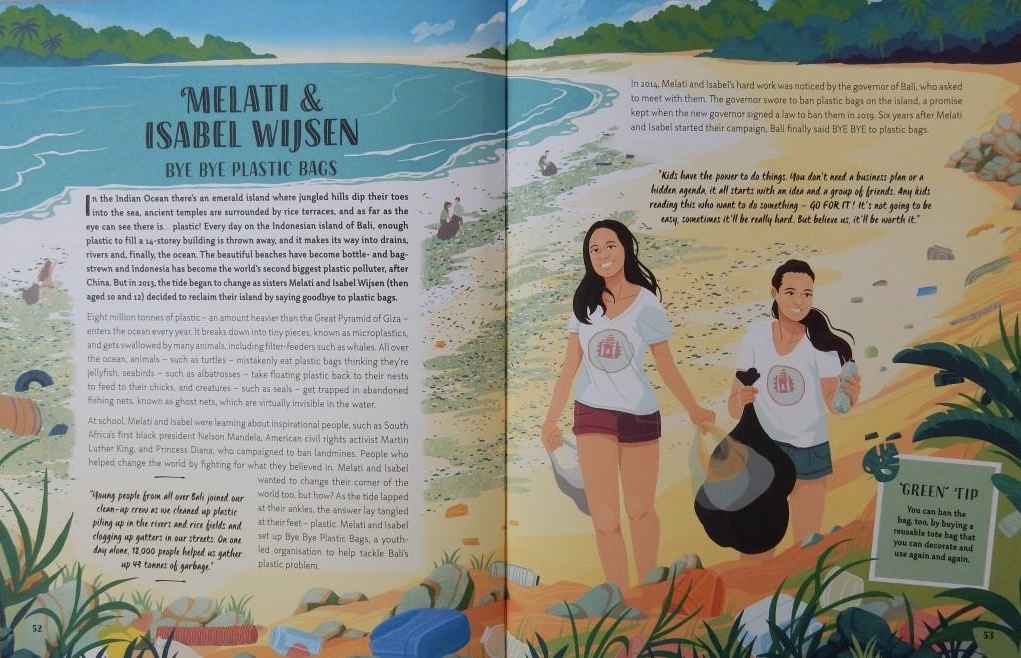
There’s no room in this review to mention the awesome work of everyone spotlighted in this hugely inspiring book but I must introduce sisters Melati and Isabel Wijsen who took on the huge task of both cleaning up the beaches of Bali and setting up the organisation Bye Bye Plastic Bags to help tackle the island’s massive plastic problem. I was amazed to learn that Indonesia has become the second worst plastic polluter in the world.

With Lydia Hill’s striking illustrations of activists and wildlife and a foreword by Lee Durrell MBE, this surely is a book to motivate youngsters to get involved, both by making small changes and joining in with a project or two that particularly interests them. (Suggestions are given at the end of the book, and there’s a glossary and letter from the author too.)