A Jungle in Your Living Room

Despite being given many houseplants of various kinds over the years by pupils, friends and relations, I have never been any good at nurturing them for long, so I was interested to see the sub- title of this book – ‘A Guide to Creating Your Own Houseplant Collection’.

There are three main sections: All About House Plants, The World of Houseplants and Houseplant Care.
The first presents basic classification, discusses some reasons for growing plants in our homes, plants used in celebrations in the home, talks about how some plants have adapted in order to survive in specific habitats, the conditions under which they survive best in a home environment. There’s a look back to houseplants in ancient history, including the origins of growing miniature trees that most of us know as bonsai. I was fascinated to read of the invention of the Wardian Case and some if its outcomes;

sadly including the triggering of journeys to remote locations of plant hunters to collect exotic plants. Better to paint them in the wild as did Marianne North and later, Margaret Lee, both of whom are mentioned in this book.

The second section is the longest and introduces houseplants of different kinds – succulents, cacti, various crassulaceae, members of the asparagus family, philodendrons, ferns, palms, a number of carnivorous plants
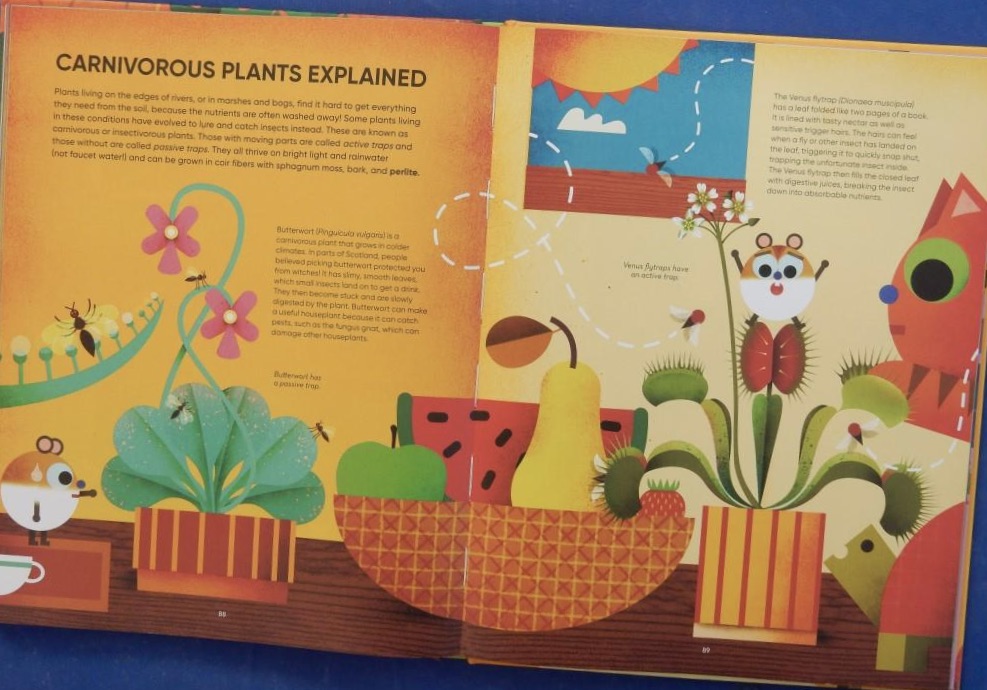
and several others. Interspersed with these are some DIY projects such as creating a desert garden and bonsai for beginners.

Section three looks at houseplant care and there’s a final glossary and index.

Drawing on his wealth of experience in the field, expertise and knowledge, Michael Holland’s straightforward text provides all young readers and beginning indoor plant growers with all they need to know and much more. Each spread is eye-catchingly, sometimes playfully, illustrated in vibrant colours by Philip Giordana.

I Ate Sunshine for Breakfast

I Ate Sunshine for Breakfast
Michael Holland FLS and Philip Giordano
Flying Eye Books

‘Plants are essential to your world. Without them, no other living thing would be able to survive.’ So begins this absolutely beautiful book aptly subtitled ‘A Celebration of Plants Around the World’ that presents much about the truly amazing plants of our planet in glorious colour. With spring well and truly bursting forth around us now, what better time to pay tribute to botanical beauties (and some animals along the way) – were you aware that some plants – the carnivorous kinds – actually feed on insects?

Written in a child-friendly style by Michael Holland, the book is divided into four main sections that together comprise pretty much everything a youngster would need to know and more, starting with what plants are, their parts, their essential processes – photosynthesis, respiration and growth, reproduction (I’m sure readers will be amused to learn of the world’s largest seed – coco de mer, that looks remarkably like a gorilla’s rear) and why they matter. 

Then comes a look at the plant kingdom in general – evolution – did you know all plant species originated from just one type of plant, millions of years back? There’s a family tree, a look at adaptation, 

food chains and food webs.

The latter part of the book explores how plants sustain our everyday lives: there are plant extracts in medicines, in toothpaste, in clothes, cooking oil, soap, plastics and then of course there are all those delicious fruits and vegetables we consume as part of our daily diet.

Despite the huge amount of information in the book, it’s all split up neatly into small sections and paragraphs, making it super-easy to digest and there’s a glossary at the back should you come across unfamiliar botanical terms. Plus, there are a dozen suggestions for some simple plant-based science experiments such as creating cornflour slime and cultivating a wild weed bottle garden. Of course environmental pollution affects plants too so the last part covers that as well as a spread entitled The Future is Green.

Visually stunning with retro-style graphics that provide a perfect complement to the text, this is a must-have book for budding botanists, family bookshelves and class collections. Readers will surely want to dig into it time and time again.