The World’s Most Atrocious Animals

The World’s Most Atrocious Animals
Philip Bunting
Happy Yak

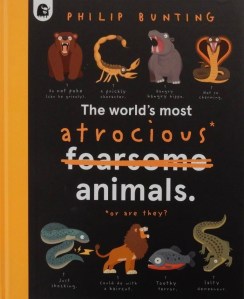
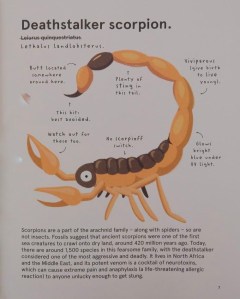
In the third of this fact-filled series Philip Bunting introduces readers to over fifty of the scariest creatures in the natural world, each of which is given both its Latin name and amusing Bunting tag. Thus the death stalker scorpion or Leiurus quinquestriatus is also Lethalus landlobstrous – very appropriate since a sting from this North African nasty can be excruciatingly painful and can cause anaphylaxis.
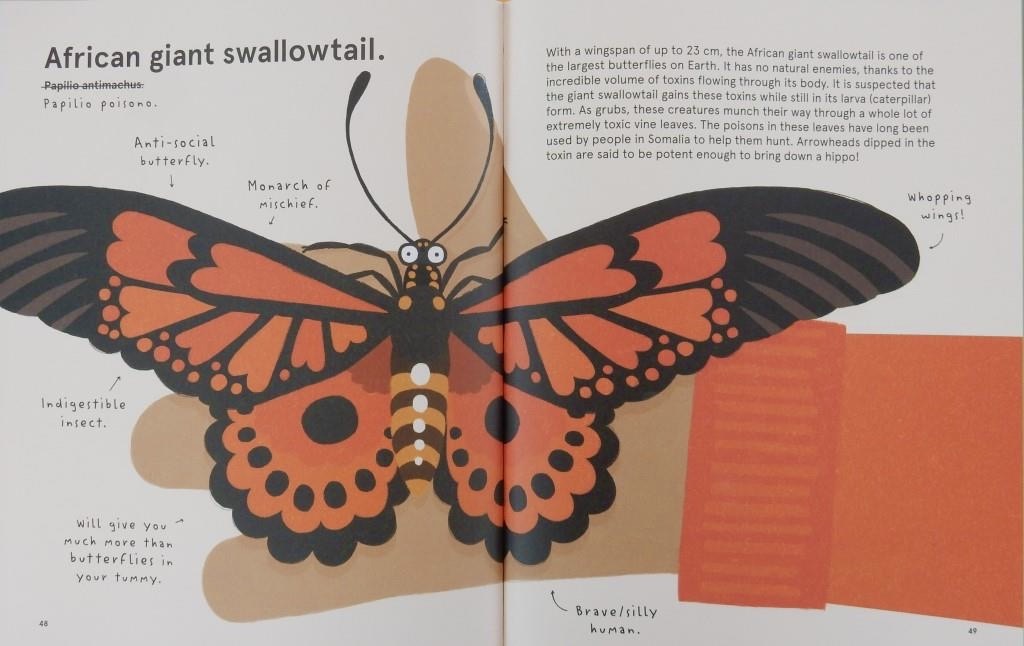
In similar fashion to the previous titles, the author uses a plethora of puns, some of which will really make you laugh (or groan depending on your mood): a group of orcas ‘sing together to form an orcastra’ and the African amphibian Trichobatrachus robustus – hairy frog to you and me – is ‘known to kermit hideous crimes’ and an encounter with an African giant swallowtail ‘will give you more than butterflies in your tummy’ – that is on account of the vast volume of toxins that flow through its body.
Moreover, should you find yourself paddling on the shores around Madagascar, Mauritius or other countries located in the Indian Ocean, be very sure not to set foot near a geography cone snail; the potent venom of this predatory mollusc could, if the nasty creature chose to inject you, finish you for good since there’s no known antivenom. No wonder that so we read, the beast has ‘shelled out extra for. a fancy pattern’.

Maintaining a good balance between humour and straightforward information, along with large, striking illustrations, Philip Bunting covers a wide range of animals of the truly scary sort. Anyone with an interest in animals, especially of the atrocious or fearsome kind, will love this book; it’s a great addition to The World’s Most …. Animals’ series.

The Very Hard Book

The Very Hard Book
Ian Ben-Barak and Philip Bunting
Allen & Unwin

In this zany book readers are asked to try some very challenging things and it’s all in the name of helping us to become aware of our thought processes (metacognition). Are you up for the challenge of some open-ended thinking? Right … ‘Sit in an empty room.’ ‘Drop something by accident.’ ‘Dig half a hole.’

Each page (almost) gives a different instruction or asks a different question and by the time you’re half way through you’ll be giggling (partly thanks to Philip Bunting’s quirky creatures) and your brain will be going into overdrive with the creators’ comical ideas. Certainly however you will be more conscious of the limitations of your own mind.

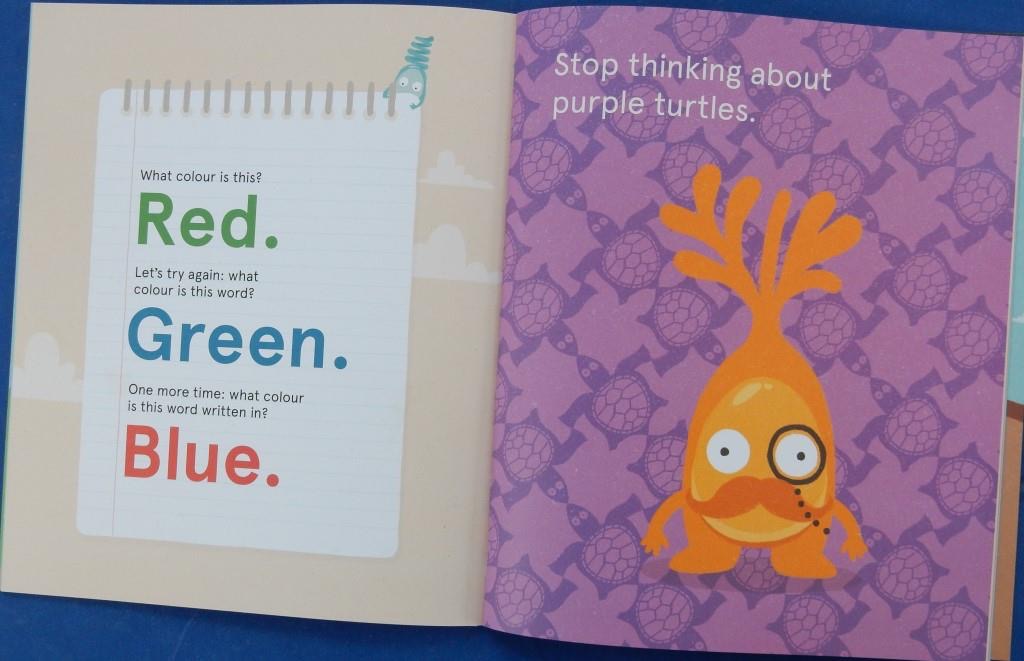
You might even be prepared to have a look at The Very Hard Gallery at the back of the book. Here you will find a more detailed exploration of the paradoxes presented: you’ll see some interesting sounding names such as the Stroop Effect (your mind having to process two conflicting messages; in the example given, they are meaning and colour); then there’s Panta rhei. You will need to find out what this means for yourself, which means getting hold of a copy of the book (no cheating by using google).

Try putting this in a KS1 classroom; as well as introducing them to some surrealism, it will surely get everyone’s little grey cells working hard as they embark on a fun-filled thinking journey.

The World’s Most Ridiculous Animals

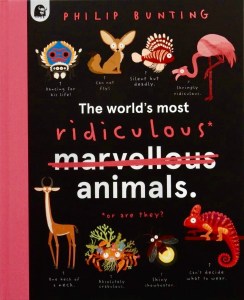
The World’s Most Ridiculous Animals
Philip Bunting
Happy Yak

This is another of Philip Bunting’s playful, punning but highly informative books about animals, some of which, with their unique adaptations, you may never have come across before. Those adaptations, in case you’ve not guessed, are what make them ridiculous.

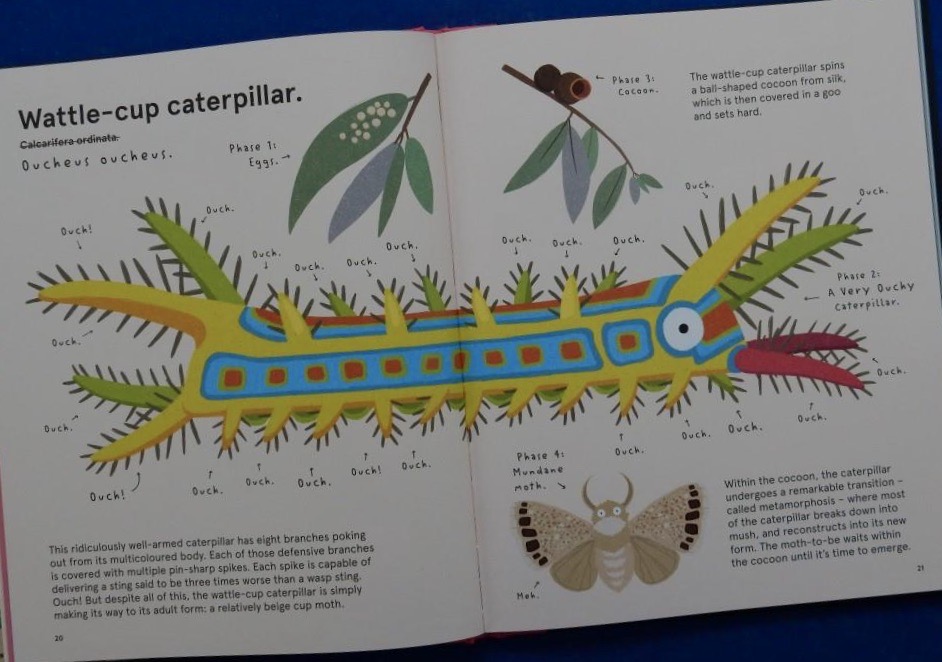
That Wattle-cup caterpillar (courtesy of the author aka Oucheus ouches) almost leapt off the page at me. It’s fortunate that it didn’t however for it has eight branches covered in pin-sharp spikes and that’s an awful lot of potential ouches. The moth stage (we’re shown all four stages) is by comparison a pretty dull specimen.

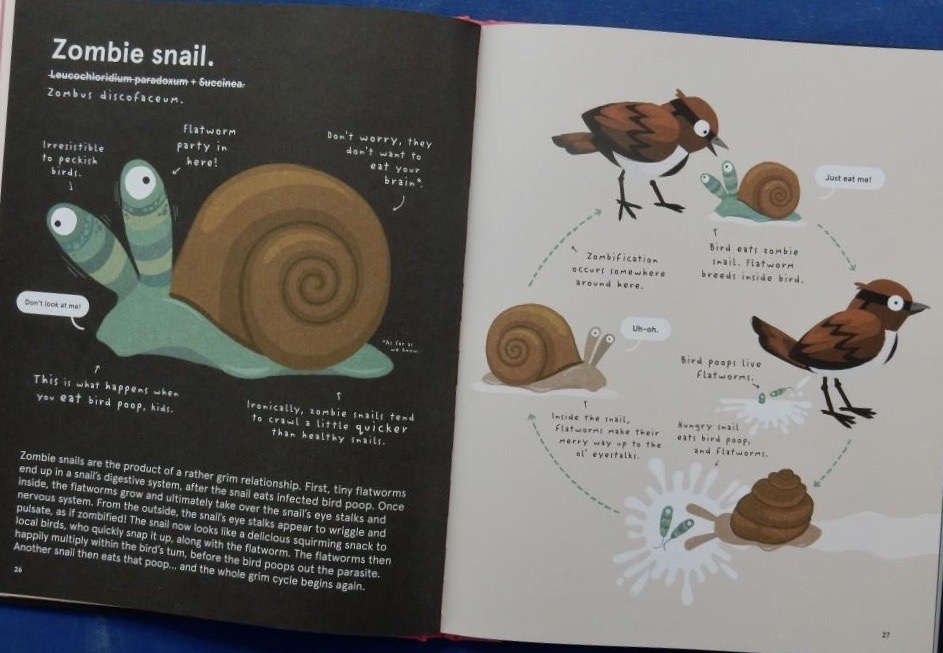
Also new to this reviewer is the Zombie snail (Zombie discofaecum). Now any child bonkers enough to contemplate tasting a morsel of bird poop will dismiss the notion instantly having read the concise paragraph giving graphic details of this snail’s life-cycle. On the other hand some youngsters like to set up snail races and this species would make a good participant in such an event as, so we learn, zombie snails tend to crawl a little faster than healthy ones. The very notion of having those eyestalks invaded by Leucochloridium, (a parasitic flatworm) and then being mind-controlled is enough to turn anyone’s stomach.

Turning to a sea dweller, well maybe I wouldn’t relish turning to this one were I swimming in the shallows around Northern Australia, but anyhow this shaggy shark (Eucrossorhinus dasypogon, or Beardus weirdus if you prefer), has facial fronds that are thought to assist in camouflaging the creature and also sense its surroundings as the woebegone waits for its next meal.

No matter your preference among the world’s fauna – fish, insects, mammals, birds. molluscs or whatever, you’ll likely discover something new in this highly humorous book that makes learning terrific fun as well as an educational activity. With its funny but anatomically accurate illustrations, eyes notwithstanding, this is a book that will appeal to a wide age range and is definitely one to add to home and school collections.

The World’s Most Pointless Animals: Or Are They?

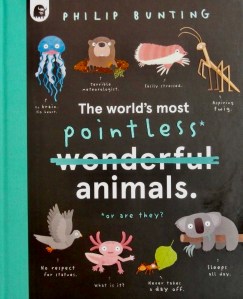
The World’s Most Pointless Animals: Or Are They?
Philip Bunting
Happy Yak

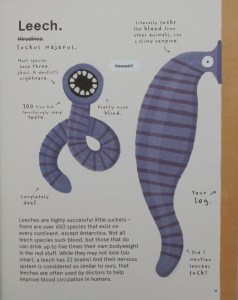
Author/illustrator Philip Bunting presents an irreverent look at some of the world’s most weird and wonderful creatures that we’re fortunate (or sometimes less so) to share our planet with. Take leeches for instance: I don’t consider myself particularly fortunate to have to live with those (despite their use by doctors) but like all the other animals from axolotls to zooplankton included herein, these hugely successful sucking parasites have undergone adaptations that have enabled them to survive, indeed to thrive. And as the author says in his introduction ‘Each creature is an illustration of Darwinian evolution, and, every animal has a unique yet important role to play on our precious planet. I was amazed to read that a leech has 32 brains. But what does it use them for?


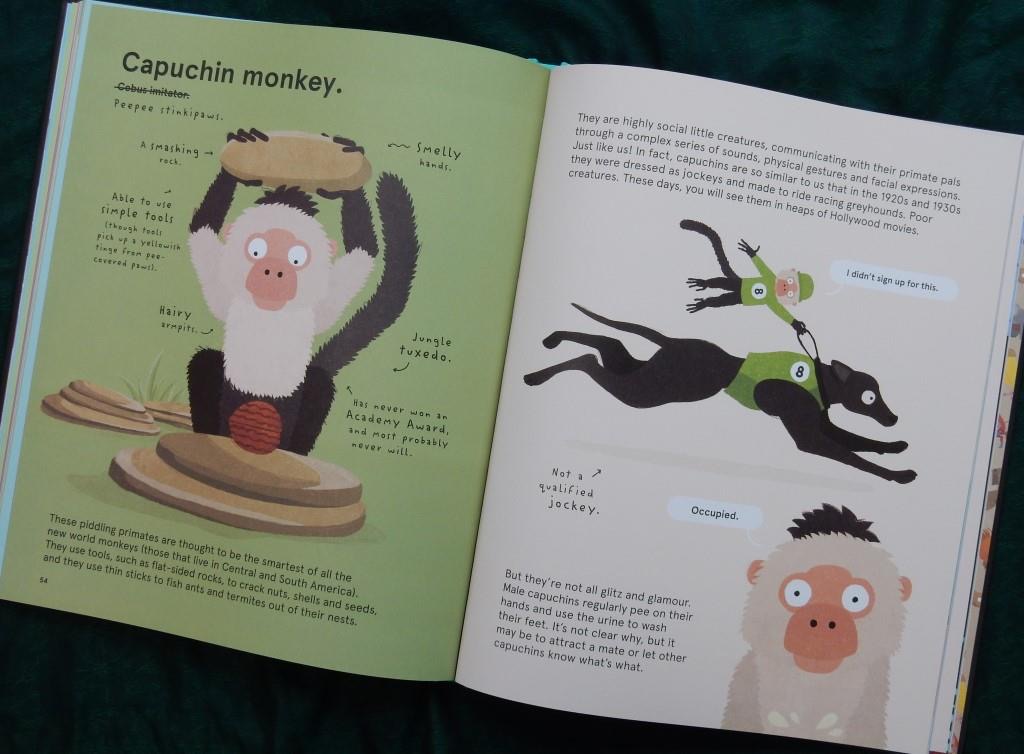
Let’s get right up close to some of the others then starting with the capuchin monkey (Cebus imitator renamed here ‘Peepee stinkipawas). These particular primates – the most intelligent of all known New World simian species –
use simple tools to procure foods they want to sink their teeth into. You certainly wouldn’t want to share their seeds or insects though, for the males make a habit of peeing on their hands and washing their feet in their urine. Yuck!

Seemingly the only raison d’être for Daddy longlegs (other than to scare some people silly) is to act as a ‘valuable source of food for birds on every continent, except Antarctica. WIth more than 15,000 species of these spindly-legged insects, that amounts to a vast number of satisfied birds.

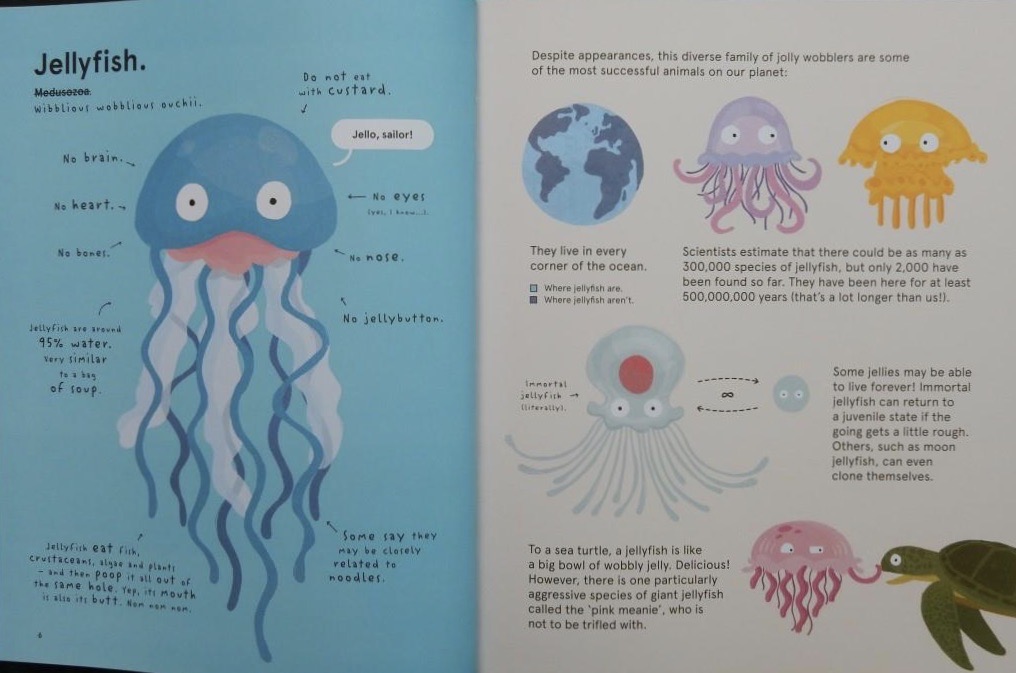
Turning to ocean dwellers, jellyfish are hugely successful medusozoa, sorry ‘wibblious wobblious ouchii’ that are about 95% water. Apparently of the possible 300,000 species estimated by scientists, so far only 2,000 have been found including moon jellyfish that can clone themselves, and immortal jelly fish. The latter can reverse its life cycle reabsorbing its tentacles becoming a blob-like cyst again which then begins over … Awesome!

Bursting with facts presented in a manner that’s huge fun and highly accessible including quirky labelled illustrations – Bunting clearly enjoyed creating these, not least inventing daft new names for every creature included – this book has a more serious mission too; To celebrate the diversity of the animal kingdom and to remind us of the fragility of the ecosystems that together make up Planet Earth.

Give a child this book to get immersed in and you could put them on the path to becoming a zoologist. I’m off to see how many Lumbricus terrestris (aka Squiggleous wriggleous) I can spot brought up after the recent rain shower – I might even be able to make a clew – that, I learned from the spread featuring same, is the collective name for a group of earthworms.

Mopoke

Mopoke
Philip Bunting
Scholastic

Ever heard of a mopoke? I certainly hadn’t until this book arrived and even then I thought at first it was a made up word. Then I discovered a note at the back telling readers that a ‘Mopoke’ is the Australian nickname for the Southern Boobook, their smallest and most common owl species.
The particular mopoke of the title is the star of Philip Bunting’s debut picture book, which unsurprisingly begins ‘This is a mopoke.’
What follows is a deliciously playful sequence in which the mopoke, sitting on its branch longing for some solitude, becomes a highpoke, a lowpoke, a poshpoke and a poorpoke.

One then becomes two and then, more pokes, and a wee poke. Thereafter the real fun starts with a ‘Fee-fi-fo-poke’.

Before long the creature has become a ‘yo-poke’ – twice thanks to the addition of an exclamation mark.
Other animals also put in an appearance – there’s a wombat, totally unexpected, a snail riding a tortoise …

and a crow(poke) until finally the long suffering creature has had enough and flies off, presumably in search of a peaceful spot, leaving an empty branch.
Gently humorous, with a deceptively simple text and delightfully droll illustrations, this extended wordplay joke is great fun to share; and perfect for beginning readers of all ages.