Line, Colour, Shape and Contrasts: Some Explorations

dscn9121

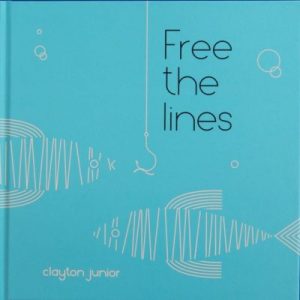
Free the Lines
Clayton Junior
Words & Pictures
It’s amazing how much you can say in a picture book without a single word of text. Clayton Junior does it all with lines – straight lines, curvy lines, thick lines and thin lines, lines close together and lines far apart; white lines and black lines. Using all these and the occasional bit of blocking, he tells a story of a small cat in a small boat sailing out into a large ocean to catch fish.

%0a

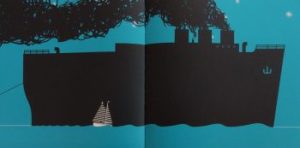
Into that same water comes a huge, smoke-belching trawler,
%0a

a trawler that casts an enormous net, an enormous net that scoops up everything in its path.

%0a

Fortunately- for the trapped, though not the trawler’s crew – an outstretched paw with a large pair of scissors puts paid to the marine life devastation and cat sails serenely into port over an ocean once more teeming with life.
This thought-provoking tale poses questions about the ethics of fishing and the fishing industry, as well as offering lessons in visual literacy and opportunities to explore and experiment Clayton Junior’s minimalist techniques of creating shape and form. It has something to offer all ages from around four to adult.
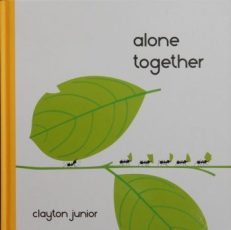
From the same artist is
%0a

Alone Together
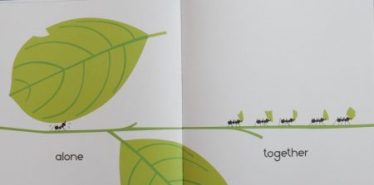
Herein all manner of animals are shown as a means of exploring a wide range of opposites and contrasts. Each one of the stylish spreads could well be a storying starting point in addition to demonstrating the concepts chosen. This one really made me smile:
%0a

Also worth adding to your early years collection are:
dscn9118

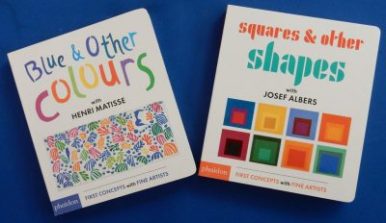
Blue and Other Colours with Henri Matisse
Squares and Other Shapes with Josef Albers

Phaidon
These are two of the ‘First Concepts with Fine Artists’ series, beautifully produced board books that use the work of famous artists to introduce very young children to everyday concepts.
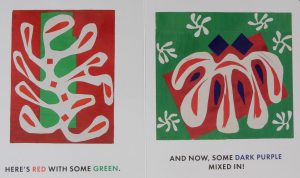
In the first, coloured cutouts from Matisse’s collages are the basis for teaching not only about colour, but also about shape and form, and how various colours can work when juxtaposed. Although blue crops up on most spreads, here’s one where it doesn’t …
%0a

Both inside covers are used to provide information: at the back is a brief introduction to the artist and some of his works, in particular the cutouts; and at the front, in tiny print, is a key to the works featured with their dates.
An unusual way to introduce colours and the notion of ‘painting with scissors’ and more important, especially if like me, you believe most children do not actually learn colours from books but from life experience, a springboard to creativity.
Equally fascinating and also essentially about colour juxtaposition and perception too, but this time introducing basic 2D shapes is an introduction to the 20th century artist Josef Albers’ work, in particular, Homage to the Square.

Canine Capers

dscn9113

Fred
Mick and Chloë Inkpen
Hodder Children’s Books
Hooray! More from Fred.. I fell in love with this mischievous puggish pup in I Will Love You Anyway and now here he is, bouncing right back to delight us once again with his prankish behaviour. In fact now it seems he can tick off a whole lot of ‘can do’ items from the list of accomplishments one might expect of a little dog. He can fetch a stick, come when called, sit and stay. There’s one word though that still eludes the little chap; he doesn’t understand the meaning of Fred – a word often on the lips of his young owner. And something else puzzles him too: another dog upstairs that looks just like him –mmm!

%0a

Could he perhaps know what this strange ‘Fred’ word is all about? Strangely enough he seems to be popping up in other places too, places like the park and he has his paws on a certain ball belonging to our narrator …
After a very wet awakening, followed by a scream, a dash, and a jump, another face appears, a face that whispers a certain word over and over and then – light bulb moment …

%0a

Adorable!

Another canine has recently won a place in my affections; he’s the Boston terrier that stars in:

%0a

Harold’s Hungry Eyes
Kevin Waldron
Phaidon
Harold is a real foodie; he spends almost all his time either eating or day dreaming about his next meal. His dreaming is done lying in one position or another on his favourite chair – a chair he loves almost as much as he loves food. One day though, this super comfy chair is no longer where it should be when he goes to eat breakfast. A devastated Harold sees it being loaded onto the rubbish cart.

%0a

Without another thought for his meal, he takes off in hot pursuit and is soon lost and even worse, his tummy is starting to rumble. His food obsession kicks in and Harold begins seeing things of the edible kind wherever he looks …

%0a

Happily though, his wits and those hungry eyes of his finally lead him back home where he finds a satisfying breakfast and a delicious surprise … a new place whereon to relax.
With smatterings of edible humour, this stylish book is a wonderful visual feast that’s more than likely to have young audiences chuckling and perhaps, drooling.

Toto’s Apple

%0a

Toto’s Apple
Mathieu Lavoie
Phaidon
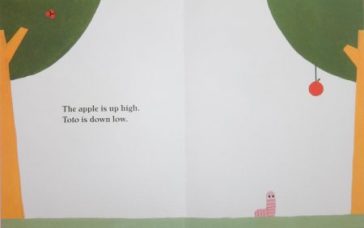
Toto is a little worm (you might at first glance mistake him for a sock) and he’s set his heart – and his eyes – on a rosy red apple. The trouble is Toto’s on the ground and the apple? Dangling tantalisingly way too high out of his reach. What’s he to do?

%0a

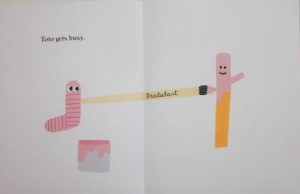
Along comes a bird and an idea too. Toto seizes a paintbrush – don’t ask me how or from where; it matters not. He gets to work …

%0a

and then waits. Bingo! His trick works and Toto hitches a ride but now look where he is …

%0a

Does he give up? Oh no he doesn’t. Out comes that paintbrush again and here we go once more, courtesy of a squirrel. Another miss and another dab of that brush and he’s ready for another try– wheee!

%0a

Oh no! He’s right back where he started. Game over? Definitely not – even when a little girl, Didi, has her teeth sunk into his prized apple – and Toto? Seems he’s still in with a chance …
A tasty ending? Sure!
Uber silly but totally brilliant is this super-satisfying Lavoie treat. Love, love, love Toto’s creativity and persistence. His tale is certain to become a much requested storytime favourite wherever it’s shared – home, early years setting or classroom.
And with its spare narrative, it is – yes all 64 pages of it – a cracking book for those in the early stages of reading to sink their teeth into. So much more satisfying than most of the rubbish fodder learner readers are fed; but you’ve got to consume it in a single sitting and THAT, takes time.